
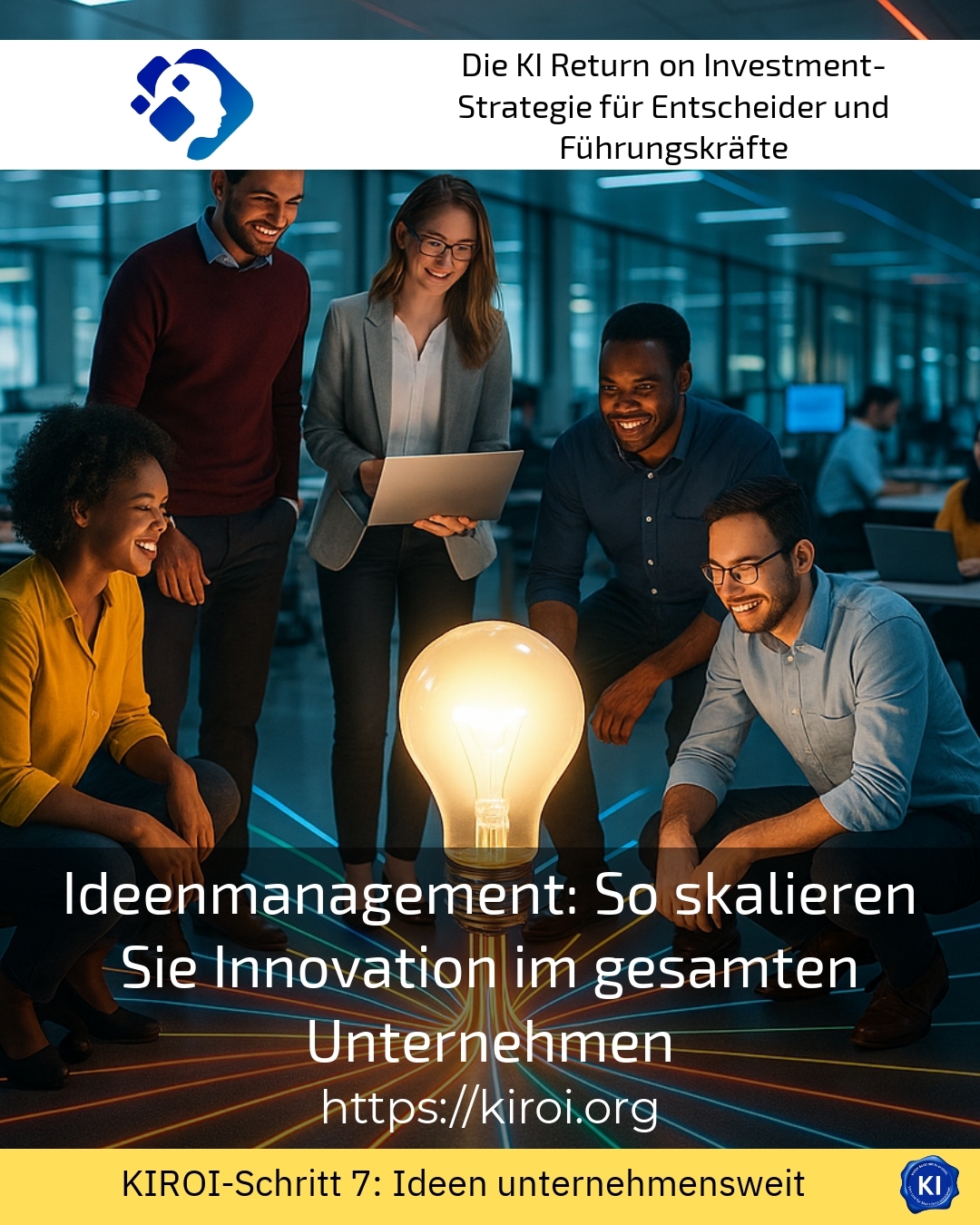
Imagine that hundreds of brilliant ideas are generated daily within your company, but they never see the light of day because there's a lack of a structured system to capture and systematically develop these valuable impulses. This is precisely where a well-thought-out Ideas management because it transforms individual flashes of inspiration into measurable competitive advantages and enables organisations of all sizes to fully unlock the creative potential of their workforce. In an era where disruptive change is the norm, the ability to innovate systematically determines which companies will survive in the long term and which will disappear from the market.
Why traditional approaches are no longer sufficient today
Traditional methods of employee suggestion schemes have undoubtedly provided valuable services over the past few decades. However, they are increasingly reaching their limits. Modern organisations require agile structures that enable rapid responses to market changes. For example, a car parts supplier reported that its paper-based suggestion system took an average of eight months. By that time, the market had already moved on. A medium-sized mechanical engineering company had similar experiences, with its best employee ideas regularly gathering dust in drawers [1].
Digitalisation has fundamentally changed employees' expectations. They want quick feedback and transparent processes. An electronics manufacturer found that younger employees rarely used traditional suggestion boxes anymore. The participation rate dropped to under two percent. Only by introducing a digital platform with gamification elements was this trend reversed. Participation rose to over twenty percent within a year.
The shift from suggestion schemes to strategic idea management
A sustainable Ideas management fundamentally differs from its predecessor, the classic suggestion box system. It integrates seamlessly into corporate strategy and combines various sources of innovation. For example, a chemical company developed a multi-stage system that linked internal suggestions with external impulses from customer feedback. This resulted in product improvements that met actual market needs. At the same time, a pharmaceutical group worked on integrating its research and development team more closely with production. The resulting synergies led to significant cost savings.
Best practice with a AIROI customer
An internationally active industrial company with locations in twelve countries approached us because it was struggling with a fragmented innovation process. Each location maintained its own methods and systems for capturing employee suggestions. This led to enormous redundancies and missed opportunities. Good ideas from one site remained hidden from the others. As part of our support, we jointly developed a unified digital architecture for the entire company. The cultural component was particularly important here. We facilitated workshops in which managers from all locations developed a common vision for innovation. After six months of intensive collaboration, the company had a central system with local customisation options. The number of suggestions submitted doubled in the first quarter after its introduction. Even more significant, however, was the emergence of cross-site collaborations that would have been unthinkable before. For example, a suggestion for improvement from the Polish plant inspired a process optimisation in Mexico. The transruption coaching helped the company not only to implement technical solutions but also to foster the necessary readiness for change among the workforce.
The technological dimension: Digital tools for effective idea management
Modern technologies significantly expand the possibilities of structured innovation management. Artificial intelligence, for example, can recognise patterns in submitted suggestions and automatically group similar ideas. A logistics company used such algorithms and discovered that many employees were independently working on related problems [2]. The automatic networking of these individuals led to powerful teams. A retail group, on the other hand, used sentiment analysis to measure the mood in submitted suggestions. This allowed management to identify areas with high frustration potential early on.
Mobile applications also play a central role in the democratisation of innovation. A food manufacturer developed an app that allowed production employees to submit improvement ideas directly at the machine. Photos and videos supplemented the textual descriptions, significantly improving the quality of the suggestions. A construction company went a step further and enabled voice control for its ideas platform. Tradespeople on the construction site could simply dictate their thoughts.
Integration into existing system landscapes
The introduction of new digital tools often fails due to a lack of integration with existing systems. An energy provider reported that its first innovation platform was barely used. Employees had to log in to a separate system. It was only when it was integrated into the existing intranet and linked to the ERP system that it became a success. An insurance company linked its idea management system directly to its project management tool. Approved suggestions were automatically transferred to projects and allocated resources. A telecommunications provider even integrated its platform into the company's collaboration software [3].
Cultural prerequisites for scalable idea management
Technology alone does not guarantee success. Company culture is a key factor in whether employees actually contribute their ideas. A steel producer invested substantial sums in a state-of-the-art platform, yet usage figures remained disappointing. Analysis revealed that managers perceived suggestions from their teams as criticism of their own work. It was only a comprehensive management development programme that changed this attitude. A textile company introduced regular innovation rounds where teams presented their ideas. Public recognition motivated even reserved employees to participate.
Psychological safety forms the bedrock of any innovation-friendly culture. Employees must be able to trust that unconventional suggestions will not have negative consequences. A software company established the principle of „intelligent failures,“ where failed experiments were viewed as learning opportunities. A medical technology manufacturer set up an anonymous channel for particularly sensitive suggestions for improvement. This allowed even critical voices to be heard without the idea generators having to fear disadvantages.
Best practice with a AIROI customer
A long-established family business from the medium-sized sector sought our support because, despite a dedicated workforce, it was generating hardly any innovative momentum. Management suspected technical causes and planned to acquire an expensive software solution. However, our analysis revealed a different picture. The company already possessed a functional system. The real problem was hidden within the company culture. Long-serving employees had had negative experiences with rejected suggestions in the past; they no longer dared to voice new ideas. As part of the transruption coaching, we conducted intensive discussions with all hierarchical levels. We identified key individuals who could act as multipliers for a new innovation culture. Together, we developed rituals and formats that fostered the exchange of ideas. After one year, management reported a noticeable cultural change. Employees were actively exchanging ideas about potential improvements. The number of submitted suggestions quadrupled. Even more importantly, the quality of the ideas improved significantly. Many suggestions now addressed strategic issues rather than just minor operational matters.
Scaling across departmental boundaries and locations
The real challenge of Ideas management lies in scaling across the entire company. Local successes must be transposed into global practices. A consumer goods manufacturer developed an ambassador programme where innovation officers at each location acted as contact persons. They networked regularly virtually and exchanged best practices. A financial services provider established thematic innovation communities that worked across departmental boundaries on specific challenges [4]. An automotive group organised annual innovation competitions where teams from all over the world presented their best ideas.
The balance between central control and decentralised autonomy proves to be critical in this regard. One technology company gave its branches complete freedom in generating ideas. This led to a flood of uncoordinated activities and duplicated effort. A different approach by a chemical group was more successful. It defined central strategic fields of research within which the sites could act independently. A food group combined both approaches and differentiated between local efficiency improvements and strategic innovation projects.
Measurability and continuous improvement in idea management
What isn't measured cannot be improved. A structured key performance indicator system forms the basis for the further development of innovation management. An electronics company tracked the entire value chain of its ideas. It measured the time from submission to decision. Likewise, it recorded the implementation rate and the financial benefit of realised suggestions. A pharmaceutical corporation extended this approach with qualitative metrics. It regularly surveyed those submitting ideas regarding their satisfaction with the process. A mechanical engineering company carried out benchmarking with other firms in its industry, thereby identifying potential for improvement.
My AIROI Analysis
Working with numerous companies on transforming their innovation processes has given me deep insights into the success factors and stumbling blocks. The effective Ideas management is far more than a technical system. It represents a fundamental cultural shift that requires time and patience. Many organisations underestimate the effort required for change management. They focus too much on tools and processes. The human dimension is left by the wayside.
At the same time, I am observing a growing maturity in the approach of many companies. Leaders increasingly recognise that innovation cannot be delegated. It must be led by example and actively encouraged. The integration of artificial intelligence opens up new opportunities for scaling. However, it does not replace personal interaction and creative collaboration among people. The most successful organisations combine technological excellence with a strong, human-centred culture.
In the coming years, I expect a further convergence of internal and external innovation management. Open innovation approaches will become increasingly important. Companies will more actively involve their ecosystems in idea generation. At the same time, the speed of idea evaluation and implementation will become a crucial differentiator. Organisations that manage to go from idea to prototype in weeks rather than months will enjoy significant competitive advantages.
Further links from the text above:
[1] Haufe: Trends and developments in employee suggestion schemes
[2] McKinsey: The Eight Essentials of Innovation
[3] Harvard Business Review: Insights on Innovation
[4] BCG: Innovation Strategy and Delivery
For more information and if you have any questions, please contact Contact us or read more blog posts on the topic Artificial intelligence here.







 Deutsch
  English (UK)