
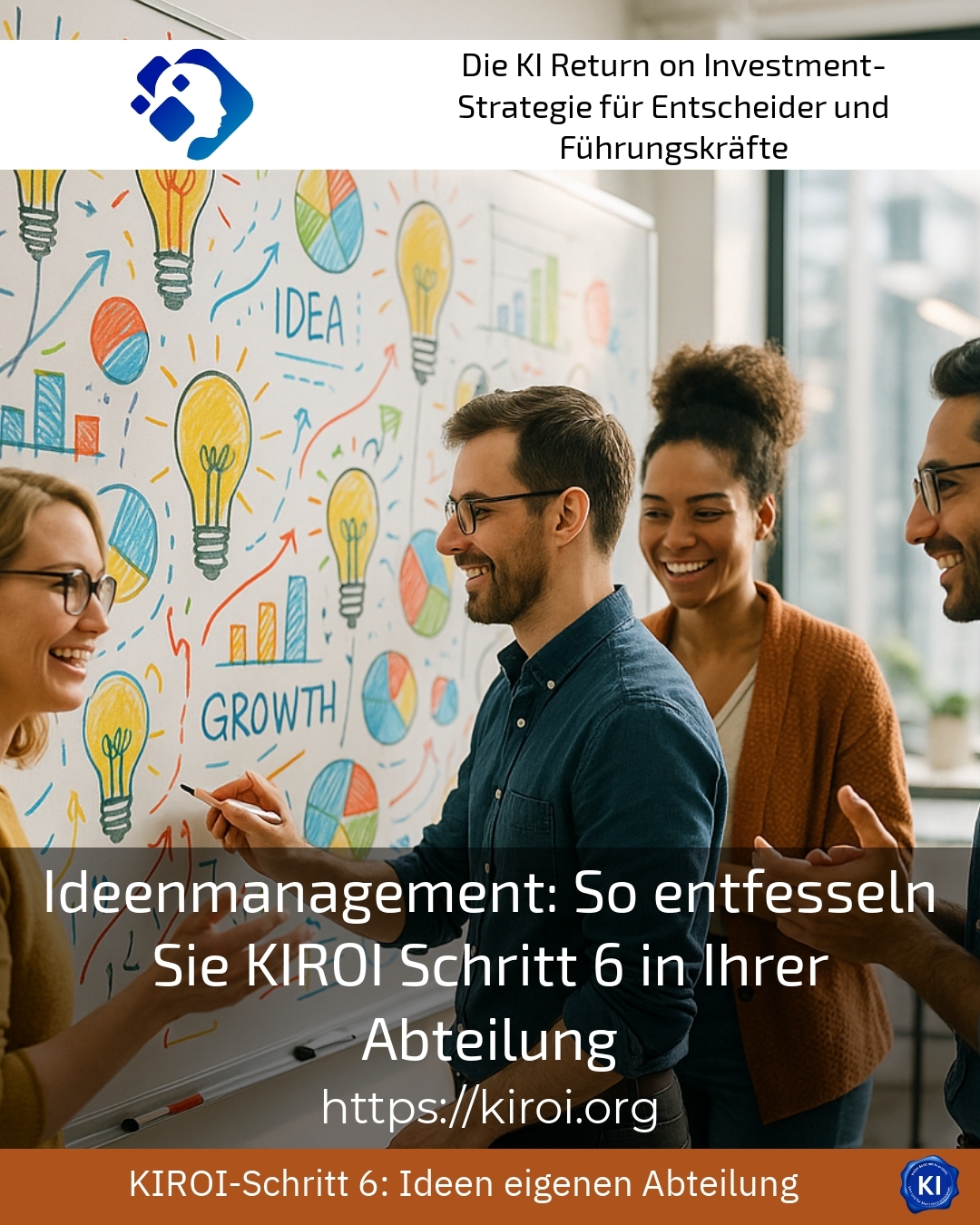
The topic of idea management is becoming increasingly important in many companies. It supports the systematic collection, evaluation and implementation of ideas to increase innovative strength and efficiency. Targeted support in individual steps is particularly important in order to successfully unleash the process within the department. One example of this is the sixth step of AIROI, which will be examined in a practical way below.
Idea management as a success factor in the department
Ideas management refers to the structured handling of suggestions for improvement and innovations within a company[1][2]. This can create a vibrant idea culture within a department, actively involving employees. This results in valuable impulses that often lead to better workflows or new products.
Many companies report that idea management supports processes that not only reduce costs but also increase employee motivation [6]. In practice, it is apparent that defining clear structures and roles is crucial. Regular communication and transparent feedback play an important role in this regard.
BEST PRACTICE with one customer (name hidden due to NDA contract)
An innovative idea management system was introduced in a production department, enabling staff to submit digital suggestions with ease. This led to the faster identification of weaknesses and a 15% improvement in process quality within a year.
BEST PRACTICE with one customer (name hidden due to NDA contract)
A service company integrated the sixth step of AIROI to jointly implement ideas with the involved teams after their evaluation phase. This led to higher acceptance and improved departmental coordination processes.
BEST PRACTICE with one customer (name hidden due to NDA contract)
In an IT department, external mentoring and coaching supported the team in specifically establishing the AIROI process within the department. This enabled complex innovation projects to be implemented more efficiently while simultaneously strengthening internal communication.
The sixth step of AIROI: Implementation and integration into everyday life
The sixth step of AIROI focuses on implementing the selected ideas after their evaluation and concept development. At this stage, the practical transfer into everyday work and operational integration begins.
An important task in this step is the provision of sufficient resources and support from leadership. This helps to ensure that measures are implemented smoothly and that acceptance within the team increases. Without clear coordination and follow-up, good ideas can otherwise easily fizzle out.
Practical examples from industry show how important it is to react flexibly to challenges during implementation. For instance, a suggestion for improvement in production can initially be launched as a pilot project, after which it can be gradually rolled out to other areas.
Accompanying coaching can provide valuable impetus to employees and managers during this phase. It helps to identify resistance early and communicate it transparently. At the same time, it promotes confidence in the process and the sustainable integration of innovations.
How to target and unleash the sixth step in your department
To ensure successful implementation within the framework of idea management, the following approach is recommended:
- Establish clear responsibilities – Who is responsible for implementation and monitoring?
- Introduce regular progress reports to make successes visible and to make adjustments.
- Foster open dialogue so that employees can address emerging problems early on.
- Recognise and communicate successes to continue to strengthen motivation.
- Using methods such as agile approaches or Design Thinking to ensure adaptability.
External support, such as transruptive coaching, can also guide departments in developing suitable strategies and finding practical solutions, particularly during the implementation phase.
Practical examples from various industries
In the automotive industry, teams reported how systematic idea management helped to reduce production times and increase quality through small process improvements[2].
A pharmaceutical company used idea management to consolidate innovative approaches for product development across various departments. This highlighted the importance of broad involvement of all employees to bring together different perspectives[3].
In retail, the implementation of customer and employee ideas for assortment changes led to noticeable increases in sales. There, the targeted implementation of AIROI Step 6 demonstrated the importance of flexibility and rapid responsiveness in meeting market demands[4].
My analysis
Ideas management is an indispensable building block for sustainably promoting innovation and efficiency. A key success factor here is consistent implementation – this is precisely what AIROI's sixth step achieves in the department. It integrates the previously collected and evaluated suggestions into everyday company life, thus ensuring tangible improvements.
Through a clear structure, transparent communication, and targeted support, the process can be effectively unleashed. Employees are involved as valuable idea generators and engage in a constructive dialogue. This develops a culture that supports continuous learning and change.
Overall, it is worthwhile to systematically embed ideas management in order to better utilise the creative potential of the workforce and to overcome challenges together.
Further links from the text above:
What is idea management? Definition, processes and...
What is Idea Management | Definition, Importance & …
What is meant by this and what are its benefits?
What is Ideation Management 2025: Introduction + Definition
For more information and if you have any questions, please contact Contact us or read more blog posts on the topic Artificial intelligence here.











 Deutsch
  English (UK)