
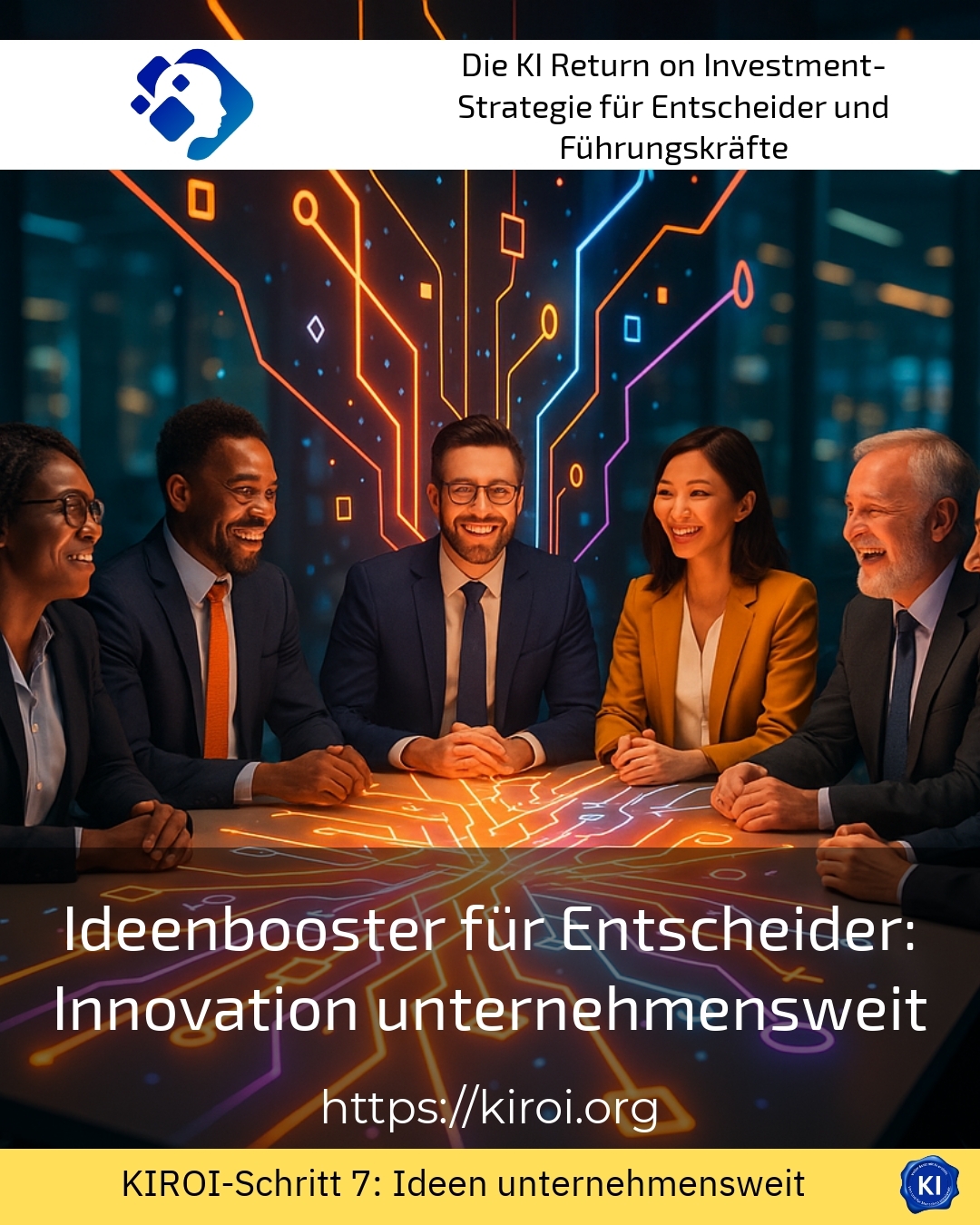
How do some companies seemingly effortlessly bring forth one groundbreaking innovation after another, while others, despite significant investments, stagnate? This question concerns executives worldwide. The crucial difference often lies not in budgets or technical resources. Rather, it is about how systematically creative impulses are fostered across all business areas. A well-thought-out idea booster for decision-makers can make the crucial difference here. For real innovation power does not arise in isolated departments. It needs a fertile breeding ground in the entire organization.
The idea booster for decision-makers: Why corporate-wide creativity has become indispensable
Business is changing at a speed that seemed unimaginable just a few years ago. Traditional business models are under pressure. New competitors appear seemingly out of nowhere. In this dynamic environment, it is no longer enough to leave creative processes solely to the research department. Successful organizations have recognized that valuable insights can come from all areas. The sales representative knows the customer needs firsthand. The logistics expert sees optimization potential that others remain unaware of. And the customer support department learns daily where actual problems lie.
A automotive supplier from southern Germany has consistently implemented this insight [1]. The company introduced a digital portal through which every employee can submit improvement suggestions. The results surprised even the management. Within a few months, over a thousand suggestions had been submitted. Many of them came from areas that are not traditionally associated with product development. For example, an employee from the accounting department proposed simplifying the ordering process. This adjustment saves the company significant sums annually. Such examples impressively show the potential that lies dormant within the workforce.
A mechanical engineering company took a similar approach. It organized regular workshops where teams from different departments worked together on challenges. This interdisciplinary collaboration led to surprising solutions. A electronics manufacturer, in turn, established a mentoring program. Experienced executives mentor younger colleagues in developing their own project ideas.
Best practice with a AIROI customer
A medium-sized manufacturer of precision tools turned to our transruptive coaching because despite high investments in research and development, the renewal rate stagnated. The management reported that there was a certain level of ideas fatigue in the workforce. Many employees felt that their suggestions would in any case not be heard. In an intensive coaching process, we jointly developed a multi-stage concept to activate the creative potential. First, we conducted structured interviews with employees from various departments. These conversations revealed surprising insights into existing barriers and untapped opportunities. Subsequently, we established a low-key system for idea generation that was deliberately kept simple. The management received guidance on how to foster a culture of appreciative feedback. After about six months, the company reported a noticeably changed atmosphere. Employees became more active, and the quality of the submitted proposals improved significantly. One particularly valuable insight was the importance of quick feedback on submitted proposals.
Create structures that enable creative development
Simply asking employees to be creative rarely leads to the desired success. People need appropriate frameworks to be able to fully develop their potential. Both physical and organizational factors play an important role in this. Many companies have realized that rigid hierarchies and excessive bureaucracy can be real killers of creativity. Therefore, they are experimenting with more flexible structures and agile work methods.
A chemical company created so-called creative zones in its production facilities [2]. These areas are deliberately designed differently from the usual workplaces. Comfortable seating, whiteboards, and plenty of space for experimentation encourage lateral thinking. Employees can meet here to work on problem-solving together. Experience shows that such spaces actually lead to more and better ideas. One pharmaceutical company created similar meeting zones between different departments. The casual interactions between researchers and production workers led to valuable insights. A technology company, in turn, introduced flexible working hours that enable focused thinking.
However, mere spatial design is not enough. The corporate culture must also be right. Employees must feel that their contributions are valued. Mistakes should not be punished, but rather seen as learning opportunities. A culture of psychological safety is the fundamental prerequisite for genuine creativity. Leaders can act as role models by openly dealing with failures themselves.
The idea booster for decision-makers in practical application
Leaders face the challenge of fostering creative processes without stifling them. This requires a fine sense of the right balance between structure and freedom. Too many guidelines can stifle creativity. Too little may lead to activities without purpose. The art lies in creating a framework within which employees can freely develop their talents.
A consumer goods manufacturer solved this dilemma in an elegant way [3]. The company defined strategic search areas in which it wanted to explore new approaches. Within these areas, employees had great freedom in developing ideas. This method ensured that the creative energies flowed in directions relevant to business. At the same time, the participants did not feel constrained. An energy provider used a similar approach and defined future topics to which proposals were particularly welcome. A logistics company complemented this approach with financial incentives for implemented improvements.
Regular exchange formats can also provide valuable impulses. Many companies are now organizing internal conferences or barcamps. At such events, employees present their projects and ideas to a wider audience. The exchange across departmental boundaries often leads to unexpected synergies. And public appreciation motivates further creative efforts.
Best practice with a AIROI customer
A traditional family business in the metalworking sector sought guidance in transforming its corporate culture. The management level recognized that the previous top-down culture was no longer relevant. Employees did not feel encouraged to bring forward their own ideas. The fear of criticism was palpable and stifled the organization’s creative potential. As part of our collaboration, we first developed a shared understanding of the desired culture. Subsequently, we guided the management in individual coaching sessions. These conversations focused on concrete behavioral changes in the day-to-day work of leadership. In parallel, we moderated workshops in which teams reflected on their collaboration. A particularly effective step was the introduction of regular feedback rounds. The management later reported that the atmosphere had noticeably relaxed. Employees now were more willing to express even incomplete ideas. This openness led to several valuable improvements in the production processes. The company now plans to expand the approach to other locations.
Using Digital Tools as Catalysts
Digitalization opens up completely new possibilities for idea management. Modern platforms allow for collecting, evaluating, and developing suggestions. Employees in different locations can connect and work together on projects. The barriers to participation are significantly reduced when an intuitive digital tool is available.
A globally operating industrial corporation implemented a corporate-wide platform for collaborative development [4]. On this platform, employees can post challenges and submit solutions. Other users comment on and evaluate the contributions. The best suggestions receive resources for further development. This system has led to valuable insights from remote locations becoming visible. A textile manufacturer uses a similar platform to collect product ideas from employees. A food producer supplemented the digital system with regular video pitches of the most promising proposals.
Artificial intelligence algorithms can further support the process. They help identify connections between different suggestions. They can identify trends and point to promising combinations. The human factor remains central and irreplaceable. However, the digital helpers enable the efficient processing of large amounts of information.
How the Ideas Booster for Decision-makers Unveils Sustainable Impact
Unique initiatives often fail to have any impact. Sustainable change requires continuous commitment and long-term thinking. Leaders should regularly put the topic on the agenda. Progress must be measured and communicated. And the structures need time to establish themselves.
A construction supplier experienced that initial enthusiasm can quickly dissipate [5]. The company had launched an ambitious program to promote ideas. However, after a few months, the engagement noticeably decreased. Analysis showed that regular communication about successes had been lacking. Employees did not know what had become of their suggestions. The company subsequently introduced monthly updates in which implemented ideas were presented. This measure significantly revived participation. A packaging manufacturer added annual awards for particularly valuable contributions to its approach. An equipment manufacturer integrated the topic into regular employee discussions.
The involvement of all levels of management is crucial in this context. If middle management is not convinced, initiatives often fail. Trainings and coaching can provide valuable support in this regard. They help managers better understand their role as facilitators of creativity.
My AIROI Analysis
Systematic promotion of renewal in companies requires a holistic approach. It is not enough to introduce individual tools or take isolated measures. Rather, a well-thought-out interplay of cultural, structural, and technological elements is needed. The idea booster for decision-makers works best when it takes a multi-level approach and involves all areas of the organization.
The experiences from numerous mentoring projects reveal several recurring success factors. First, the visible commitment of top management is indispensable. Employees are guided by what their superiors demonstrate. Second, low-threshold opportunities for participation are needed. Complex forms or lengthy approval processes are discouraging. Third, quick and appreciative feedback on submitted proposals is crucial. People want to know that their contributions are being taken into account.
At the same time, experience warns of some typical pitfalls. Excessive perfectionism can be paralyzing. Not every idea needs to be fully developed before it can be shared. Companies should also avoid over-bureaucraticizing the creative process. A certain degree of chaos and disorder is part of creativity. After all, patience is required, because cultural changes take time and cannot be brought about overnight.
Accompanying companies along this path with transruptive coaching can provide valuable support. External perspectives help identify blind spots and develop new approaches. The investment in corporate-wide creativity promotion often pays off many times over. Organizations that succeed in activating the full potential of their employees are significantly better equipped to meet the challenges of the future.
Further links from the text above:
[1] Bosch – Innovation culture in the company
[2] BASF – Creative work environments
[3] Henkel – Strategic Innovation
[4] Siemens – Digital innovation platforms
[5] Fraunhofer – Sustainable innovation processes
For more information and if you have any questions, please contact Contact us or read more blog posts on the topic Artificial intelligence here.







 Deutsch
 English (UK)