
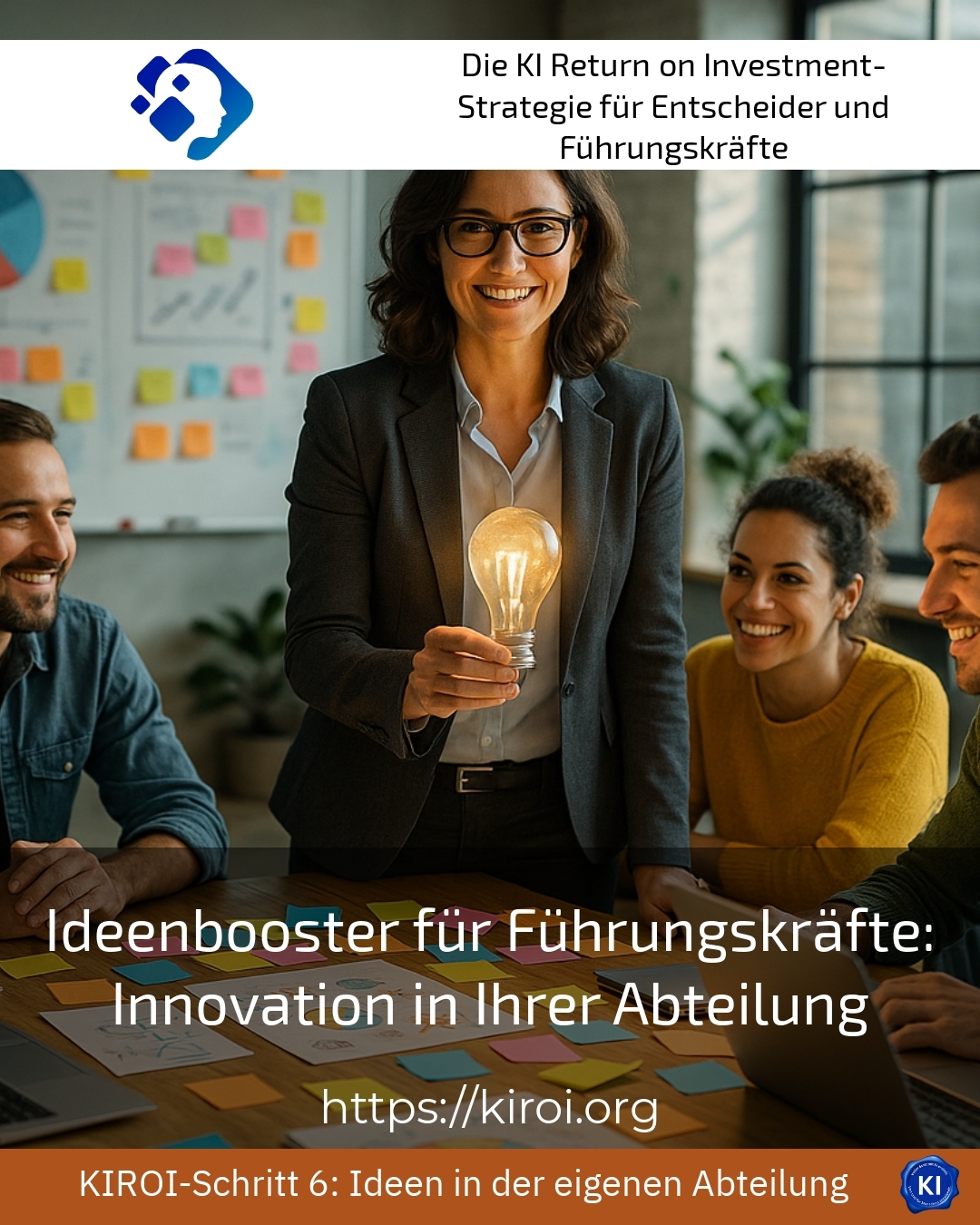
Imagine your department suddenly develops ideas that surprise and excite even seasoned industry experts. The Executive Idea Booster: Innovation in your department is not an abstract theory, but a tangible tool that has already transformed numerous companies. In a rapidly changing world where traditional business models are questioned daily, the ability for creative renewal determines long-term success or slow disappearance from the market. Leaders face the particular challenge of not only thinking creatively themselves, but also creating an environment where employees can and want to contribute their best ideas.
The fundamentals of creative transformation in modern organisations
Creative renewal doesn't begin with large strategy papers. It starts in the mind of each individual team member. Leaders often underestimate how much their own attitude influences the creativity of their teams. An open mindset acts as a catalyst for new ideas and unconventional solutions. In the automotive industry, for example, it is clearly evident how companies have been able to develop completely new mobility concepts that go far beyond the classic vehicle business by consistently fostering creative processes. The shift from a pure vehicle manufacturer to a mobility service provider required a fundamental rethink at all hierarchical levels.
The pharmaceutical industry also provides impressive examples of successful transformation processes. Here, interdisciplinary teams have achieved groundbreaking progress by combining classic research with digital analysis methods. Another example can be found in retail, where brick-and-mortar retailers have been able to tap into new customer groups through creative hybrid concepts. These developments impressively show that the idea booster for managers: Innovation in your department works across industries and delivers measurable results.
Practical methods for idea generation in everyday leadership
The implementation of structured creativity processes initially requires an understanding of the different available methods and their respective strengths. Design Thinking has established itself as a particularly effective approach in practice because it consistently places the user at the centre of all considerations. In the banking sector, managers are successfully using this methodology to develop more customer-friendly financial products and simplify complex processes. The insurance industry is also increasingly relying on user-centred development approaches. This results in digital solutions that offer customers real added value. Positive effects of structured creative work are also evident in the healthcare sector.
Transruptions-Coaching helps leaders to effectively integrate these methods into their daily work and initiate sustainable changes. The support covers both strategic and operational aspects of fostering creativity. Clients often report initial scepticism, which quickly turns into enthusiasm as soon as the first successes become visible.
Best practice with a AIROI customer
A medium-sized engineering company faced the challenge of expanding its traditional business area with digital service offerings without neglecting or overwhelming its existing customer base. Management recognised the need for a structured process to channel the creativity of its technically adept employees and transform it into marketable solutions. In collaboration with the transruptions coaching team, a multi-stage programme was developed that combined regular idea workshops with targeted prototyping phases, involving all departments. Sales staff contributed valuable customer insights, while engineers assessed technical feasibility and service technicians highlighted practical implementation aspects. After six months of intensive collaboration, the company had developed three new digital service packages that generated significant additional revenue and demonstrably improved customer loyalty within the first year of their market launch. Employees also reported increased job satisfaction, as they were finally able to contribute and realise their ideas.
Ideas Booster for Managers: Innovation in Your Department Through Psychological Safety
Psychological safety forms the foundation of any successful creative culture. Employees must feel safe to voice even unfinished thoughts. Only then can truly new perspectives emerge. In the technology sector, leading companies have recognised that the best ideas often come from unexpected quarters. One major software provider therefore introduced so-called "Failure Celebrations", where failed projects are analysed and the lessons learned from them are celebrated [1]. The aviation industry uses similar approaches in the area of error culture. Here, incidents are systematically reviewed to enable continuous improvement. The chemical industry is also increasingly relying on open feedback cultures that encourage a willingness to experiment.
Leaders can actively foster psychological safety. They should themselves show vulnerability and openly address their own mistakes. This behaviour gives team members permission to be authentic as well. Transruption coaching supports leaders on this path with individual impulses and practical exercises.
Structural prerequisites for sustainable creativity
In addition to the cultural dimension, structural factors also play a crucial role in fostering creative processes within organisations. Time flexibility allows employees to think outside the box. Spatial design demonstrably influences the quality of creative collaboration [2]. In the publishing industry, companies are experimenting with flexible work environments that encourage spontaneous encounters and unplanned idea exchange. The food industry is increasingly establishing innovation labs where new products can be tested under realistic conditions. Telecommunications companies are relying on virtual collaboration spaces that enable cross-location creative work.
The idea booster for executives: Innovation in your department only unfolds its full potential when structural and cultural elements interlock and reinforce each other. A well-thought-out incentive system can further increase motivation to submit ideas. This is not primarily about financial rewards. Recognition and visibility are often more motivating than monetary incentives.
Best practice with a AIROI customer
A retail company with several hundred branches was struggling with declining employee engagement and stagnant suggestions for improvement from the operational level. Management realised that the existing suggestion scheme was too bureaucratic and discouraged employees from submitting their ideas. As part of the transruption coaching, the company developed a completely new system based on rapid feedback and maximum transparency. Every submitted idea received an initial assessment within 48 hours, and those submitting them were consistently informed of its progress. The introduction of innovation ambassadors in each branch, who acted as multipliers and encouraged their colleagues to submit even small suggestions for improvement, proved particularly effective. The number of submissions quadrupled within a year, and several of the implemented ideas led to measurable efficiency improvements in branch processes. Employees felt heard and valued, which had a positive impact on the overall company culture.
Digital tools as catalysts for creative processes
Modern technologies are opening up entirely new possibilities for idea generation and further development within organisations. Artificial intelligence can support leaders in recognising patterns within large quantities of data and deriving innovation impulses from them [3]. The energy sector is using AI-powered analysis tools to identify optimisation potential in complex supply networks. Logistics companies are relying on machine learning to make supply chains more efficient. The textile industry is experimenting with algorithmic design assistants that inspire creative teams.
At the same time, it is important to know the limits of digital tools. Technology never replaces human creativity. It merely complements and enhances it. Leaders should therefore adopt a balanced approach. Digital and analogue methods can complement each other wonderfully. Transruption coaching provides impetus on how this balance can be achieved.
Idea Booster for Leaders: Innovation in Your Department through External Networking
Successful creative processes rarely remain confined within a company's own boundaries. Opening up to the outside brings fresh perspectives and unexpected impulses. The construction industry impressively demonstrates how cross-industry collaborations can lead to innovative solutions. Here, architects, material scientists, and software developers work together. Together, they develop sustainable construction concepts. The media industry is increasingly relying on partnerships with startups to tap into new business models. Traditional industrial companies are also increasingly opening up to open innovation approaches.
Networks with universities and research institutions offer valuable access to current knowledge [4]. Industry associations facilitate exchanges with competitors on pre-competitive topics. International partnerships bring cultural diversity into the creative process. Managers should actively seek out such networking opportunities and encourage their teams to maintain external contacts.
My AIROI Analysis
The systematic promotion of creative processes represents one of the most important leadership tasks of our time and requires a well-thought-out interplay of various factors. My analysis of numerous company projects shows that successful leaders consistently use three central levers: they create psychological safety, provide structural freedom, and actively promote the networking of their teams with external knowledge providers. These three elements mutually reinforce each other and together form a robust foundation for sustainable creativity.
It is particularly striking that many leaders initially approach us with similar challenges. They report rigid structures and a lack of willingness to change. Often, there is a lack of clear understanding of how creativity can be systematically fostered. Transruption coaching accompanies these leaders on their individual path to a more creative organisation.
Experience shows that sustainable changes take time. Quick wins are possible, but long-term transformation requires patience. Leaders should develop realistic expectations while pursuing ambitious goals. The presented methods and examples offer diverse starting points for your own context. It is important to start with small steps and learn continuously. This is how a culture of creative excellence is built, step by step.
Further links from the text above:
[1] Harvard Business Review: Insights on Innovation
[2] Steelcase Research: Creativity and Innovation
[3] McKinsey Digital: AI and Innovation
[4] Fraunhofer-Gesellschaft: Research Fields
For more information and if you have any questions, please contact Contact us or read more blog posts on the topic Artificial intelligence here.








 Deutsch
  English (UK)