
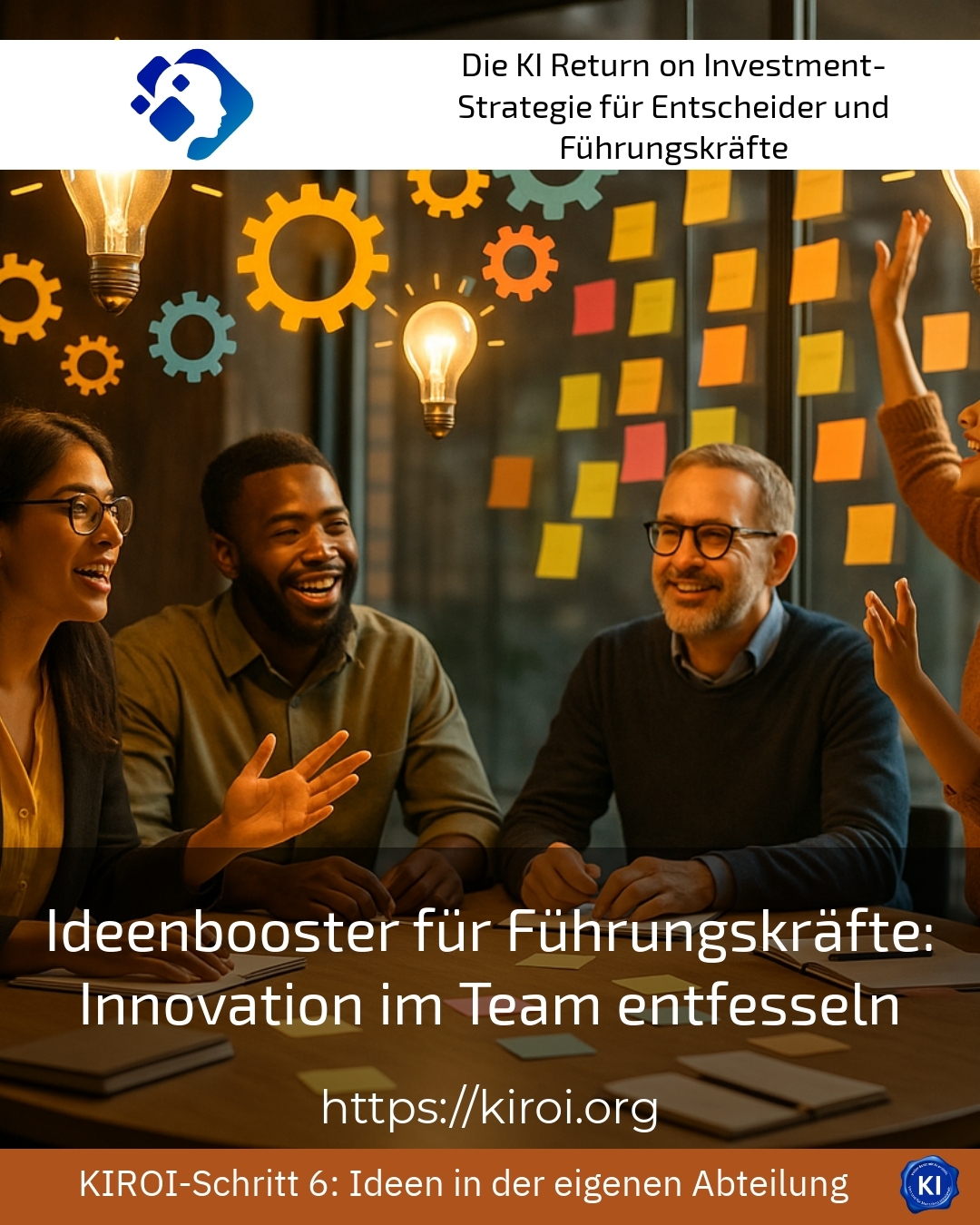
Imagine your team developing more groundbreaking concepts in just one week than in the entire previous quarter. What initially sounds like an unattainable dream is already a tangible reality for many leaders in their daily work. The crucial difference lies not in larger budgets or new staff, but in the systematic application of methods that are known as Innovation Booster for Leaders: Unleashing Team Innovation can be described. This approach transforms stagnant departments into vibrant centres of creativity. It's about far more than superficial motivation techniques. It is a fundamental change in the way organisations unlock potential.
Recognising the hidden barriers to creative development
Many companies face a paradoxical problem. They employ highly qualified staff with enormous creative potential. At the same time, innovative breakthroughs are lacking. The causes often lie in invisible structures. These structures consciously or unconsciously inhibit any approach to new ways of thinking. Hierarchical communication channels stifle spontaneous ideas in their infancy. Fear of criticism paralyses even the bravest team members.
A medium-sized engineering company only recognised this pattern after an external analysis [1]. The engineers possessed outstanding specialist knowledge. Nevertheless, no suggestions for improvement were made regarding production processes. The cause lay in a culture of perfection. No one dared to present immature ideas. A software house experienced similar blockages. Developers worked in isolation on their projects. Informal exchange across departmental boundaries practically did not take place. A marketing agency also reported comparable challenges. Creatives only realised their potential in individual projects. As soon as teamwork was required, originality and courage dropped considerably.
Idea Booster for Leaders: Innovation in Teams Through Psychological Safety
Amy Edmondson's research highlights a central success factor [2]. Psychological safety forms the foundation for a genuine culture of innovation. Teams that view mistakes as learning opportunities generate significantly more ideas. Leaders play a key role in this. They must actively demonstrate that failure is part of experimentation.
A pharmaceutical company implemented this approach in a remarkable way. Leaders regularly shared their own failures in team meetings. The effect was impressive. Within a few months, the number of submitted improvement suggestions rose by more than sixty percent. An insurance company used so-called "failure celebrations". At these events, failed projects were analysed and acknowledged. The insights gained were incorporated into new ventures. A logistics service provider also reported positive experiences. There, open retrospectives led to a noticeably improved idea development.
Best practice with a AIROI customer
A medium-sized company from the electronics industry approached us for transruption coaching with a specific challenge. For some time, management had noticed stagnation in internal improvement processes. Although the company had excellent specialists, disruptive product ideas were lacking. As part of our support, we first analysed the existing communication structures. We found that idea proposals had to go through a multi-stage approval process. This process took an average of six weeks. Employee motivation suffered considerably from this waiting time. Together, we developed a new format for rapid idea evaluation. Weekly pitch sessions enabled direct feedback within minutes. Managers received special training in constructive feedback. The results exceeded all expectations. Within one quarter, the number of submitted concepts tripled. Three of these ideas were developed into marketable product extensions. Clients frequently report similar breakthroughs after our support.
Structured Creativity Methods for Management Daily Life
Spontaneous creativity alone is not enough for sustainable innovation. Leaders require concrete tools for systematic idea generation. These methods support teams in moving beyond established thought patterns. The selection of the right technique is crucial for success.
The SCAMPER method has proven itself in numerous industries [3]. This approach systematically questions existing products or processes. A car supplier used this technique to optimise its manufacturing processes. The team examined each step according to the principle: Substitute, Combine, Adapt, Modify, Put to other uses, Eliminate, Reverse. Fifteen actionable improvement suggestions emerged within two workshops. A hotel chain applied SCAMPER to its guest experience. The result was innovative service concepts with strong differentiation. A publishing house also reported successful applications in the development of new media formats.
Harnessing Design Thinking as an idea booster for leaders
Design Thinking offers a comprehensive framework for user-centred innovation [4]. The iterative process begins with a deep understanding of the target audience. Problems are then defined, ideas generated, and prototypes developed. Leaders guide their teams through these phases with targeted input.
A telecommunications provider used Design Thinking to develop new customer services. The cross-functional team initially spent time with real users. The insights gained surprised even experienced product managers. Numerous assumptions about customer needs turned out to be incorrect. A bank used the approach to redesign its digital interfaces. Prototypes were created and tested within days. An energy provider reported similar experiences when developing sustainable offerings.
Unleash the power of diverse perspectives
Homogeneous teams tend towards groupthink and blind spots. Genuine innovation often arises at the intersection of different experiences. Leaders can purposefully foster and utilise this diversity. The conscious inclusion of different perspectives enriches any creative process considerably.
A medical technology company regularly invited external experts to innovation workshops. Artists, philosophers, and craftspeople brought completely new perspectives. The results of these sessions led to patentable product improvements. An advertising agency deliberately rotated employees between different client projects. The fresh perspective demonstrably accelerated problem-solving. An architectural firm also systematically used interdisciplinary collaboration. Sociologists and environmental scientists complemented the classic planning team on selected projects.
Best practice with a AIROI customer
An internationally operating consumer goods manufacturer sought guidance for a stalled innovation process. Product development had been stagnating in familiar patterns for several years. Although the company invested significant resources in research, breakthrough innovations were lacking. As part of our transruption coaching, we established a new format for idea generation. We combined employees from production, sales, and customer service into mixed innovation teams. Additionally, we integrated perspectives from end consumers through regular feedback rounds. Management received intensive input on moderating heterogeneous groups. Particularly important was training in appreciative communication across hierarchical levels. After six months, a significant shift in corporate culture became apparent. Employees proactively contributed ideas without waiting for formal requests. Three new product lines emerged from this process. The revenue contribution of these innovations significantly exceeded initial forecasts. This example demonstrates how targeted guidance can unlock hidden potential.
Boosting team innovation through digital collaboration tools
Modern technologies significantly expand the possibilities of collective creativity [5]. Digital whiteboards enable synchronous collaboration across locations. Idea management platforms structure the entire innovation process transparently. Managers should use and champion these tools purposefully.
A consultancy firm utilised virtual brainstorming tools for global project teams. The asynchronous ideation enabled contributions regardless of time zones. A retail chain implemented an enterprise-wide innovation platform. Employees from all branches could submit and rate suggestions for improvement. An industrial conglomerate also reported positive experiences with digital creativity tools. The option for anonymous idea submission proved particularly valuable.
Embedding a sustainable innovation culture
Individual creative workshops generate short-term euphoria. However, for long-term success, organisations require systematic integration. Structures that foster innovation must be integrated into processes and incentive systems. Leaders bear the responsibility for this sustainable transformation.
A technology company reserved twenty percent of working time for experimental projects. These allowances enabled self-initiated innovation ventures without direct target agreements. An insurance company introduced innovation bonuses as a supplement to classic bonuses. Recognition for creative contributions was independent of immediate economic success. An automobile manufacturer also reported on structural measures to promote innovation. Internal incubators supported promising ideas from conception to market readiness.
My AIROI Analysis
The guidance of numerous organisations in unlocking creative potential shows a clear pattern. Sustainable innovation success is not achieved by individual methods or tools alone. Rather, genuine transformation requires a holistic interplay of various factors. Leaders form the central link between vision and implementation. They must actively embody psychological safety and consistently dismantle structural obstacles. At the same time, they need concrete methods for systematic idea generation.
The integration of diverse perspectives repeatedly proves to be a powerful Ideas booster for leaders. Teams that combine different experiences and ways of thinking achieve significantly more creative solutions. Digital tools further enhance this dynamic. They enable collaboration across spatial and temporal boundaries. The sustainable integration of innovation-promoting structures is the key to long-term success.
Our disruption coaching specifically supports leaders with these challenges. We guide organisations from the analysis of existing blockages to the implementation of new processes. The best-practice examples described show what results are possible. This always involves individual solutions for specific contexts. Standard recipes do not exist in this area. Every organisation needs tailor-made impulses for its unique situation.
Further links from the text above:
[1] Harvard Business Review – Innovation Research
[2] Amy Edmondson – Psychological Safety
[3] Interaction Design Foundation – SCAMPER Method
[4] IDEO – Design Thinking Resources
[5] McKinsey – Innovation Insights
For more information and if you have any questions, please contact Contact us or read more blog posts on the topic Artificial intelligence here.







 Deutsch
  English (UK)