
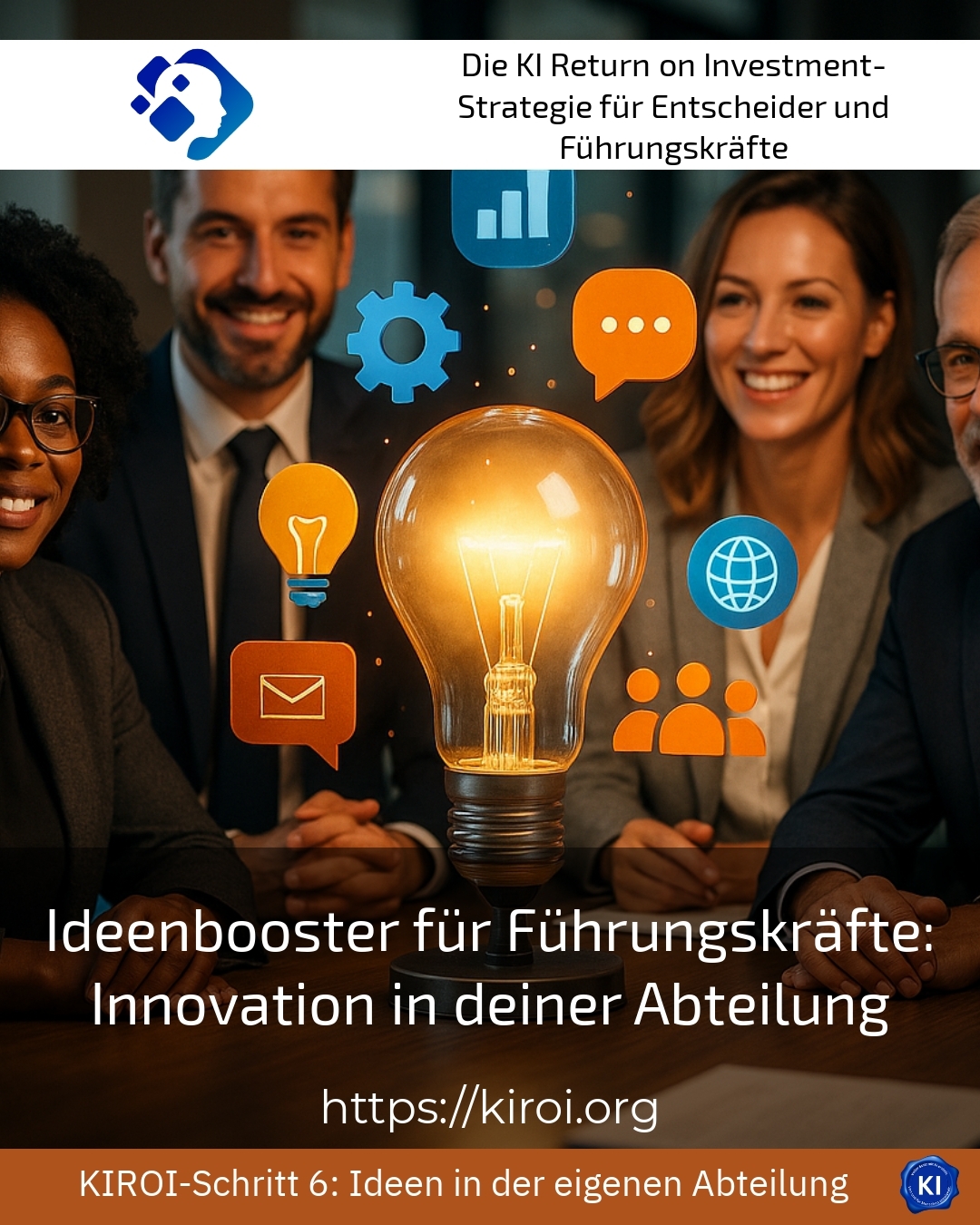
Imagine your department suddenly develops groundbreaking concepts. Employees bring fresh perspectives. The team dynamic changes noticeably. This is precisely where Innovation Booster for Managers: Innovation in Your Department Many leaders report similar challenges. They are looking for ways to kick-start creative processes. At the same time, they must achieve operational goals. This balancing act is not always easy. Nevertheless, there are tried-and-tested methods and approaches. You can implement these directly in your daily work. The following sections will show you concrete possibilities.
Why creative impulses are indispensable for modern leadership
The world of work is changing rapidly and continuously. Leaders are facing increasingly complex tasks. They must motivate teams while simultaneously delivering results. Clients often report a feeling of being overwhelmed. The pressure to be innovative is constantly growing. This often leaves no time for creative reflection. Transruption Coaching supports exactly these kinds of projects. It helps leaders to open up new ways of thinking.
In the manufacturing industry, for example, department heads struggle with process optimisation. They are looking for ways to improve production processes. At the same time, employees should be able to contribute their own suggestions. In the financial sector, on the other hand, the focus is on digital transformation. Here, teams need more freedom for experimental work. A similar need is also evident in the healthcare sector. Nursing care managers wish for more scope for improvement ideas. All these examples demonstrate a common denominator. Creative impulses do not arise by themselves.
Ideas booster for leaders: Innovation in your department starts with trust
Trust forms the foundation of any creative culture. Employees must feel safe. Only then will they share unconventional ideas. We see this particularly clearly in retail. Store managers who are open to feedback receive more suggestions. Their teams independently develop improvements for customer service. Something similar can be seen in the logistics sector. Warehouse managers who view mistakes as learning opportunities encourage a spirit of experimentation. Employees then dare to try new picking methods. This pattern is also confirmed in the IT industry. Team leaders with transparent communication receive more innovative solution proposals.
Best practice with a AIROI customer
A medium-sized company in the mechanical engineering sector approached us with a particular challenge. Department heads reported stagnating idea generation within their teams. Employees were notably reserved during meetings. Suggestions for improvement were absent, despite management explicitly requesting them. As part of our support, we first analysed the existing communication culture. It transpired that previous suggestions had been shelved without feedback. Employees had lost confidence in being heard. Together, we developed a transparent feedback system with fixed response deadlines. Within three months, the number of submitted ideas increased significantly. Particularly noteworthy was the quality of the suggestions for process optimisation. Several of these led to measurable efficiency gains in production. Managers reported a palpable change in the atmosphere within their departments. This example impressively demonstrates the importance of systematic trust-building for creative development.
Creating structures that enable creative thinking
Creativity paradoxically also requires structure. Without clear frameworks, ideas get lost. Leaders can specifically create spaces for development. In the automotive supply industry, fixed innovation times have proven effective [1]. Teams are given dedicated hours each week for free thinking. These protected time slots signal appreciation for creativity. Similar models exist in the pharmaceutical industry. Research teams are allowed to use a portion of their working time freely. The results of these dedicated spaces often surprise positively. Departments in the banking sector are also experimenting with such approaches. Customer advisors develop new service concepts in innovation workshops.
Innovation Booster for Managers: Innovation in Your Department also requires physical conditions. Creative spaces with flexible furnishings encourage unconventional thinking. Whiteboards, mobile furniture and inspiring materials help with this. In the advertising industry, such spaces have long been the standard [2]. However, these concepts are also catching on in traditional industries. Insurance companies are increasingly setting up innovation labs. Cross-departmental teams meet there for joint idea development. Spatial separation from day-to-day business supports the mental shift.
Methods for Systematic Idea Generation
Various methods support the systematic development of new approaches. Design Thinking has established itself across industries. This user-centric approach often yields surprising insights [3]. In the telecommunications industry, teams regularly use this method. They develop customer-oriented service improvements with it. Design Thinking is also used in the energy sector. Innovative concepts for renewable supply models are emerging here. The food industry also benefits from this approach. Product developers gain a better understanding of customer needs.
Another proven method is so-called reverse brainstorming. Teams deliberately look for ways to make a problem worse. Positive solutions can be derived from these negative ideas. In the construction industry, project managers frequently use this technique. They identify potential weaknesses in construction projects. In transport, reverse brainstorming helps with route optimisation. Dispatchers recognise inefficient processes more quickly. This method is even used in the education sector. School heads use it to develop better teaching concepts.
Best practice with a AIROI customer
A retail company with multiple branches was looking for new ways to engage customers. The management team had tried various strategies without resounding success. As part of our consultancy, we conducted a series of Design Thinking workshops, involving employees from different hierarchical levels. The perspectives of till operators and shelf stackers were particularly valuable, as they had daily direct contact with customers. Through structured observation tasks, the teams initially gathered insights into customer behaviour. Subsequently, in creative sessions, they developed various prototypes for new service formats. One particularly promising approach was tested in a pilot branch. The concept of a personalised shopping assistance service for older customers was met with great enthusiasm, and customer satisfaction scores in the test branch increased noticeably. The concept is now being rolled out to further locations. This project exemplifies how methodical creative work can lead to concrete business success.
The role of the leader as an enabler
Leaders crucially shape the creative culture of their department. Their behaviour sends strong signals to the team. If they are open to new ideas themselves, employees follow this example. This is particularly evident in the chemical industry. Lab managers who share their own uncertainties encourage experimentation. Their teams dare to try more unconventional approaches. We observe similar dynamics in the hotel industry. Hotel managers who ask service staff for their opinions gain valuable insights. Guest satisfaction often benefits from these impulses. This pattern is also confirmed in the media industry. Editorial leaders with an open attitude foster journalistic creativity.
Transruptions-Coaching supports leaders in this role development. Clients often come with a desire for personal development. They want to learn to inspire teams better. This is not about quick fixes. Rather, we guide a process of gradual change. Innovation Booster for Managers: Innovation in Your Department grows from authentic leadership. This requires reflection on one's own patterns and behaviours.
Dealing with resistance and setbacks
Not every idea leads to success. This circumstance is part of the creative process. Leaders must learn to deal productively with failure. This is particularly evident in the toy industry. Many product ideas never make it to market. Nevertheless, new approaches often emerge from failed concepts. The same applies to agile development in the software sector [4]. Teams learn from failed sprints for future iterations. Failure is also part of the business in the fashion industry. Designers discard numerous designs before a collection is created.
Resistance within a team requires special attention. Some employees feel threatened by changes. Others are sceptical of new methods. Leaders should take these concerns seriously. In mechanical engineering, we often encounter scepticism towards digital tools. Experienced skilled workers fear for their tried-and-tested competencies. Such resistance can often be resolved through respectful inclusion. In administration, we face similar challenges. Long-serving clerks react reservedly to process innovations. Patient communication helps to build bridges.
Practical steps for everyday leadership
Concrete measures can be implemented directly. Start with small experiments. Allocate thirty minutes weekly for creative team discussions. In the hospitality industry, short morning meetings work particularly well. Service staff share observations from the previous day. In skilled trades, journeyman rounds can fulfil similar functions. Experienced professionals pass on knowledge to younger colleagues. At the same time, suggestions for improvement arise from these discussions. Regular reflection sessions also prove their worth in the social sector. Care teams develop new care approaches during these sessions.
Documentation plays a vital role in sustainable success. Systematically record all ideas. Use digital tools or analogue idea collections. In the printing industry, idea boards in production halls have proven their worth. Employees jot down spontaneous ideas there. In retail, similar systems work at staff entrances. Sales assistants leave short notes after customer conversations. Even in the funeral industry, such practices have become established. Employees gather suggestions for dignified improvements to services.
Best practice with a AIROI customer
A municipal council contacted us regarding challenges in citizen communication. Department heads from various offices reported similar difficulties. Citizen enquiries were often handled inadequately, and satisfaction continually declined. As part of our collaboration, we developed a cross-departmental innovation programme. Employees from different areas formed mixed creative teams. These teams met monthly for structured idea sessions with clear objectives. The collaboration between the registry office and the residents' registration office was particularly fruitful. Together, they developed a simplified application process for change of address notifications with marriage registration. The new process significantly reduced the effort required from citizens. At the same time, processing times in both offices measurably decreased. Management reports increased motivation within their teams. Employees feel effective and valued. This project demonstrates how creative collaboration can succeed even in traditional structures.
My AIROI Analysis
Accompanying numerous leaders has provided important insights. Creative development within departments does not follow rigid rules; rather, it requires tailored approaches for each context. Nevertheless, some patterns can be identified. Trust always forms the indispensable foundation. Without psychological safety, creative potential remains untapped. Structures and freedom must be in balance. Too many guidelines stifle creativity, while too few create a sense of disorientation.
The exemplary role of leaders appears particularly significant to me. Their own behaviour sends the strongest signals. Those who are open to new things themselves encourage others to be open. Those who view mistakes as learning opportunities foster a willingness to experiment. This attitude can be developed, but it requires conscious effort. Transruption coaching can provide valuable impetus in this regard. It supports personal development towards inspirational leadership.
The industry examples presented impressively show the diversity of possible approaches. From manufacturing to administration, creative methods work. However, the specific implementation must always be context-specific. What works in the advertising industry does not automatically fit mechanical engineering. Leaders should therefore experiment and adapt. Small steps often lead to sustainable changes. Patience and perseverance pay off in the long run. Investing in a creative culture is worthwhile for any organisation.
Further links from the text above:
[1] McKinsey – The Eight Essentials of Innovation
[2] Harvard Business Review – Innovation Articles
[3] IDEO Design Thinking
[4] Scrum.org – What is Scrum
For more information and if you have any questions, please contact Contact us or read more blog posts on the topic Artificial intelligence here.








 Deutsch
  English (UK)