
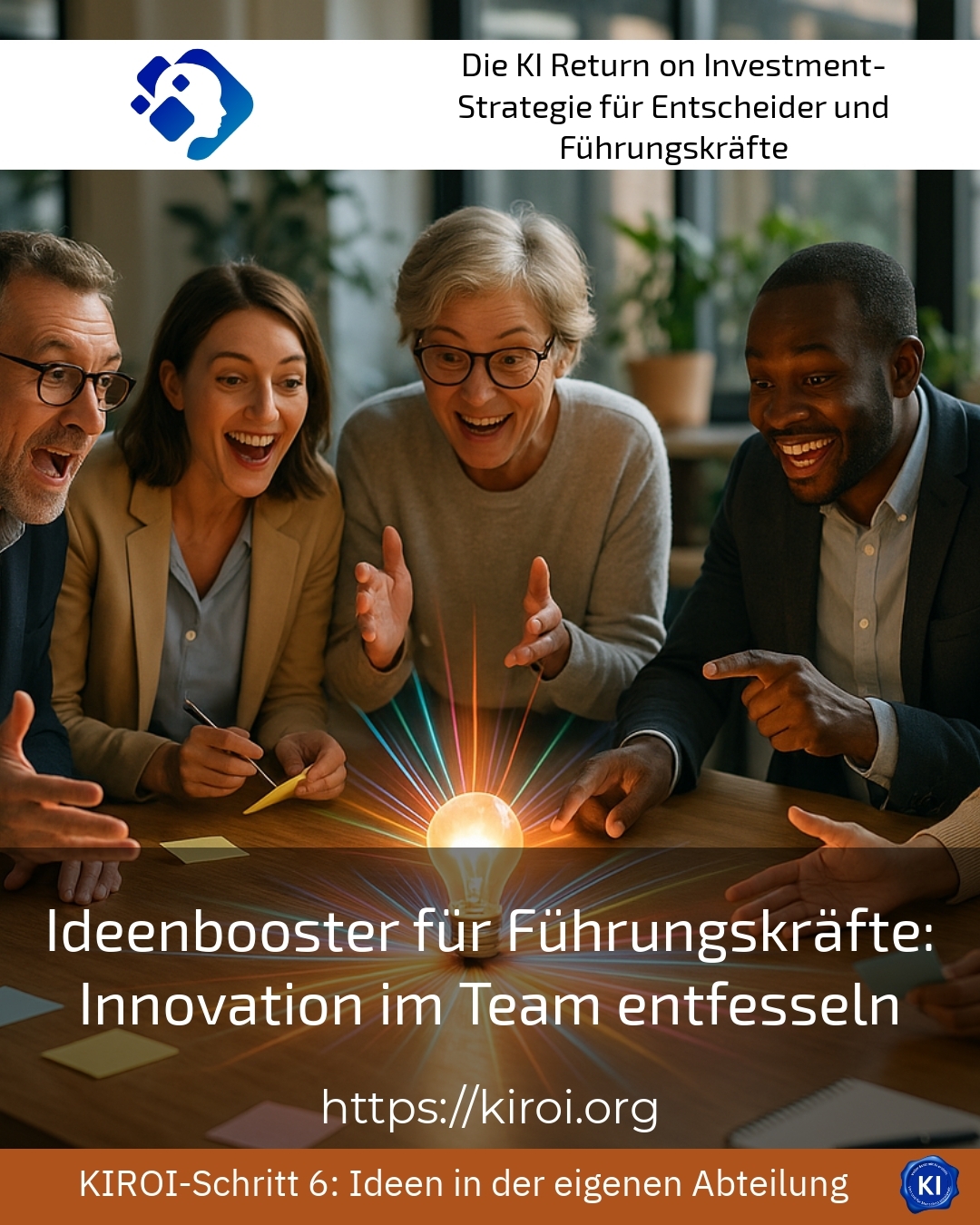
Imagine your team developing groundbreaking concepts within weeks, concepts that revolutionise your entire department. An idea booster for leaders can make exactly that difference. It unleashes hidden potential and fundamentally transforms daily work. Many decision-makers come for coaching with similar challenges. They report on stagnating creativity and stuck thought patterns, while simultaneously seeking ways to re-inspire their employees. The good news is encouraging: proven methods exist to systematically increase innovation power. These impulses don't just change individual projects; they shape the entire corporate culture positively and sustainably.
Why classic brainstorming methods often reach their limits
Traditional creativity techniques are no longer sufficient in many cases. The world of work has fundamentally changed. Hybrid teams collaborate across different time zones. Digital communication is increasingly replacing personal interaction. Therefore, modern leaders need tailored strategies for their specific situations. A production manager at a medium-sized mechanical engineering company recently shared his experiences. His weekly brainstorming sessions were yielding hardly any usable results. Employees were repeating familiar suggestions without genuine enthusiasm. Similar patterns are observed across logistics service providers and retail companies alike. The cause often lies in unconscious hierarchical barriers and established mental blocks.
Transruptions-Coaching helps leaders identify these invisible obstacles. The focus is on creating psychological safety within the team. Bold ideas only emerge when employees can speak openly without fear of criticism. An example from the automotive supply industry impressively illustrates this connection. Following a targeted intervention, production employees began to directly submit suggestions for improvement. Previously, they had held back their thoughts for fear of negative reactions. Within three months, the number of implemented optimisations increased by more than sixty percent.
Best practice with a AIROI customer
A leading food processing company approached us with a specific concern. The management had observed a declining willingness to innovate in product development for some time. New recipes and packaging concepts were progressing only slowly, even though the market urgently demanded fresh ideas. As part of the transruption coaching, we first analysed the existing communication structures between the development, production, and marketing departments. An interesting pattern emerged, as the creative minds felt constrained and blocked by administrative requirements. We then implemented a system of weekly short sprints where interdisciplinary teams worked on specific issues. The results positively and lastingly surprised even the most sceptical participants. Within six months, four market-ready product concepts were developed, which significantly increased sales of the new products. Particularly noteworthy was the increased motivation of the employees, who finally felt heard and valued.
The idea booster for managers as a strategic tool
An effective idea booster for leaders goes far beyond spontaneous creative exercises. It combines systematic methodology with individual adaptation to company culture. The foundation for this is a deep understanding of specific industry dynamics. In the pharmaceutical industry, for example, different framework conditions apply than in retail. Regulatory requirements significantly influence the scope for innovative approaches there. Nevertheless, universal principles exist that can be effective across industries.
The psychological attitude A leader plays a crucial role. Those who remain open to unconventional thoughts automatically inspire the entire team. The managing director of a construction company trialled this approach with impressive results [1]. He began to deliberately ask naive questions in meetings. These seemingly simple prompts triggered profound discussions about established processes. Subsequently, employees also dared to question ostensibly self-evident procedures. The consequence was significant efficiency improvements on several construction projects simultaneously.
In the financial services sector, similar patterns and developments are emerging. Banks and insurance companies are under enormous pressure to transform due to digital competitors. Executives from this sector often report difficulties in generating ideas. The heavily regulated environment initially seems to hinder creativity. However, this very framework offers interesting opportunities for systematic innovation work. Clear boundaries paradoxically often lead to particularly creative solutions.
Practical methods for the idea booster for managers
The Reverse perspective represents a particularly effective technique. Teams consider their challenges from the perspective of competitors or customers. A manufacturer of industrial electronics used this approach for its product development. The engineers put themselves in the position of a start-up. They asked themselves how an agile company would attack their own solutions. This exercise revealed several weaknesses in the existing portfolio. At the same time, innovative concepts for future product generations emerged.
The Temporal distancing also offers valuable impulses for idea generation. In this approach, teams project their situation five or ten years into the future. An energy provider successfully applied this method during a strategy workshop. The participants developed scenarios for a fully decarbonised energy supply. From this future perspective, they formulated the necessary development steps backwards. The result was a concrete innovation roadmap with measurable milestones.
The Inspiration from outside the industry This rounds off the methodological repertoire effectively. In doing so, teams systematically analyse successful concepts from entirely different economic sectors. One industrial cleaning provider drew inspiration from the hotel industry. Service standards and customer communication were fundamentally revised. Employees received training in customer-oriented communication and proactive service. Customer satisfaction increased measurably and significantly within a year.
The role of corporate culture in sustainable innovation
Individual methods only reach their full potential in a supportive environment. Company culture forms the foundation for lasting readiness to innovate. For this reason, Transruption Coaching supports organisations holistically in cultural change processes. Concrete behavioural changes are the focus of the collaborative work. In practice, abstract guiding principles alone bring about little sustainable transformation.
An example from the textile industry illustrates this connection vividly. A traditional family business was struggling with declining market shares among younger target groups. The product range appeared increasingly stale and out of touch with the times. As part of our support, we identified deeply ingrained beliefs about the company's own brand. These beliefs prevented bold experiments with new designs and sales channels. Through targeted interventions at various hierarchical levels, a gradual opening was achieved. The company successfully launched a collection for direct online sales.
Best practice with a AIROI customer
A medium-sized medical technology manufacturer sought support with an ambitious innovation project. The company wanted to fundamentally realign and accelerate its product development. Previous development cycles took several years and consumed significant resources. In transruption coaching, we initially focused intensely on the mindset of the management personnel involved. Many of them had unconsciously internalised a perfectionist basic attitude, which prevented rapid iterations. We established the concept of controlled experiments as a new working method. Teams were given permission to go to market early with imperfect prototypes. Regulatory requirements were, of course, fully complied with and respected throughout. The result convinced everyone involved, as the time to market was significantly reduced. At the same time, the quality of the final products noticeably increased due to early customer feedback. Employees reported a renewed joy in their work and increased motivation.
Unleashing innovation in the team through structured free time
Paradoxically, creativity often requires clear structures and defined parameters. Absolute freedom can overwhelm many people and lead to a lack of direction. Therefore, establishing targeted innovation formats with fixed rules is recommended. A chemical company introduced weekly innovation hours for all employees. During this time, only ideas outside of day-to-day operations were permitted for discussion. The clear temporal boundaries significantly increased concentration and productivity.
A logistics service provider took a similar path with an adapted format. Here, so-called innovation tandems were formed from employees from different departments. Two people from different departments regularly exchanged perspectives. This simple measure promoted knowledge transfer and generated surprising connections. A tandem pair from dispatch and customer service jointly developed an app feature. This significantly and sustainably improved shipment tracking for business customers.
Exciting developments and approaches are also emerging in the tourism industry. Hotels and tour operators are increasingly experimenting with employee initiatives for service innovation. One hotel chain established an internal ideas competition with attractive incentives. The best suggestions were piloted within three months. The winning idea fundamentally and measurably improved the guest check-in experience.
Overcoming obstacles and embedding sustainable change
The path to an innovation-friendly organisation is rarely straightforward. Setbacks and resistance are a normal part of change processes. Transruption coaching constructively supports leaders through these challenging phases. The focus is on building resilience and perseverance. Many innovation initiatives fail not due to a lack of ideas [2]. They fail due to a lack of consistency in implementation and follow-up.
A mechanical engineering company experienced precisely this challenge in practice. After a promising start, the innovation programme lost momentum and attention. The operational rush of day-to-day business increasingly overshadowed strategic issues. In coaching, we developed a system for continuously visualising progress. Small successes were regularly communicated and celebrated together. This measure reactivated motivation and led to new dynamism.
Integrating innovation routines into existing processes increases sustainability. An insurance company cleverly linked idea generation with regular team discussions. Each monthly meeting included a fixed agenda item for improvement suggestions. This embedding in daily operations successfully prevented the initiative from stagnating.
My AIROI Analysis
The support of numerous organisations on innovation projects reveals recurring patterns and insights. Successful leaders understand innovation as a continuous process rather than a one-off event. They create space for experimentation and accept controlled failure as a learning opportunity. The idea booster for leaders is most effective when combined with cultural change. Methods alone are not sufficient if the fundamental attitude within the company is not right.
The AIROI methodology offers a structured framework for this transformation. It systematically combines strategic objective setting with operational implementation support. Working on multiple levels simultaneously proves particularly effective. Leadership development, team development, and process optimisation are interconnected in this process. Experience shows that sustainable results typically become visible after six to twelve months. Quick successes are possible, but profound cultural changes require patience and perseverance.
Transruptions Coaching supports organisations in finding their individual path. There is no universal solution that fits all companies equally. The art lies in adapting proven principles to the specific situation. Clients frequently report surprising side effects of innovation work. Collaboration between departments improves, and employee satisfaction rises. These positive effects, in turn, reinforce innovation capacity in a virtuous cycle.
Further links from the text above:
[1] Harvard Business Review – Innovation Management Insights
[2] McKinsey – The Eight Essentials of Innovation
For more information and if you have any questions, please contact Contact us or read more blog posts on the topic Artificial intelligence here.









 Deutsch
  English (UK)