
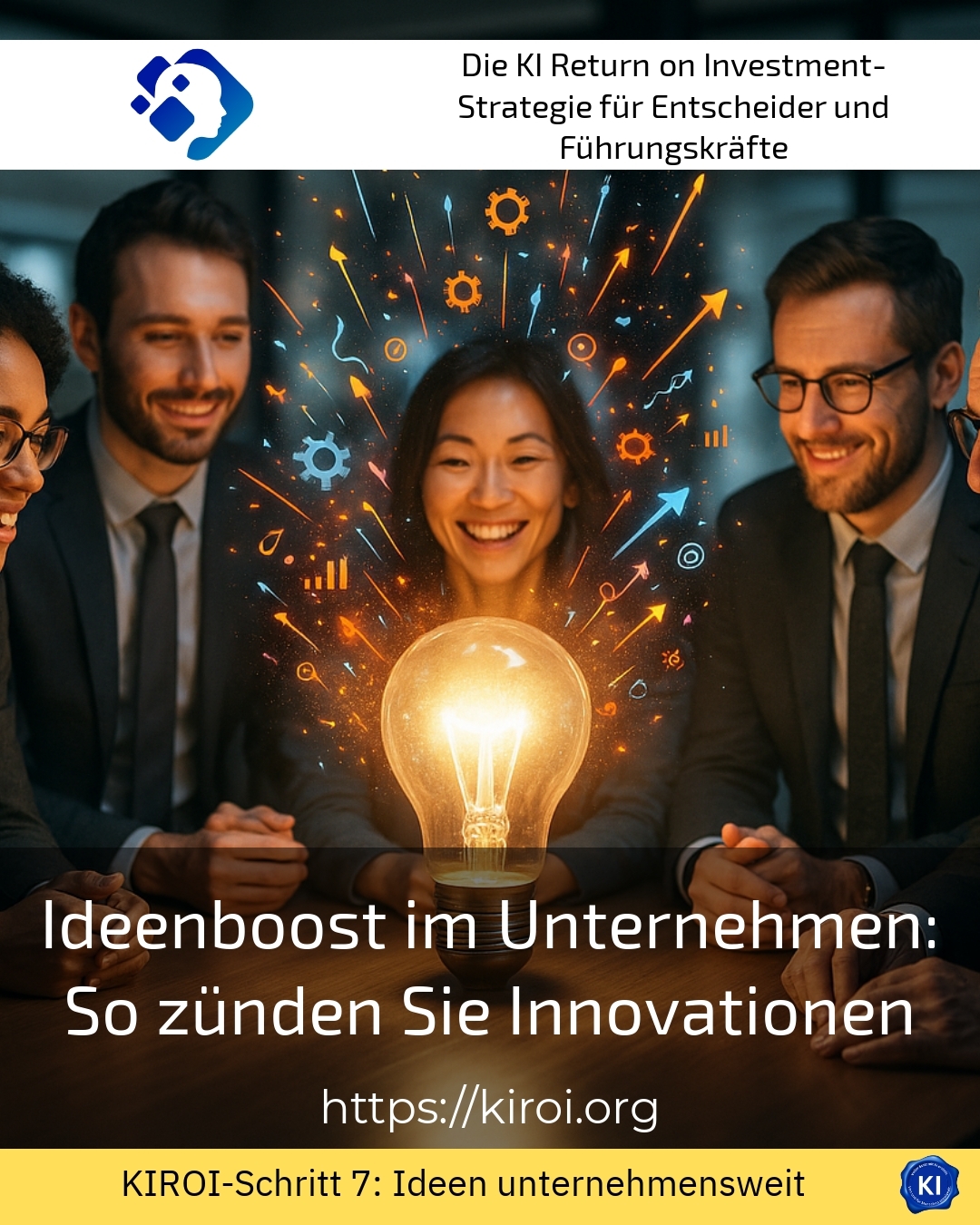
Imagine your employees brimming with creative ideas. They develop groundbreaking solutions and drive your company forward. Does that sound like a distant dream? A targeted Idea boost in the company can make this exact scenario a reality. Many managers massively underestimate the creative potential of their teams. They overlook the hidden treasures in the minds of their workforce. Organisational future viability lies in the ability for continuous renewal. Clients often report stagnating development and a lack of enthusiasm. They are looking for ways to inject fresh impetus. This is precisely where well-thought-out support from transruption coaching comes in.
Why the idea boost in companies is more important today than ever
The business world is changing at a breathtaking pace. Markets are shifting and customer demands are constantly evolving. Businesses must therefore remain agile and adaptable. A structured approach to idea generation supports organisations in remaining competitive. This is not just about individual flashes of inspiration. Rather, a systematic process is paramount. This process fosters creative thinking at all levels of the hierarchy. This creates a culture of continuous improvement.
This is particularly evident in the manufacturing industry.
The invisible barriers to creative development
Many organisations struggle with invisible obstacles. These sustainably block the free flow of ideas. Hierarchical structures often nip creative impulses in the bud. Employees don't dare to voice unconventional thoughts. They fear negative evaluations from superiors or colleagues. This fear of failure paralyses entire departments. Furthermore, there is often a lack of time for creative thinking. Everyday routines consume all available resources.
A logistics company recognised this problem and acted decisively. It introduced protected spaces for undisturbed brainstorming. The management deliberately refrained from being present. This allowed employees to experiment and think outside the box freely. A financial services provider took a similar approach. It established anonymous idea platforms for all employees. This significantly lowered the inhibition threshold for unusual suggestions. A retail company, in turn, explicitly rewarded even failed experiments. This culture of psychological safety unleashed unknown potential.
Best practice with a KIROI customer
A medium-sized company in the technical services sector approached us with a specific concern. Management reported a growing lack of ideas within their teams. Although the employees were highly qualified in their respective fields, new developments had stagnated for months. As part of comprehensive support through transruption coaching, we first analysed the existing communication structures. We discovered that valuable impulses were regularly getting lost in hierarchical layers. Together, we developed a multi-stage programme for idea promotion. This included both digital platforms and regular face-to-face workshops. Employees were allocated dedicated time slots for creative work. Managers were trained in a culture of appreciative feedback. After six months of support, the company recorded a threefold increase in submitted suggestions for improvement. Three of these had already resulted in concrete product extensions. Employee satisfaction increased measurably. Of particular value was the newfound openness in dealing with unconventional ideas.
Methods for a Sustainable Idea Boost in the Company
Numerous proven methods exist for stimulating creative processes. These can be adapted to different business contexts. Design Thinking is one of the best-known approaches worldwide [1]. This method consistently places the user at the centre of all considerations. User-centred solutions emerge through iterative loops. Brainstorming sessions often mark the start of creative work. They allow for free association without premature evaluation. Edward de Bono's Six Thinking Hats method structures discussions productively.
A software company implemented weekly hackathons for all its teams, which led to the creation of innovative features for existing products. A pharmaceutical company used the SCAMPER method for product development [2]. With this technique, they combined known active ingredients in new ways. An energy provider introduced interdisciplinary innovation circles, where employees from various departments developed sustainable business models.
Digital tools as catalysts for an idea boost
Modern technologies can significantly support creative processes. Digital collaboration platforms enable cross-location teamwork. Idea management systems systematically collect and evaluate suggestions. Artificial intelligence can help to recognise patterns in idea pools. It identifies promising approaches for further development. Virtual whiteboards allow simultaneous work on complex issues. Mind-mapping tools visualise connections and promote associative thinking.
An insurance company implemented a company-wide ideas platform. All employees could submit and rate suggestions there. The best ideas received budget for prototype development. A telecommunications provider used AI-supported analysis of its idea database. This allowed them to identify recurring themes with high potential. A construction company introduced virtual innovation spaces. Teams from different countries collaborated on projects there.
The Role of Leadership in Fostering Creativity
Leaders play a crucial role in fostering creative cultures. They set the framework for experimental work. Their attitude determines whether employees are willing to take risks. Appreciative communication forms the foundation of successful idea generation. Leaders must actively listen and show interest. They should also seriously consider unusual suggestions. Quick rejection poisons the creative climate in the long term.
A media company trained its executives in creative leadership. They learned to ask questions rather than dictate answers. A technology group consistently established the principle of tolerance for failure. Failed experiments were celebrated as learning opportunities there. A consulting firm introduced rotating leadership roles within project teams. This allowed every team member to develop their leadership skills.
Best practice with a KIROI customer
An established company in the consumer goods sector was looking for ways to rejuvenate its product range. The leadership recognised that traditional development processes had become too slow. As part of our collaboration, we guided a profound cultural shift. Initially, we conducted interviews with employees at all hierarchical levels. This revealed significant communication barriers between departments. We developed a cross-functional innovation programme with clear structures. Marketing, production, and sales worked together on product ideas for the first time. The accompanying transruptions coaching also included intensive leadership development. Managers learned to view their teams as creative partners. They practised active listening and constructive feedback. The result significantly exceeded all expectations. Within a year, several market-ready product concepts were developed. Time-to-market was reduced by more than thirty percent. Particularly noteworthy was the increased motivation of the employees. For the first time, they felt truly heard and valued.
Creating structures for continuous renewal
One-off creative workshops are not enough for sustainable change. Organisations need lasting structures for idea generation. Regular formats embed creative thinking into everyday business life. Dedicated innovation budgets enable the implementation of promising ideas. Clear processes for idea evaluation create transparency and trust. Employees must understand what happens to their suggestions. Quick feedback increases motivation for further participation.
A manufacturing company established a standalone innovation department. This department supported promising ideas from conception to implementation. A healthcare provider introduced monthly innovation days. On these days, all employees worked exclusively on improvement ideas. A retailer implemented a reward system for implemented suggestions. The bonuses were linked to the economic benefit.
Overcoming obstacles and transforming resistance
Every change generates resistance within organisations. This is natural and should be taken seriously. Some employees fear an increased workload due to creative processes. Others fundamentally doubt the benefit of unconventional methods. Managers sometimes worry about a loss of control over their teams. These concerns require sensitive communication and patient persuasion. Positive experiences and visible successes reduce resistance most effectively.
A transport logistics specialist started with voluntary pilot projects in individual teams. The positive results convinced sceptical colleagues. A hotel group integrated creative time into existing workflows. This meant there was no feeling of additional burden. A manufacturing company systematically documented the return on innovation. The clear figures also convinced critical voices in management.
Diversity as a driver for the company's idea boost
Heterogeneous teams demonstrably generate more and better ideas [3]. Different perspectives enrich discussions and broaden thinking spaces. Age, gender, cultural background, and field of expertise play a role in this. Different personality types also complement each other productively. Introverted individuals often contribute well-thought-out concepts. Extroverted team members drive discussions forward. The art lies in moderating this diversity.
A technology company deliberately focused on age-diverse innovation teams. There, experience and fresh perspectives combined fruitfully. An architecture firm integrated clients directly into development processes. Their everyday experiences inspired completely new design approaches. A food manufacturer invited start-ups to joint workshops. The different company cultures mutually enriched each other.
Best practice with a KIROI customer
An international bank faced the challenge of modernising its digital services. The existing development teams worked in isolation, within their own silos. Innovative approaches were becoming scarce, and competitiveness was declining. As part of our support, we first thoroughly analysed the team compositions. We found that important perspectives were missing from decision-making processes. Together, we developed a programme to foster interdisciplinary collaboration. Employees from IT, sales, compliance, and customer service worked in mixed teams. The support provided through transruptive coaching included intensive team development measures. We trained facilitators for diverse groups. Conflicts were understood as productive friction and resolved constructively. After eight months, the teams presented several innovative service concepts. Two of these are already in the pilot phase with selected customers. The quality of the ideas had measurably improved. The speed of implementation also increased significantly.
My KIROI Analysis
The ability to renew continuously is key to the long-term success of companies. It is repeatedly shown that technical solutions alone are not enough. The human factor remains central to successful creative work. Employees must feel psychologically safe in order to voice innovative ideas. Leaders bear a particular responsibility for the working atmosphere. They must create spaces where experimentation is permitted and encouraged. Structured processes support the systematic generation and evaluation of ideas. Digital tools can significantly accelerate these processes. However, they do not replace personal exchange and human creativity. Guidance from experienced coaches can provide valuable impetus. Transruptions-Coaching offers a proven framework for change processes. Organisations benefit from an external perspective and methodical expertise. The long-term perspective in innovation projects seems particularly important to me. Short-term programmes often fizzle out without sustainable impact. Only the permanent integration of creative practices leads to genuine cultural change. Diversity in teams proves to be a decisive success factor. Different perspectives enrich discussions and expand solution spaces. Investing in an innovation culture pays off many times over in the long run.
Further links from the text above:
[1] IDEO Design Thinking Methodology
[2] MindTools – SCAMPER Technique
[3] Harvard Business Review – Diversity and Inclusion
For more information and if you have any questions, please contact Contact us or read more blog posts on the topic Artificial intelligence here.











 Deutsch
  English (UK)