
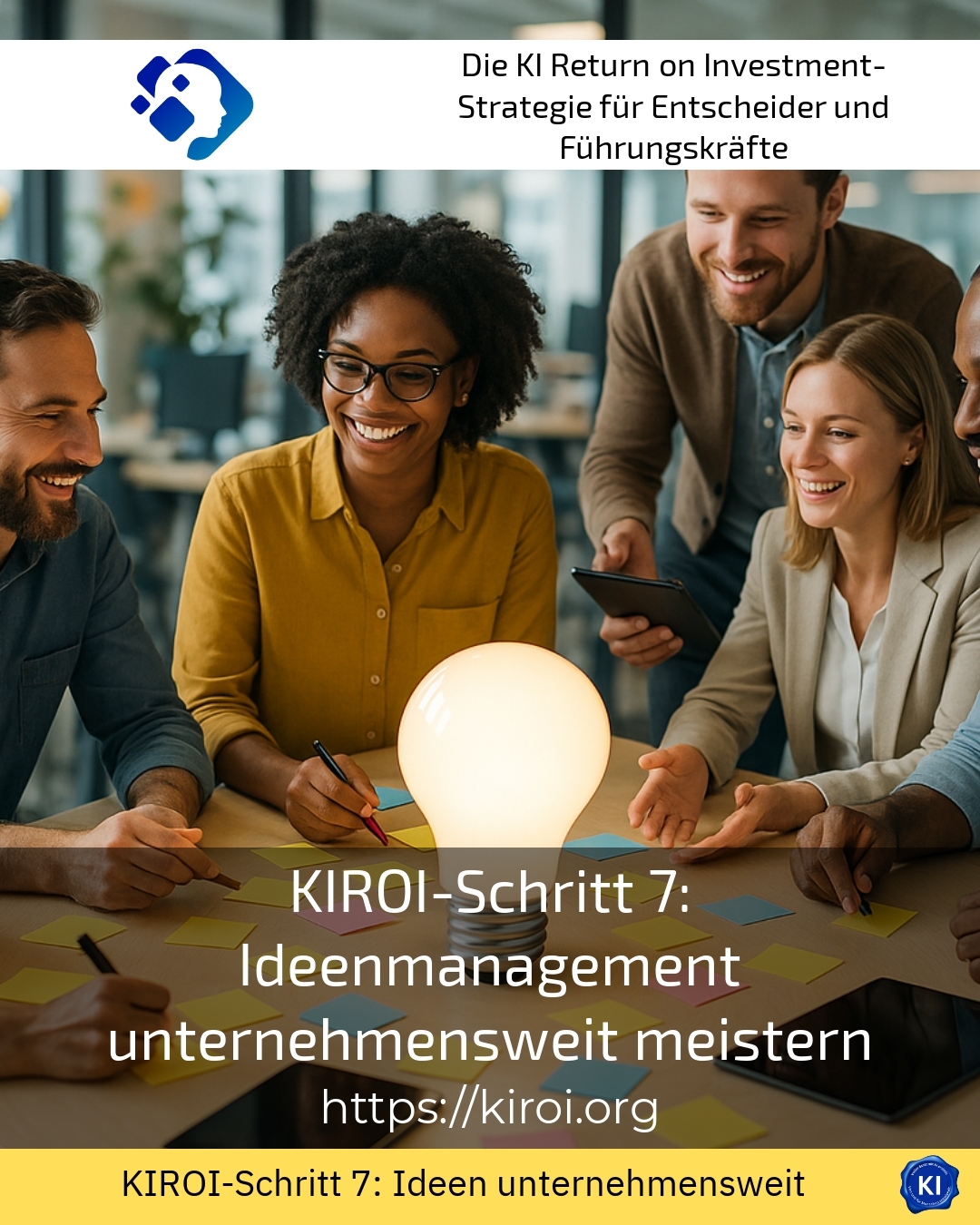
Modern companies face the challenge of systematically capturing and sustainably implementing creative impulses. This is where ideas management comes into play. It is more than just collecting suggestions. It is about a continuous process that actively involves employees and promotes innovation across the company. Step 7 of KIROI, in particular, provides important impulses here. It supports organisations in not viewing ideas in isolation, but in anchoring them as a firm component of the company culture.
Ideas management as a continuous support process
Many companies are finding that simply collecting ideas isn't enough. There's often a lack of a sustainable culture that keeps suggestions alive and evolving. Ideas management is therefore understood as a dynamic, ongoing process. It ensures a continuous exchange and accompanies ideas through all phases – from submission to implementation.
In the automotive industry, regularly moderated workshops demonstrate how ideas for improving manufacturing efficiency can be quickly transformed into profitable solutions. Here, teams benefit from the guidance of experts who clear communication blockages and open up new perspectives. In the financial services sector, this approach helps to successfully integrate customer process improvement suggestions into agile development teams, thereby increasing customer satisfaction. Similarly, a large retail group uses a digital exchange platform to transparently pool suggestions from numerous branches, thus quickly communicating and implementing regional innovations company-wide.
Ideas management in practice: examples from the industry
In mechanical engineering, moderated innovation workshops regularly lead to ideas from different areas coming together and new synergies emerging. This allows product innovations to reach production more quickly. Software development companies strengthen collaboration and improve the quality of new features by actively involving development teams. At the same time, retail companies use digital platforms, through which employees from different branches can transparently exchange and implement ideas.
A software developer integrated feedback loops to implement customer wishes into product features. These are practical examples that show how flexible and dynamic idea management can be. Clients often report that they achieve hardly any peak performance with classic idea management, because the best impulses often lie dormant in other specialist areas.
Ideas management and transruption coaching
Transruptions-Coaching helps teams identify blocks, develop new perspectives, and take concrete steps towards implementation. It supports organisations in establishing an innovation culture that involves all levels of the company. Guidance from experienced coaches is crucial for sustainable success.
In industrial manufacturing, targeted, moderated workshops were used to systematically identify obstacles to the implementation of promising ideas. This resulted in accelerated implementation of innovation projects and more intensive exchange between departments, which sustainably strengthened innovative capacity.
BEST PRACTICE with one customer (name hidden due to NDA contract) In the area of industrial production, step 7 was used to systematically identify obstacles to the realisation of promising ideas. The obstacles were removed through moderated workshops. This resulted in an accelerated realisation of innovation projects and a more intensive exchange between the specialist departments, which sustainably strengthened the innovative power.
Idea management as a corporate strategy
Many companies today recognise that simply collecting suggestions is not enough. Idea management needs more: a holistic process that involves all employees. KIROI Step 7 therefore focuses on company-wide implementation and continuous support of idea processes. A key approach is to remove obstacles and enable transparent dialogue. This makes employees feel taken seriously and actively promotes their company's innovative strength.
For example, a digital platform in a retail company ensures that suggestions become visible quickly and all branches learn from each other. In industrial manufacturing, moderated innovation workshops regularly bring together ideas from different areas, creating new synergies. A software developer integrated feedback loops to implement customer wishes into product features. These are practical examples showing how flexibly and dynamically ideas management can be designed.
My analysis
Ideas management is a crucial success factor for companies today that want to remain continuously innovative and assert themselves in the competitive landscape. It is more than just collecting suggestions. It is about a dynamic process that promotes an open communication culture and breaks down barriers within the company. KIROI Step 7 focuses precisely on this: with targeted measures, ideas management is effectively unleashed throughout the company. Support from experienced coaches is crucial for sustainable success.
Further links from the text above:
Idea Management 2.0: KIROI Step 7 for Company-Wide Innovation
Rethinking idea management: KIROI Step 7 for your business
Rethinking Idea Management: KIROI Step 7 for Businesses
Rethinking Idea Management: KIROI Step 7 for Businesses
Unleashing Idea Management: KIROI Step 7 for Businesses
For more information and if you have any questions, please contact Contact us or read more blog posts on the topic Artificial intelligence here.











 Deutsch
  English (UK)