
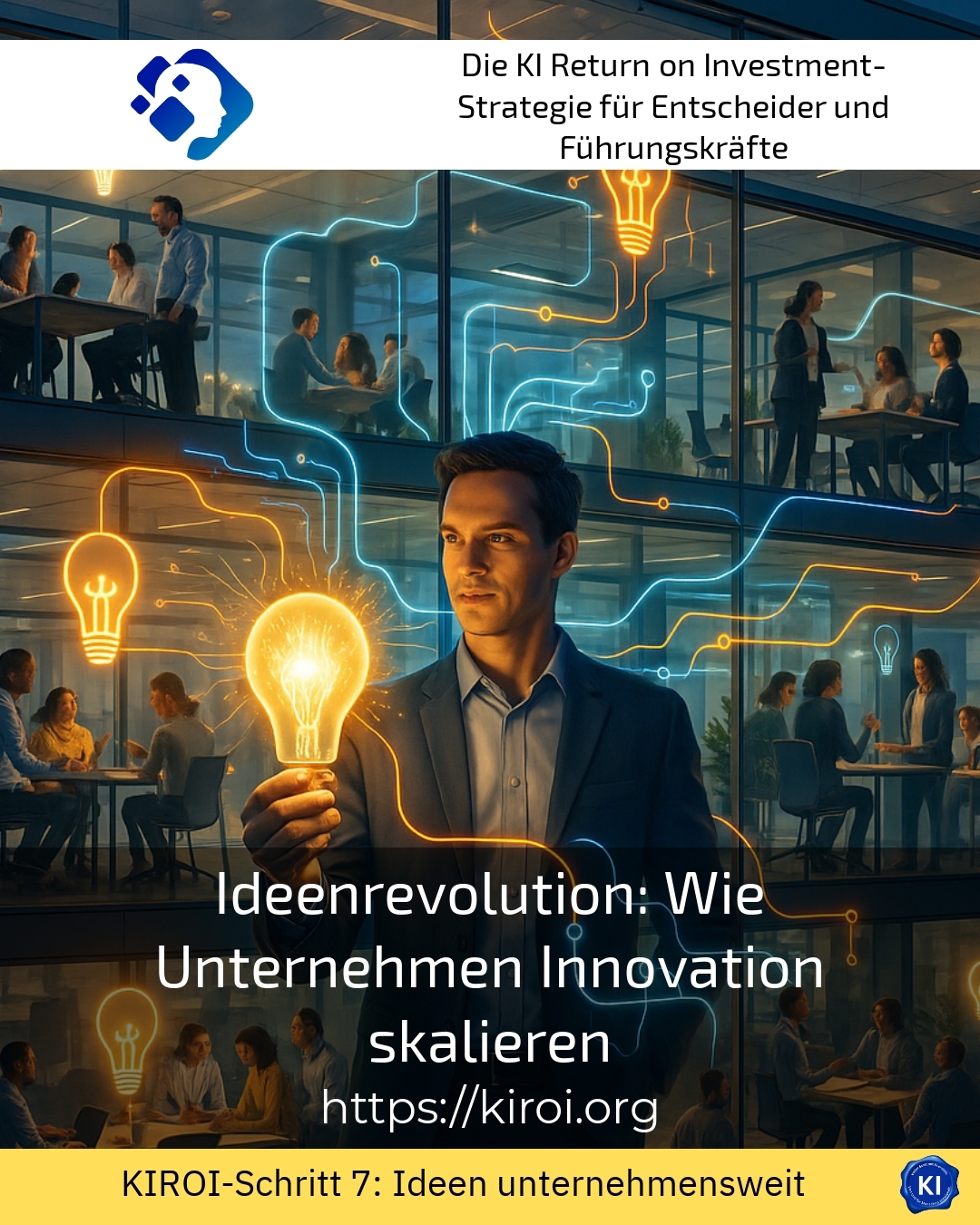
Imagine a single, game-changing idea fundamentally transforming a company's entire business model. This is precisely what happens daily in organisations that have understood how to systematically unleash creative potential. Idea Revolution: How Companies Scale Innovation This sits at the heart of modern competitive strategies. But how do you make the leap from isolated flashes of inspiration to a company-wide culture of innovation? Many leaders are seeking answers to this central question. They come with a desire for transformation and growth. At the same time, they feel the uncertainty of profound change. This is precisely where professional support comes in, providing impetus and supporting development processes.
The Foundations of the Idea Revolution: How Companies Learn to Scale Innovation
Innovation rarely arises in a vacuum or through divine inspiration from solitary geniuses in secluded laboratories. Instead, it requires a fertile ecosystem that nurtures creativity while simultaneously channelling it in a structured way. Organisations that master this balancing act create sustainable competitive advantages for themselves and their stakeholders. The first step is to critically question one's own thought patterns and let go of old certainties.
For example, a medium-sized mechanical engineering company realised that its engineers were developing brilliant technical solutions. However, these ideas never reached market readiness because of communication barriers between departments. This situation only fundamentally changed with the introduction of cross-functional teams. A logistics company experienced something similar when it discovered its drivers were an underestimated source of innovation. These employees knew the daily challenges of the last mile better than any market analysis. A financial services provider, in turn, implemented so-called innovation safaris, where employees visited other industries. The insights gained were then incorporated into new product developments and significantly enriched the portfolio.
transruptions-Coaching supports companies with such transformation projects using a holistic approach. Clients often report initial scepticism which then turns into enthusiasm. Experience has shown that external perspectives can break down entrenched structures and open up new ways of thinking.
Best practice with a KIROI customer
A trading company with a long tradition and over 500 employees faced the challenge of increasing its innovation capacity. Management had recognised that disruptive competitors were changing the market and traditional business models were coming under pressure. As part of the KIROI support, a comprehensive analysis of existing innovation processes was initially carried out. This revealed that valuable ideas often got lost in silos and never reached management. Together, the team developed a digital idea platform that connected all levels of the hierarchy. Employees could submit, comment on, and further develop suggestions, which greatly increased participation. Within six months, over 200 improvement suggestions were submitted and systematically evaluated. Eighteen of these ideas were actually implemented and generated measurable efficiency gains for the company. The realisation that innovative strength lies dormant in all areas of the company proved to be particularly valuable. Managers learned to establish a culture of psychological safety, where mistakes are seen as learning opportunities. This cultural change represented the most sustainable success of the entire project and continues to have an impact today.
To create structures that foster creativity and systematically scale ideas
Creativity needs scope, but equally clear structures that turn ideas into concrete results. This apparent contradiction is resolved when companies establish and consistently maintain the right framework. Both physical spaces and mental freedom play a crucial role in success.
A technology group completely redesigned its office space, creating what are known as collaboration zones [1]. These areas encourage chance encounters between employees from different departments and stimulate spontaneous idea exchange. A consumer goods manufacturer introduced regular hackathons where teams develop prototypes in 48 hours. The best concepts receive budgets for further development and are personally supported by management. An energy provider established an intrapreneurship programme that grants ambitious employees time and resources for their own projects. These internal entrepreneurs have already developed several successful business areas that usefully complement the core business.
The Idea Revolution: How Companies Scale Innovation also requires digital tools to support processes. Modern idea management software enables transparent evaluation processes and prevents suggestions from being forgotten. At the same time, such systems create traceability and motivate further participation through visible progress.
The Role of Leadership in the Ideas Revolution
Leaders significantly shape whether an innovation culture thrives or atrophies, and which behaviours are rewarded. Their role modelling sends powerful signals throughout the organisation and influences the behaviour of all employees. Therefore, every sustainable transformation begins at the top of the company and works its way down from there.
A pharmaceutical company fundamentally changed its leadership development after innovation projects repeatedly failed. The new programmes emphasise coaching competencies and the ability to create and maintain psychological safety. An automotive supplier introduced so-called reverse mentoring programmes, where younger employees coach experienced leaders. This unusual constellation breaks down hierarchies and significantly promotes intergenerational knowledge transfer. An insurance group established a reward system that not only recognises successful innovations but also acknowledges failed experiments. This culture of constructive failure encourages employees to take calculated risks and venture into new territory.
Best practice with a KIROI customer
An international corporate group, with a focus on the service sector, approached KIROI with a specific concern. Executives felt overwhelmed by the pace of technological change and sought guidance. Together, a bespoke development programme was designed, linking technological expertise with leadership excellence. In monthly workshops, participants developed concrete strategies for their respective business areas and implemented them. The peer-learning approach, where leaders learned from and inspired one another, proved particularly valuable. Participants developed a shared understanding of what innovation means and requires in their specific contexts. They identified barriers that had previously hindered progress and developed solutions to overcome these obstacles. Upon completion of the programme, executives implemented their own innovation initiatives within their departments, multiplying what they had learned. Management observed a distinct cultural shift, manifesting in increased willingness to experiment and higher employee satisfaction. This change was the result of consistent support, which provided impetus and facilitated development processes.
Technology as a catalyst for scalable innovation
Digital technologies open up entirely new possibilities for accelerating and scaling innovation processes. Artificial intelligence For example, it can recognise patterns in large datasets that remain hidden from human analysts. These insights form the basis for data-driven innovations that precisely address customer needs.
A retail company uses machine learning to identify trends early and adjust its product range accordingly [3]. The algorithms analyse search queries, social media posts, and sales data in real-time and generate actionable recommendations. A media group uses generative AI to develop and test prototypes for new content formats more quickly. The technology does not replace creative employees but rather expands their capabilities and significantly accelerates iterative processes. A construction company implemented Building Information Modelling, which links virtual building models with real-time data and revolutionised planning processes.
Simultaneously, transruptions-coaching urges caution against the unthinking use of technology and exaggerated expectations. Not every innovation requires complex technical solutions, and sometimes the answer lies in simpler approaches. The art lies in finding the right balance between technological possibility and practical benefit.
Ideas Revolution: How Companies Scale Innovation Through Networking
No single organisation possesses all the competencies required for groundbreaking innovations that create sustainable competitive advantages. Therefore, collaborations, partnerships and open innovation models are becoming increasingly strategically important for forward-thinking companies. Looking beyond one's own horizons broadens perspectives and unlocks previously untapped potential.
A chemical company is cooperating with start-ups that are developing complementary technologies and bringing fresh perspectives. These partnerships significantly accelerate the time-to-market for new products while simultaneously reducing development risks. A telecommunications provider operates an innovation hub that grants founders access to infrastructure and expertise. The resulting synergies benefit both sides and create win-win situations that are sustainable in the long term. A food manufacturer opened its research department to external scientists and universities, thereby expanding its knowledge base. This open innovation strategy led to several patented processes that would not have emerged internally [4].
Best practice with a KIROI customer
A medium-sized manufacturing company recognised the need to fundamentally transform its business model and make it future-proof. Traditional products were losing relevance, while new competitors with digital offerings were changing the market. In the KIROI project, a comprehensive ecosystem analysis was first carried out, identifying potential partners and cooperation opportunities. The company subsequently initiated strategic alliances with a software developer and a data analysis startup from the region. Together, the partners developed a service offering that supplemented and expanded the physical products with digital services. Customers could now monitor usage data in real-time and receive proactive maintenance recommendations, thereby increasing added value. This transformation from product manufacturer to solution provider opened up new revenue streams and sustainably strengthened customer loyalty. The success was based on a careful selection of partners and clear agreements on responsibilities and profit sharing. KIROI accompanied the entire process with regular reflection loops and strategic impulses that set the direction. Management today emphasises that this external perspective was crucial for the success of the transformation.
My KIROI Analysis
Scaling innovation capability is one of the most complex challenges facing companies today. My experience from numerous support projects shows that successful organisations share several factors and consistently nurture them. Firstly, they have a clear vision that provides direction and motivates employees to go above and beyond. This vision is embodied by leadership and conveyed and anchored credibly through consistent action.
Furthermore, successful companies create structures that foster and balance both creativity and execution strength. They invest in the development of their people and recognise that technological innovation without cultural transformation is futile. The willingness to take calculated risks and learn from mistakes clearly distinguishes innovation leaders from laggards.
At the same time, I often observe that companies underestimate the effort involved in and accompanying genuine cultural change. Quick successes are rarely sustainable, and superficial initiatives often generate cynicism among employees. Therefore, I recommend a long-term approach that combines gradual changes with regular reflection and allows for adjustments.
Transruptions coaching can provide valuable impetus for such transformation projects and serve as a sparring partner. The external perspective helps to identify blind spots and break through entrenched patterns that are often overlooked internally. Coaching never replaces internal expertise, but rather complements and enriches it in a constructive way. For leaders embarking on this journey, the first step is often the most difficult and, at the same time, the most important. It requires courage to leave familiar paths and enter new territory that brings uncertainty. However, it is precisely this willingness to change that holds the key to sustainable innovation success and long-term competitiveness.
Further links from the text above:
[1] Harvard Business Review: Insights on Innovation
[2] McKinsey: Perspectives on Innovation
[3] Gartner: Artificial Intelligence Research
[4] WIRED: Innovation Coverage
For more information and if you have any questions, please contact Contact us or read more blog posts on the topic Artificial intelligence here.











 Deutsch
  English (UK)