
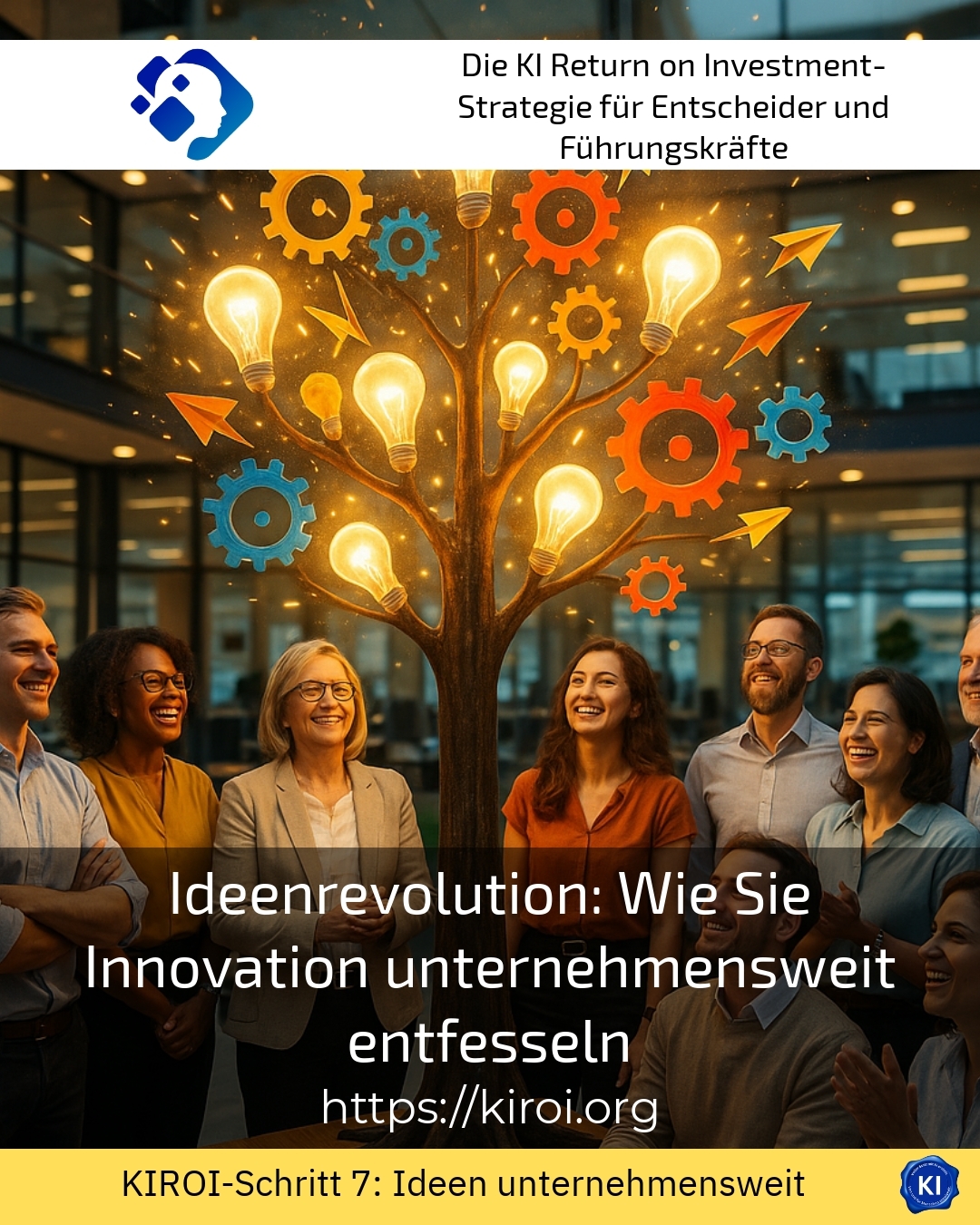
Imagine your company transforming into a living organism, where creative impulses no longer disappear into drawers but spread like wildfire through all departments, triggering real change. Idea Revolution: How to Unleash Innovation Company-Wide begins precisely where traditional structures reach their limits and new ways of thinking become necessary. Many leaders report similar challenges. They experience valuable suggestions from the workforce going unheard. At the same time, pressure to continuously evolve is growing. In this article, you will learn how to systematically unlock creative potential. You will discover proven methods from various industries. And you will learn how transruption coaching can support you in this process.
The hidden sources of creative energy in organisations
Every company possesses untapped creative resources. These often lie dormant in the minds of employees. However, suitable channels for their development are frequently lacking. A medium-sized mechanical engineering firm from Baden-Württemberg recognised this problem some time ago. Management observed that suggestions for improvement were rarely submitted. The cause was not a lack of ideas, but rather the absence of a structured process for capturing them [1]. After introducing a digital platform, submissions increased fivefold. A similar phenomenon was observed at a logistics company in Hamburg. They introduced regular creative workshops, after which employees developed new route optimisations that resulted in significant savings in fuel costs. A retail group also used this insight to its advantage. It installed anonymous feedback boxes in all branches. The suggestions collected measurably improved the customer experience.
The Idea Revolution: How to Unleash Innovation Company-Wide This is precisely where it starts. It first requires identifying existing barriers. This is then followed by their systematic removal. Many organisations underestimate the importance of psychological safety in this process. Employees must feel confident enough to express even unconventional ideas. A pharmaceutical company from Munich created special protected spaces for this purpose. In these so-called safe spaces, different rules applied than in everyday work. Criticism was explicitly encouraged there. This approach led to several patentable developments.
Best practice with a KIROI customer
An internationally operating automotive supplier approached us with a specific challenge. The company had highly qualified engineers in various countries. Nevertheless, groundbreaking product improvements rarely emerged. Analysis revealed several reasons for this situation. Firstly, the different sites barely communicated with each other regarding development topics. Secondly, a standardised system for capturing suggestions for improvement was lacking. Thirdly, incentives for creative engagement beyond everyday work did not exist. As part of the transruption coaching, we supported the management team for several months. Together, we developed a cross-site communication structure. We introduced virtual creative spaces that took place regularly. Furthermore, we implemented a recognition system for particularly valuable contributions. The results exceeded even the most optimistic expectations. Within a year, submitted suggestions increased by over three hundred percent. Several of these ideas led to concrete product improvements. Employee satisfaction in the affected departments also rose significantly. This example impressively shows how structured support can facilitate transformative processes.
Creating structures that foster creative thinking
Creativity doesn't arise in a vacuum; it requires supportive frameworks. Creating these frameworks is the responsibility of company management. A technology group from the Rhine-Main region experimented with various approaches. Initially, they introduced flexible working hours, allowing employees to use part of their time for their own projects. This measure was based on well-known examples from Silicon Valley [2]. The results were remarkable, with several internal startups emerging from this initiative. An insurance company took a different approach, establishing an in-house innovation lab where teams could experiment without the usual budget pressures. A food manufacturer focused on interdisciplinary collaboration, deliberately mixing teams from production, marketing, and sales.
Spatial design plays an underestimated role in this. Open meeting zones promote spontaneous exchange. A media company from Berlin completely redesigned its office spaces. Instead of separate departments, thematic zones were created. Employees from different areas met there. These chance encounters led to unexpected collaborations. A construction company from North Rhine-Westphalia pursued a similar approach. It created mobile workstations on its construction sites. This allowed planners and craftsmen to work more closely together. As a result, the error rate on projects dropped significantly.
The ideas revolution needs courageous leaders
Leaders play a key role in unleashing creative potential. They must be willing to relinquish control. At the same time, they are responsible for fostering a supportive environment. A financial service provider from Frankfurt experienced this challenge firsthand. The management wanted to develop more innovative products, yet shied away from the associated risks. Transruption coaching supported the team through this area of tension. Together, we developed a tiered experimentation system. Small pilot projects could be launched quickly, while larger initiatives continued to go through established review processes. This combination provided security and agility at the same time [3].
A chemical company from Bavaria demonstrated a different leadership approach. The senior executive team participated in creative workshops themselves. They worked as equals alongside junior staff. This gesture had a strong symbolic effect. It signalled that creative thinking is valued at all levels. An energy supplier from the Ruhr area went even further. They introduced rotating leadership roles for innovation projects. This allowed younger employees to gain leadership experience as well. The resulting dynamism surprised even critical voices within management.
How to systematically bring innovation into all areas
True transformation doesn't just encompass research departments. It permeates all areas of a company. A textile manufacturer from Saxony had this experience in an impressive way. Traditionally, creative thinking there focused on design. Production was considered a purely executive area. This perspective changed fundamentally. They began to actively involve production employees in development processes. Their practical knowledge led to significant efficiency improvements. Some suggestions reduced material waste by double-digit percentages [4].
A hospital provider applied similar principles in healthcare. Nurses brought valuable perspectives to organisational matters. Their daily proximity to patients provided unique insights. These were incorporated into improved processes and treatment concepts. A trading company even involved external stakeholders. Customers were invited to brainstorming sessions. Suppliers contributed their expertise in joint workshops. This broadened perspective opened up entirely new possibilities.
Best practice with a KIROI customer
A medium-sized software company sought our support in driving a comprehensive cultural transformation. The company was technically successful but struggled with a backlog of innovation. New product ideas took too long to reach market maturity, and employees felt trapped by rigid processes. As part of our collaborative work, we initially analysed existing structures and identified several bottlenecks in the decision-making process. We also found that valuable expertise remained untapped. Together with the leadership team, we developed a new approach, establishing so-called innovation sprints that ran parallel to daily business. These sprints had clear timelines and defined resources, enabling teams to quickly prototype and test ideas. Managers learned to let go and to trust, receiving regular coaching to support this process. After about six months, the first visible successes emerged. The time-to-market for new features significantly decreased, and employees reported increased motivation and satisfaction. The company was able to tap into several new customer segments. This transformation likely would not have occurred without continuous support.
Measurable successes through structured creativity promotion
Creative initiatives must be measured by their results. A Stuttgart-based car manufacturer developed its own key performance indicators for this purpose. It not only recorded the number of suggestions submitted but also documented their implementation rate and economic benefit. This transparency fostered employee engagement [5]. A telecommunications provider used similar metrics for its innovation programme. This allowed them to identify and expand successful measures, while less effective approaches were adjusted accordingly. A consumer goods manufacturer linked creative engagement with its remuneration system. Particularly valuable contributions received financial recognition. This combination of creativity and appreciation proved to be extremely motivating.
The Idea Revolution: How to Unleash Innovation Company-Wide requires long-term thinking. Quick successes are possible, but sustainable change takes time. A mechanical engineering company from Thuringia experienced this impressively. The first few months showed little visible change. Management was tempted to discontinue the programme. Transruption coaching helped preserve perspective. After about a year, significant improvements then occurred. Patience had paid off.
Overcoming obstacles and using resistance productively
Not every transformation process goes smoothly. Resistance is normal and can even be valuable. A publishing house in Hamburg experienced this during its digital transformation. Employees with traditional orientations initially voiced concerns. These critical voices were taken seriously and included. Their objections led to important adjustments in the approach. The final result was therefore more robust than originally planned. A production company from the Black Forest experienced similar dynamics. The introduction of new creative processes met with scepticism. Time was taken for dialogue and explanation. Sceptics became ambassadors for change [6].
Clients often report initial doubts within their teams. These doubts are understandable and justified. People protect themselves from changes they don't understand. Open communication can alleviate these fears. An electronics manufacturer from Dresden opted for regular information events. Both progress and challenges were discussed equally. This transparency built trust and acceptance. A service company from Cologne chose a more personal approach. Managers held one-on-one conversations with sceptical employees. They listened to their concerns and sought solutions together.
My KIROI Analysis
The systematic promotion of creative potential presents companies with complex challenges. Our experience from numerous support projects reveals clear patterns. Successful transformations are based on several pillars simultaneously. Structural changes alone are not enough. They must be accompanied by cultural change. Leaders play a central role as role models and enablers. At the same time, creative engagement must not become an additional burden. It must be integrated into everyday work. Measuring success helps to make progress visible. However, it must not become an end in itself. People need space to be truly creative. Overly strict guidelines stifle exactly what they are supposed to promote.
Our KIROI methodology takes these diverse factors into account. It offers a framework for sustainable change, while remaining flexible enough for individual adjustments. Every company has its own history and culture, which must be respected and included. Transruption coaching supports organisations on this path with impetus and reflection. We do not dictate ready-made solutions, but rather support individual insight processes. Experience shows that this approach delivers more sustainable results. People implement changes more committedly when they have co-developed them themselves. Idea Revolution: How to Unleash Innovation Company-Wide It is not a one-off project. It is a continuous journey that never truly ends.
Further links from the text above:
[1] Harvard Business Review – Innovation Management
[2] McKinsey – Insights on Corporate Innovation
[3] Forbes – Innovation Section
[4] MIT Sloan Management Review – Innovation Topics
[5] Boston Consulting Group – Innovation Strategy
[6] Gartner – Innovation Strategy Research
For more information and if you have any questions, please contact Contact us or read more blog posts on the topic Artificial intelligence here.











 Deutsch
  English (UK)