
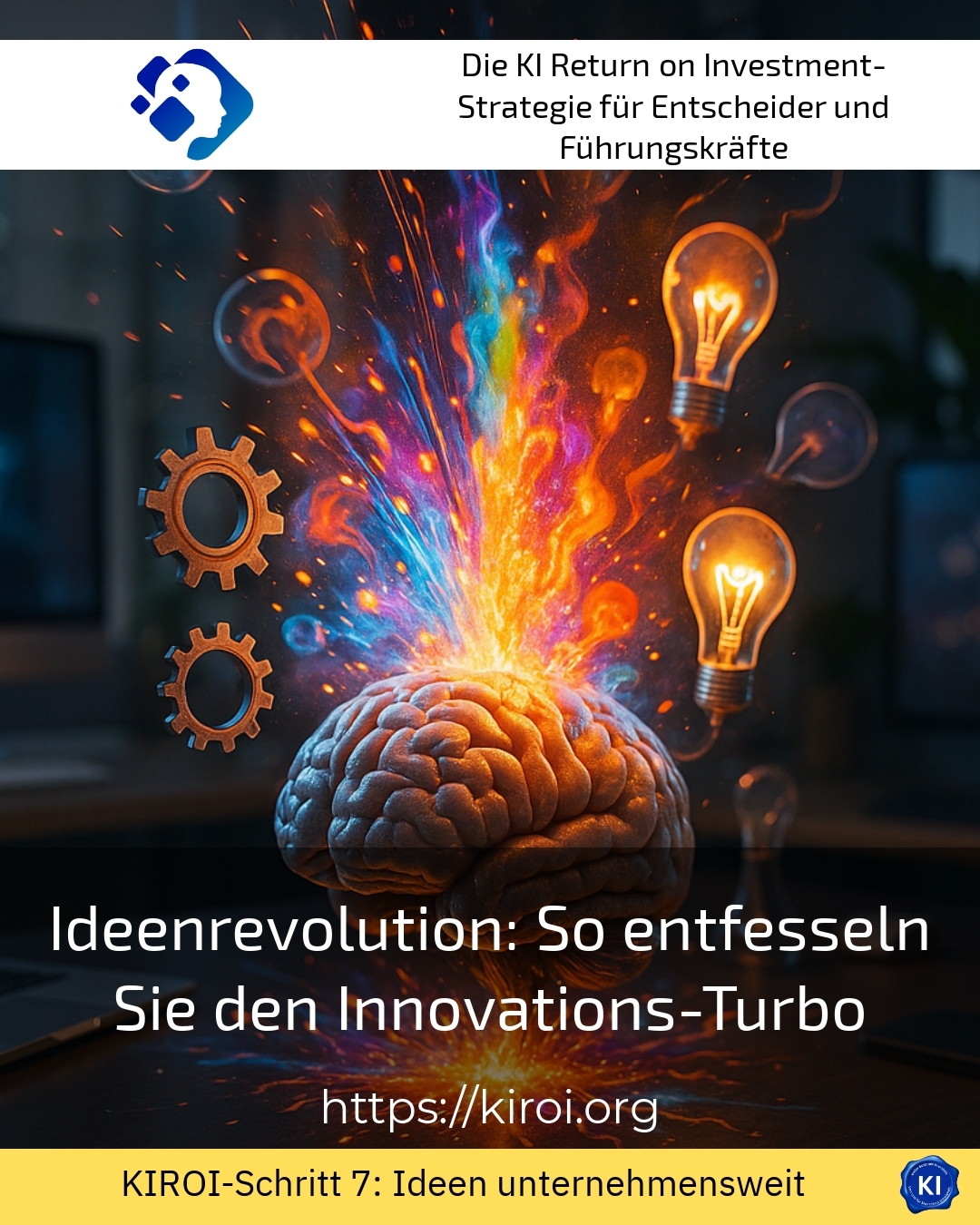
Imagine you could flip the invisible switch that catapults your business from the slow lane onto the fast track to the future. The Idea revolution doesn't begin in the research departments of large corporations, but in the minds of those willing to stray from beaten paths and forge entirely new ones. In a world changing at breathtaking speed, the ability for creative renewal determines success or stagnation. This article shows you how to unleash the innovation turbo.
Understanding the Power of Creative Disruption
Many companies struggle with the same problem. They have talented employees and sufficient resources. Nonetheless, they lack that crucial spark. The Idea revolution begins with a fundamental rethink. It requires the courage to critically question existing structures. At the same time, it needs the willingness to take seemingly crazy ideas seriously.
A medium-sized mechanical engineering company from the Ruhr area faced exactly this challenge. Order books were full, but the products hadn't changed significantly for years. A competitor from Asia began to conquer the market with cheaper alternatives. It became clear here that technological support and new ways of thinking were urgently needed.
In the automotive industry, we are currently experiencing a fundamental shift. Traditional manufacturers are transforming into mobility service providers. A well-known German premium manufacturer has begun to see its vehicles as rolling computers and is developing corresponding digital ecosystems. A supplier from Baden-Württemberg, in turn, has converted its entire product range to software-controlled components. Both examples show how profound the changes already are.
Best practice with a AIROI customer
A family-run company with a long tradition in the manufacturing industry approached transruptions coaching with a specific question. Management had noticed that younger employees frequently submitted innovative suggestions, but these were often lost in the day-to-day operations. The company culture was characterised by hierarchies and established decision-making processes. Together, we developed a programme for systematic idea generation, which encompassed several levels. First, we established weekly creative circles where employees from all departments came together. These meetings did not follow a rigid agenda but allowed for free brainstorming. In parallel, we introduced a digital idea management system that enabled anonymous suggestions. Anonymity proved to be a crucial factor, as many employees initially felt hesitant to share their thoughts openly. After six months of intensive support, we were able to document over two hundred suggestions for improvement collectively. Thirty of these were directly incorporated into product development. The company now reports significantly increased employee satisfaction and measurable efficiency gains.
Anchoring the idea revolution in everyday business life
The difference between sporadic creativity and sustainable innovation lies in systematic integration. A chemical company from North Rhine-Westphalia has developed an interesting model for this. Every employee receives half a day per month for independent project work outside their regular duties [1]. This time is protected and may not be used for operational activities.
In contrast, the pharmaceutical industry has seen an international corporation establish "fail-fast labs". Here, experiments are deliberately conducted where failure is explicitly desired. The insights gained from failed attempts are incorporated into new developments, thereby significantly accelerating the learning process. A medium-sized biotech company has adopted this method and reports considerably shorter development cycles.
The food industry is showing further inspiring approaches. A well-known beverage manufacturer has launched an internal start-up programme. Employees can apply with their own business ideas and, if successful, receive resources for implementation. This has already led to the creation of several new product lines that now contribute significantly to revenue.
Overcoming mental barriers and gaining new perspectives
Clients often report that missing resources are not the main obstacle. Rather, it is mental blocks and ingrained thought patterns that hinder progress. Idea revolution therefore, it first requires work on inner resistances. transruptions coaching supports leaders and teams in identifying and gradually dissolving these blockades.
A logistics company from Hamburg came with precisely this request. Management wanted to drive digitalisation forward but encountered massive reservations from the workforce. The fear of job losses and scepticism towards new technologies dominated the mood. Here it became apparent that technological change always has an emotional component too.
We are experiencing similar challenges in the construction industry. A property developer from Munich has begun to implement Building Information Modelling across the board [2]. The technical aspect was comparatively simple. The real hurdle was convincing experienced site managers of the advantages of the new way of working. A craft business from the same region took a different approach and relied on peer learning. Older employees were trained in digital tools by younger colleagues, while in return they passed on their expertise.
Best practice with a AIROI customer
A medium-sized company in the renewable energy sector found itself in a period of upheaval when it approached us. The industry was changing rapidly due to new regulatory requirements and technological developments. Management recognised the need for a fundamental reorientation but didn't know where to start. As part of the "transruption" coaching, we initially carried out a comprehensive analysis of the existing processes and structures. In the process, we discovered that the company had considerable untapped potential slumbering in the minds of its employees. We established a monthly innovation forum, to which external experts were also invited to bring in fresh perspectives. The combination of internal knowledge and external input proved to be particularly effective. Within a year, the team developed three new service offerings that transformed the company from a pure plant manufacturer into a complete solutions provider. Particularly pleasing was the change in company culture, as employees now feel confident expressing and discussing unconventional ideas.
Harnessing technological impulses for the revolution of ideas
Modern technologies can significantly accelerate the innovation process. For example, artificial intelligence enables the analysis of large amounts of data to identify market trends at an early stage. A retail company from Frankfurt uses AI-powered systems to predict the purchasing behaviour of its customers [3]. This leads to new product ideas that precisely meet the needs of the target group.
In the healthcare sector, a medical technology company from Erlangen has begun using virtual reality for product development. Doctors can test new devices as early as the concept phase and provide feedback. A hospital operator from the same federal state is using similar technologies for staff training. A third example can be found at a rehabilitation centre that has developed VR-based therapy approaches.
The financial industry demonstrates how blockchain technology enables entirely new business models. A direct bank in Munich has introduced smart contracts for specific loan products. An insurance company is experimenting with automated claims processing. A fintech startup has developed a platform for tokenised real estate investments.
Accelerating the ideas revolution through networking
No organisation can still retain all relevant competencies internally today. Strategic partnerships and networks are therefore gaining in importance. A textile company from Saxony has entered into an innovation partnership with a regional university. Students work on real-world problems and bring fresh perspectives. The company benefits from scientific expertise and potential future skilled workers.
In the aviation industry, a supplier from Hamburg has formed a consortium with three competitors. Together they are researching new materials for lighter aircraft components. An engine manufacturer from Bavaria is participating in several university research projects. A maintenance service provider has entered into a partnership with a drone manufacturer to offer automated inspections.
The Idea revolution benefits from the diversity of perspectives. Transruptions coaching provides impetus for shaping such collaborations and supports the development of appropriate structures. Because every partnership has its own dynamics, an individual approach is essential.
Best practice with a AIROI customer
An IT service provider faced the challenge of fundamentally rethinking its business model because traditional consulting services were coming under increasing price pressure. Management looked for ways to make the company future-proof while optimally leveraging existing expertise. As part of our support, we first organised a workshop with customers to better understand their actual needs. This direct involvement of the target group proved extremely valuable because it corrected assumptions and revealed new possibilities. In parallel, we initiated discussions with potential technology partners who brought complementary skills. These contacts developed into a strategic alliance with a software startup that had innovative automation solutions. Together, both companies designed a new service offering that combines manual consulting with automated analyses. The first pilot projects were promising and exceeded the expectations of both partners, leading to the decision to expand the collaboration.
Creating sustainable structures for continuous renewal
One-off innovation initiatives often fizzle out after a short time. The key lies in establishing permanent structures. An energy supplier from the Rhineland has set up a Chief Innovation Office for this purpose. This department works independently of day-to-day operations and has direct access to company management. A consumer goods manufacturer from North Rhine-Westphalia has chosen a similar approach and also established an Innovation Board with external experts.
Further interesting models are emerging in the media industry. A Berlin-based publishing house has launched an internal accelerator programme where employees can develop their own project ideas. A television broadcaster is experimenting with agile production methods that enable faster format development. A music company has reorganised its entire organisational structure into project teams that are assembled flexibly.
Agriculture also offers inspiring examples. A farm in Lower Saxony has entered into a cooperation with a technology startup to implement precision farming. A vineyard in the Palatinate is using drones to monitor its vines. A horticulture company in the Rhineland has developed vertical farms that produce vegetables year-round in urban areas.
My AIROI Analysis
Looking at numerous company examples from various sectors reveals a clear pattern. Successful innovators don't primarily differ from their competitors through larger budgets or better technologies. The crucial difference lies in the ability to establish and nurture a culture of continuous renewal. This culture requires courage, openness, and the willingness to tread even uncomfortable paths.
The importance of the human element is particularly striking. Technology alone does not create innovation. It is only the combination of technological possibilities with creative people and supportive structures that unlocks the full potential. The leadership level plays a central role in this, as it sets the framework and provides a role model.
The examples also show that there is no single correct way. Each company must find its own approach that suits the industry, company culture, and available resources. Transruption coaching can support this process and provide impetus, but the actual work must be done within the company itself. It is important to have realistic expectations and to be patient, as profound changes take time.
The Idea revolution is not a one-off event, but an ongoing process. Companies that understand this invest continuously in their innovative capacity and create space for creative thinking. They accept setbacks as part of the learning process and celebrate small successes. This creates a positive dynamic that reinforces itself and secures long-term competitive advantages.
Further links from the text above:
[1] Haufe: Innovation through freedom for employees
[2] BIM Portal: Building Information Modelling Explained
[3] Bitkom: Artificial Intelligence in Retail
For more information and if you have any questions, please contact Contact us or read more blog posts on the topic Artificial intelligence here.








 Deutsch
  English (UK)