
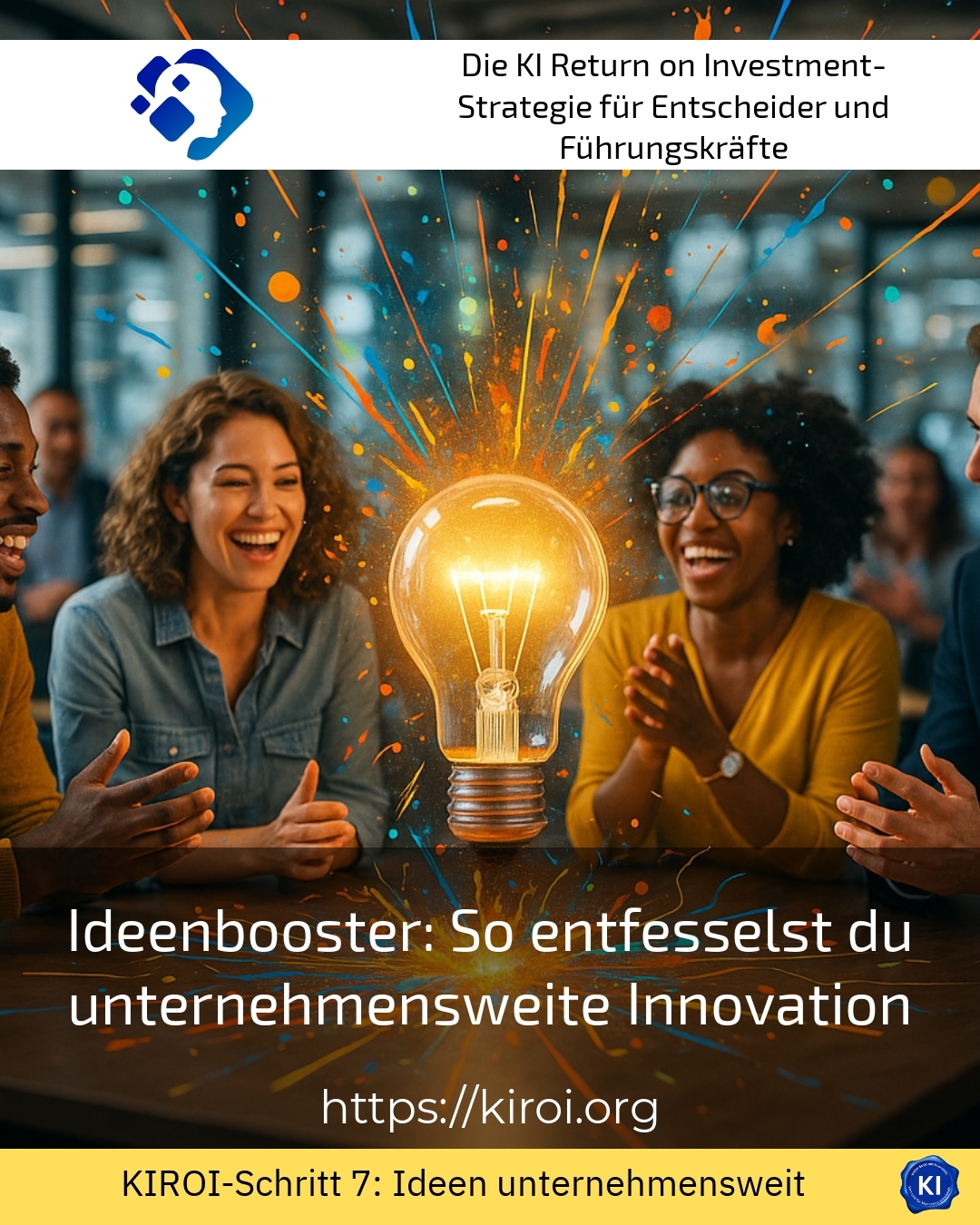
Imagine your organisation has an inexhaustible reservoir of creative solutions. These solutions lie dormant in the minds of your employees, waiting to be awakened. The Idea booster: How to unleash company-wide innovation describes precisely this process of systematically activating hidden potentials. In a world that is spinning faster and faster, the ability to continuously renew oneself determines success or failure. This is not about spectacular individual achievements by brilliant visionaries. Rather, the collective creativity of all participants is at the heart of future-proof organisations.
Discovering the hidden power of collective creativity
Managers frequently report a paradoxical phenomenon. Although their teams possess outstanding technical expertise, ground-breaking suggestions for improvement fail to materialise. The cause is rarely a lack of potential among employees. Rather, the suitable structures and psychological safety required for creative thinking are often missing. For example, a medium-sized logistics company recognised that its warehouse workers observed inefficient processes every day, yet never reported them. It was only when management established a low-threshold communication channel that ideas for improvement came flooding in. Within a few months, the company was able to reduce its order-picking times by almost a fifth.
A hospital that systematically involved its nursing staff in optimisation processes had similar experiences. They immediately recognised which administrative tasks were keeping them from actual patient care. Their proposals for simplifying documentation led to noticeable relief in their daily work. In addition, a software company reported surprising impetus from its accounting department. There, an employee had realised how invoice processes could be accelerated through simple automation. These examples impressively demonstrate that valuable ideas can emerge anywhere in an organisation.
The Idea Booster as a catalyst for sustainable change
The term Idea booster: How to unleash company-wide innovation describes a holistic approach to fostering creativity. Structural framework conditions play just as important a role in this as cultural factors. A successful support programme for employee ideas requires clear processes and transparent evaluation criteria. At the same time, it must create an atmosphere in which unconventional suggestions are also welcome. To achieve this, an automotive supplier established regular creative workshops in which hierarchies were deliberately suspended. Production workers developed new manufacturing approaches together with engineers. These workshops led to a significant increase in patent applications.
A retail group relied on digital platforms for gathering ideas. Employees from over a hundred branches were able to share their observations and suggestions there. The best ideas were rewarded monthly and implemented promptly. For example, a new concept for product placement at the point of sale was created in this way. This concept had been developed and submitted by an apprentice from a small branch. In addition, a telecommunications provider used gamified elements to increase participation in idea competitions. Points, leaderboards and virtual awards motivated the workforce to actively participate in innovation projects.
Best practice with a AIROI customer
An internationally active mechanical engineering company approached our transruptions coaching team because its innovation rate was stagnating despite high research budgets. The executive board recognised that valuable impulses from operations were not reaching the development department. Together, we developed a multi-stage programme to activate the entire idea potential of the organisation. First, we conducted structured interviews with employees from various hierarchical levels. This revealed that many suggestions for improvement were failing due to bureaucratic hurdles. In the second step, we established a lean evaluation system that guaranteed rapid feedback. We also trained managers in the constructive handling of employee suggestions. After about six months, the company recorded a significant increase in submitted ideas. Particularly noteworthy was the increase in the quality of suggestions from production. A machine operator developed a modification that reduced the energy consumption of a production line by twelve percent. This improvement would presumably never have been identified without the new system. The transruptions coaching accompanied the entire transformation process and regularly provided valuable impetus for further development.
Creating structures for continuous renewal
Sustainable promotion of creativity requires more than one-off campaigns or isolated workshops. Instead, organisations must establish permanent structures that systematically support creative thinking [1]. A pharmaceutical company set up so-called innovation labs for this purpose, in which employees could work on their own projects. These labs were equipped with state-of-the-art technology and were open to all staff. Several product ideas emerged there, which have since been successfully established on the market.
A financial services provider took a different path. It introduced a system that allowed employees to use ten percent of their working time for their own projects. This self-determined time led to a multitude of process improvements and new service concepts. In addition, an energy supplier experimented with cross-departmental innovation teams. Employees from sales, engineering and customer service jointly developed new solutions for the energy transition. The diverse perspectives led to particularly robust and practical concepts.
Psychological safety as the foundation for the idea booster
The Idea booster: How to unleash company-wide innovation can only become effective in a supportive environment [2]. Employees must feel that their suggestions are taken seriously and treated respectfully. A culture of error that views failure as a learning opportunity is crucial in this regard. To this end, a technology corporation established so-called Failure Fridays, where teams presented their failed experiments. These events normalised failure and promoted open discussion about lessons learned.
A retail company trained its managers in constructive feedback. In doing so, they learned how to formulate even critical feedback in an appreciative manner. The improved communication led to a noticeably higher participation rate in idea competitions. In addition, an insurance company introduced anonymous submission options. Employees were initially able to submit their suggestions without naming themselves. This option significantly lowered the threshold, particularly for new staff members.
Best practice with a AIROI customer
A medium-sized corporate group in the food sector sought our guidance because competitive pressure was continuously increasing. Their traditional product lines were losing market share to innovative competitors. As part of the transruption coaching, we first analysed the existing communication structures. In doing so, we discovered that valuable market observations from field sales staff never reached product development. The sales representatives held daily conversations with end customers and retailers. They knew the current trends and wishes of the target group precisely. However, these insights remained stuck in visit reports that nobody systematically evaluated. Together, we developed a new information system that forwarded relevant market impulses directly to product development. We also established monthly innovation meetings between sales and development. This direct communication significantly accelerated the development process for new products. Within a year, the company launched three new product lines on the market. Two of these lines were based directly on impulses that field staff had picked up during customer conversations. The transruption coaching helped to anchor the new processes sustainably within the organisation.
Technology as an enabler for organisation-wide creativity
Modern digital tools can Idea booster: How to unleash company-wide innovation significantly intensify [3]. Collaboration platforms enable cross-location exchange of thoughts and concepts. For example, a chemical company used an internal social network for knowledge sharing. There, researchers from different countries could share their experiments and findings. This networking led to several unexpected synergies between previously isolated projects.
A construction group relied on virtual idea boards, on which employees could visualise proposals. The option for graphical representation significantly eased the communication of complex concepts. In addition, a media company experimented with AI-driven systems for idea analysis. These systems recognised thematic connections between different proposals and identified promising concepts. The technology supported human creativity without replacing it.
Rethinking leadership for sustainable promotion of creativity
The role of leaders is changing fundamentally when organisations want to fully unleash their creative capacity. Traditional control and management functions are increasingly giving way to supportive and enabling tasks. A consultancy trained its partners in so-called servant leadership. This leadership philosophy places the needs of employees at the centre. The partners learned how they can optimally support their teams and clear obstacles out of the way.
An industrial company introduced a system of decentralised decision-making powers. Teams were able to decide independently on the implementation of suggestions for improvement. This autonomy considerably accelerated the implementation of good ideas. Furthermore, a service company established regular feedback sessions between managers and teams. Critical issues were also openly addressed in these discussions. The improved communication strengthened trust and promoted the development of ideas.
My AIROI Analysis
The systematic promotion of organisation-wide creativity represents one of the most important success factors for future-proof companies. It repeatedly becomes apparent that the necessary resources are already available. Employees at all hierarchical levels possess valuable knowledge and creative potential. The actual challenge consists in activating this potential and making it usable.
The examples described illustrate that successful promotion of creativity requires a holistic approach. Structural measures such as idea platforms or innovation labs form the foundation. At the same time, cultural factors such as psychological safety and appreciative communication must be taken into account. The role of managers shifts in the process from controller to enabler.
Transruption coaching can effectively support organisations in this complex transformation. The external perspective helps to identify and overcome blind spots. Experienced coaches provide impetus for the design of suitable structures and processes. They support managers in developing new competencies and accompany teams through change processes. Experience shows that sustainable transformation requires time and patience. Quick wins are possible, but the full unfolding of creative potential takes persistence. However, organisations that consistently follow this path secure lasting competitive advantages.
Further links from the text above:
[1] Harvard Business Review – Innovation and Creativity Resources
[2] McKinsey – The Eight Essentials of Innovation
[3] Forbes Tech Council – Innovation Insights
For more information and if you have any questions, please contact Contact us or read more blog posts on the topic Artificial intelligence here.









 Deutsch
  English (UK)