
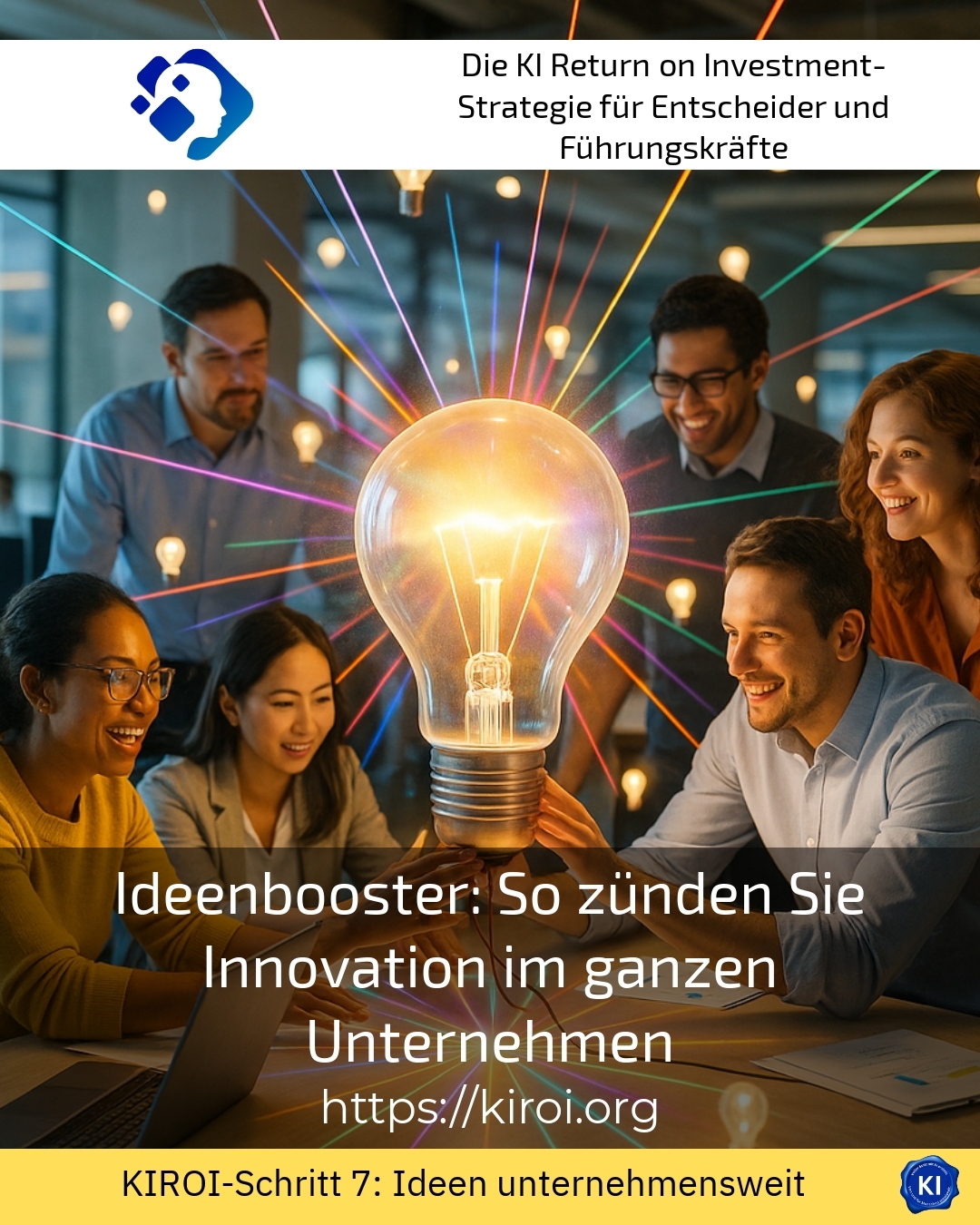
Imagine every employee in your company has a brilliant idea within them. This idea is just waiting to be ignited and to develop into a groundbreaking innovation. But how do you manage to unlock this Idea-booster to activate and unleash creative energy across all departments? The answer doesn't lie in expensive consulting programmes or rigid processes. It lies in the systematic support of change processes that encourage and empower people. Companies that take this path often report surprising breakthroughs and a completely new dynamic within their teams.
The hidden power of creative impulses in everyday business life
Many organisations underestimate the potential that lies dormant within their own ranks. Production employees observe small inefficiencies daily that could add up to significant savings. Customer service staff hear wishes and complaints that provide valuable insights for product improvements. Sales teams often recognise market gaps sooner than any market research. However, there is often a lack of structures to collect and develop these insights. This is where professional support comes in, creating space for creativity while providing practical tools. For example, a medium-sized mechanical engineering company introduced monthly creative circles where workshop employees could share their observations. Within a few months, this resulted in three patentable improvements. A logistics company used digital platforms to collect and evaluate ideas across different locations. Participation increased by more than two hundred percent compared to traditional suggestion schemes [1].
The idea booster as a strategic leadership tool
Leaders play a crucial role in unlocking creative potential within their teams. They need to learn not only to demand results but also to foster a willingness to experiment and view mistakes as learning opportunities. This often requires a fundamental shift in leadership culture, which transruptions coaching can specifically support. A retail company faced the challenge of innovative suggestions regularly getting lost within the hierarchy. Management recognised the problem and initiated a leadership development programme with coaching elements. The leaders learned to ask open-ended questions and not to judge ideas immediately. After six months, the teams reported a distinctly changed climate. A pharmaceutical company integrated creativity workshops into its leadership training with remarkable results. Participants there developed concrete approaches for their own departments [2].
Best practice with a AIROI customer
An international automotive supplier approached us with a specific challenge that affects many companies in this sector. Despite a well-equipped research department, the innovation rate had been declining for years, and competition from Asia was rapidly catching up. As part of the support provided by transruptions coaching, we first analysed the existing structures and communication channels within the company. It emerged that the separation between development and production was far too rigid, and valuable practical knowledge was not flowing into the innovation process. Together, we developed a concept for interdepartmental innovation teams that worked on specific challenges on a quarterly basis. Employees were given dedicated time for creative work, which initially met with resistance but quickly proved to be productive. Within a year, twelve concrete improvement suggestions were generated, five of which were directly implemented and brought measurable cost savings. Particularly noteworthy was the change in the workforce's attitude, who now actively looked for opportunities for improvement and contributed ideas on their own initiative. This cultural shift proved to be even more valuable than the concrete innovations themselves.
How the idea booster supports technological transformation
Digital transformation presents companies with immense challenges, but at the same time offers unimagined opportunities for innovation. Artificial intelligence, for example, can help identify patterns in customer feedback that would elude human analysts. Cloud platforms enable real-time collaboration on ideas across locations with colleagues worldwide. Automation technologies free up employees from routine tasks, creating space for creative thinking and strategic consideration. An insurance company used AI-powered analysis tools to systematically evaluate customer complaints and identify areas for improvement [3]. A retailer implemented a digital ideas platform that automatically categorised suggestions and forwarded them to the relevant departments. An energy provider used virtual reality workshops to enable spatially distributed teams to work together on innovation topics.
Psychological Safety as a Foundation for Innovation
Without a climate of trust, even the best ideas will never be voiced, because employees will be afraid of negative consequences. Psychological safety means that people can admit mistakes and make unusual suggestions without having to fear sanctions. This climate does not arise on its own, but must be actively cultivated and modelled by leaders. A technology company introduced so-called Failure Fridays, where teams openly discussed failed projects and the lessons learned from them. A consulting firm established anonymous feedback channels through which critical ideas could also be expressed without anyone having to fear disadvantages. A manufacturing company specifically trained its leaders in appreciative handling of unconventional suggestions [4]. The results in all three cases were impressive and demonstrated how important this aspect is for successful innovation.
Structured Creativity: The Idea Booster in Practice
Creativity requires freedom, but also structure, to become truly effective and not end in chaos. Design Thinking offers a proven framework for systematically analysing user problems and developing innovative solutions. Agile methods such as Scrum enable rapid iterations and continuous improvement of ideas in short timeframes. Lean Startup approaches help to test ideas early on in the market and learn from feedback. A financial services provider implemented Design Thinking workshops to develop new customer services and react more quickly to market changes. A media company used agile methods to revolutionise its editorial processes and react more quickly to current topics. A healthcare company first tested new offerings on a small scale before making larger investments [5].
Best practice with a AIROI customer
A family-run business with a rich tradition in the consumer goods sector approached us with the challenge that younger employees were frustrated. Their ideas for digital products and sustainable packaging were not being heard by the older management level, leading to increased staff turnover. As part of our transruption coaching, we developed a multi-stage programme that involved both management and young talent. Initially, we facilitated dialogue formats where both sides could exchange perspectives without falling into patterns of justification. The older management recognised the value of fresh perspectives, while the younger employees learned to present their ideas more convincingly. We then established a mentoring programme where experienced managers and young innovators worked together on projects. This reverse mentoring element led to an intensive transfer of knowledge in both directions and broke down prejudices. Within eighteen months, the company launched three new product lines that specifically target younger demographics while also incorporating sustainability aspects. Turnover among high potentials decreased significantly, and the company gained recognition as an attractive employer.
Activate idea boosters for various business areas
Innovation should not be limited to the research and development department, but must permeate all areas of the company. In sales, new outreach strategies and sales channels that have hitherto remained untapped can be developed. In human resources, innovative recruiting approaches and employee retention programmes emerge that can make a real difference. In finance, processes can be optimised and new financing models developed that create competitive advantages. A construction company revolutionised its complaints management through innovative digital solutions that delighted customers and strengthened customer loyalty. A telecommunications provider developed a gamified onboarding programme in its HR department that integrated new employees more quickly. A food manufacturer transformed its supply chain through innovative partnerships with start-ups, which brought fresh perspectives [6].
The role of networks in fostering innovation
No organisation can retain all relevant competencies internally, which is why external networking is becoming increasingly important for sustainable innovation. Collaborations with universities bring scientific findings into practice and provide access to talented junior staff. Partnerships with start-ups deliver fresh impetus and agile working methods that often inspire established companies. Industry networks facilitate the exchange of best practices and joint innovation projects that would not be possible alone. A chemical company established an innovation hub in cooperation with a university of applied sciences, which has already produced several market-ready products. A logistics group set up an accelerator programme for promising start-ups, some of which were later acquired. An industrial company initiated a cross-industry innovation circle that regularly analyses and evaluates new technology trends [7].
Measurability and continuous improvement of the idea booster process
What isn't measured cannot be improved, which is why innovation processes also require systematic success monitoring. Key performance indicators such as the number of ideas submitted, the implementation rate, and economic benefits provide important indications of effectiveness. Qualitative indicators such as employee satisfaction and perceived innovation culture complement the picture with important subjective perspectives. Regular reviews allow for the adaptation of processes and the removal of obstacles before they become major problems. A software company implemented a dashboard that visualised all innovation-relevant KPIs in real-time and made them accessible to everyone. An industrial group conducted annual innovation audits to systematically identify and address areas for improvement. A service company used regular employee surveys to measure the perceived innovation culture and identify trends early on [8].
My AIROI Analysis
Following intensive consideration of the various aspects of innovation promotion in companies, a clear picture of the success factors and challenges emerges. Companies that truly want to anchor innovation throughout the entire organisation must turn several screws simultaneously and have patience. The technological infrastructure must be right, but it alone is not enough to bring about real change. The leadership culture, which encourages a willingness to experiment and views failure as a learning opportunity rather than punishing it, is crucial. Structured methods such as Design Thinking or agile approaches provide a helpful framework for the creative process without restricting it. External networking broadens the horizon and brings fresh perspectives into the organisation, which are often lacking internally. Measuring results enables continuous improvement and prevents innovation initiatives from fading or losing momentum.
From supporting numerous projects through transruption coaching, we've learned that the human factor is often underestimated. While technical solutions and processes are important, people must be brought along and empowered for change to be sustainable. Leaders need support to fulfil their role as enablers of innovation and overcome old patterns. Employees require psychological safety and concrete tools to contribute and develop their ideas. Organisations benefit from external support that uncovers blind spots and provides new impetus without being didactic. Ultimately, the Ideas Booster is not a single measure, but an attitude that must permeate the entire company. Companies that consistently pursue this path often report not only more innovations but also higher employee satisfaction.
Further links from the text above:
[1] Harvard Business Review – Innovation
[2] McKinsey – The Eight Essentials of Innovation
[3] Gartner – Artificial Intelligence Insights
[4] Google re:Work – Team Effectiveness
[5] IDEO U – Design Thinking
[6] BCG – Innovation Strategy
[7] World Economic Forum – Innovation
[8] Forbes Innovation
For more information and if you have any questions, please contact Contact us or read more blog posts on the topic Artificial intelligence here.






 Deutsch
  English (UK)