
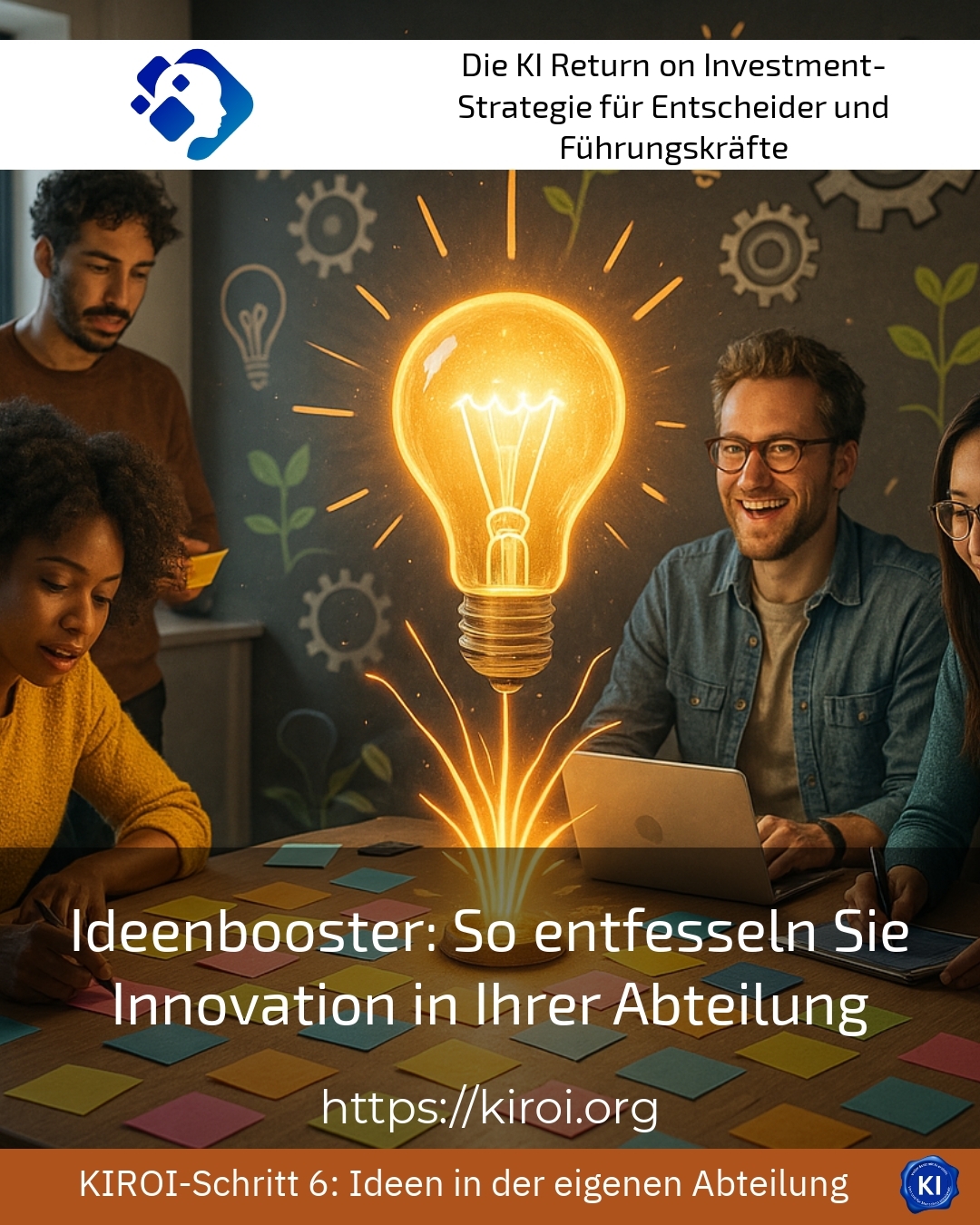
Imagine your department suddenly bursting with creative ideas, and employees regularly bringing forward groundbreaking suggestions that advance the entire company. This vision is by no means utopian, because with the right Idea-booster Can you specifically unleash innovation in your department and create a culture where creativity thrives? Many leaders report coming to us with precisely this concern because they sense untapped potential slumbering within their teams. They are looking for ways to release this potential, and professional guidance can provide valuable impetus in this very area.
Why departments need an idea booster
In many companies, there is a climate that hinders rather than promotes creative impulses. Employees do not dare to make unconventional suggestions. They fear negative reactions or worry about not being taken seriously. We often observe this phenomenon in projects that we have the privilege of supporting [1]. However, practice shows that it is precisely the supposedly crazy ideas that often offer the greatest added value. For example, a manufacturing company introduced weekly creative hours. The results surprised even sceptical managers because process improvements suddenly emerged that no one had thought of before.
Another example comes from a service company that revolutionised its customer service. A member of staff from the second tier suggested a different way of categorising customer enquiries. This seemingly small change led to a significant increase in customer satisfaction. Furthermore, processing times were considerably reduced, which also boosted team morale. A third example shows a retail company that optimised its warehouse logistics. An apprentice had proposed an idea for rearranging the shelving. This idea saved the company several hours of working time each day.
Cultural change as a basic requirement
Innovation doesn't emerge in a vacuum; it requires fertile ground. This ground is made up of trust, psychological safety, and the willingness to view mistakes as learning opportunities. transruptions-Coaching supports companies in establishing and sustainably embedding precisely this culture. For example, a financial services provider struggled for a long time with a strong aversion to mistakes. Through targeted workshops and continuous support, a more open climate gradually developed. Employees began to actively contribute suggestions for improvement, and managers learned to constructively address them.
A technology company, in turn, relied on regular retrospectives where failures were discussed openly. This practice led to teams experimenting more boldly, knowing that even failed attempts would be valued. A medium-sized mechanical engineering firm went a step further. It established an internal innovation award that also recognised failed projects. This measure fundamentally changed the entire corporate culture.
Best practice with a KIROI customer A medium-sized company in the industrial manufacturing sector approached us with the challenge that innovative ideas almost exclusively originated from the management level, while the operational teams contributed hardly any suggestions, despite them being at the forefront of production daily and knowing the processes best. As part of our consultancy, we collaboratively developed a multi-stage concept. This first established low-threshold formats for idea submissions, while simultaneously training managers on how to respond constructively and appreciate suggestions. We implemented digital channels through which employees could anonymously submit ideas, significantly lowering the initial inhibition threshold. In parallel, we introduced monthly innovation circles where cross-functional teams discussed the submitted proposals and selected the most promising ones for implementation. After six months of intensive support, the number of submitted ideas had quadrupled, and several of them had already been successfully implemented, leading to measurable efficiency improvements and a palpable increase in employee satisfaction.
Methods and tools as idea boosters
As well as a cultural foundation, successful innovation also requires concrete methods and tools. Design Thinking, for example, has proven to be a powerful Idea-booster Proven in many industries. This method consistently places the user at the centre and encourages iterative work. An insurance company used Design Thinking to develop new products. The customer perspective was consistently the focus, leading to completely new approaches. The resulting offers hit the mark with the target group much better than previous developments.
Even agile methods like Scrum or Kanban can foster innovation. A pharmaceutical company introduced Scrum within its research department. The short sprints and regular reviews not only significantly accelerated development cycles but also enabled ideas to be tested and validated more quickly. Another example comes from a media company that used Kanban boards to visualise creative processes. This transparency helped the team to identify bottlenecks early and deploy resources more flexibly.
Digital tools to support the idea booster process
Digitalisation offers numerous opportunities to support and accelerate creative processes [2]. Collaboration platforms enable teams to collect and further develop ideas regardless of location and time. A consulting firm used such a platform and recorded a significant increase in idea quality. Employees were able to comment on, supplement, and rate suggestions, which led to collective intelligence. A retail company used AI-powered tools to analyse customer feedback and derive innovation impulses. Artificial intelligence recognised patterns that would have escaped human analysts.
Furthermore, an increasing number of companies are experimenting with virtual innovation spaces. An automotive supplier set up a digital idea marketplace. There, employees from different locations could collaborate on concepts. This virtual collaboration overcame geographical boundaries and provided access to a broader knowledge pool. The results significantly exceeded expectations.
The Role of the Leader in Unleashing Innovation
Leaders play a key role in fostering innovation within their departments. Their behaviour sends important signals to the team. Clients often report that they are unsure how to actively fulfil this role model function. Transruptions coaching supports leaders in developing their personal leadership style and establishing innovation-promoting behaviour. For example, a managing director of an energy company learned to consciously manage his own reactions to new ideas. He trained himself to ask questions first, rather than expressing concerns immediately. This change in behaviour had a positive impact on the entire team.
A healthcare department head, in turn, realised that she was unconsciously favouring certain voices within the team. Through targeted coaching, she learned to actively involve quieter employees. Another aspect concerns resource allocation. An IT manager insisted that his team be allowed a fixed portion of time for experimental projects. These freedoms became fertile ground for several successful innovations.
Best practice with a KIROI customer A logistics executive approached us because they felt their team, while technically excellent, lacked initiative and primarily acted reactively rather than proactively driving improvements. As part of our collaborative work, we first analysed the existing communication patterns and decision-making processes within the department. It became apparent that the executive, with good intentions, made many decisions themselves to relieve their team, but unintentionally restricted their initiative. Together, we developed a step-by-step plan that helped the executive delegate more decision-making power to the team while simultaneously creating a safe space for experimentation. The executive learned to ask open questions and allow ideas to be explored before giving feedback, signalling to the team that creative thinking was desired and valued. After a few months of support, the team's dynamics had fundamentally changed, with employees independently making suggestions and taking responsibility for their implementation, significantly increasing both innovation and job satisfaction.
Identifying and overcoming obstacles with the Idea Booster approach
Numerous obstacles lie on the path to an innovative department. A lack of time is one of the most common arguments cited by both managers and employees. A construction company tackled this problem creatively. It introduced so-called innovation breaks, short daily windows for creative thinking. This structured approach ensured that innovation was not sacrificed to daily operations. A telecommunications company struggled with silo thinking between departments. It established cross-functional innovation teams that met regularly.
Budget constraints represent another common obstacle. However, a startup in the sustainable energy sector proved that innovation doesn't always have to be expensive. It used rapid prototyping with simple materials to test ideas quickly. This approach saved costs and significantly accelerated the learning process. A chemical company, in turn, set up an internal innovation fund. Employees could apply for funds for promising projects there. This low-threshold funding opportunity set numerous initiatives in motion.
Sustainability and long-term embedding
Innovation must not remain a one-off event. It needs to be sustainably integrated into the daily working routine. One food manufacturer, for example, established an innovation board that met quarterly [3]. This committee evaluated new ideas and monitored the implementation of already started projects. A textile company linked innovation goals with the individual development plans of its employees. This connection ensured that creative thinking was also discussed during appraisal interviews.
Documentation and knowledge transfer also play an important role. A software company introduced an internal wiki in which successful and failed innovation projects were documented. This knowledge base helped new employees learn from past experiences. A mechanical engineering company organised regular innovation days at which teams presented their projects. These events promoted exchange and inspired other departments.
My KIROI Analysis
Extensive engagement with the topic of innovation promotion in departments clearly shows that there is no universal "one-size-fits-all" solution, but rather that each organisation must find its own path that suits its specific culture, structure, and industry. Nevertheless, some overarching success factors can be identified that repeatedly play a central role in practice and that we consistently address in our support for companies. Firstly, psychological safety is of fundamental importance, as genuine innovation can only arise if employees dare to voice even unconventional ideas. Furthermore, leadership is needed that acts as a role model and demonstrates through its behaviour that creative thinking is desired and valued. The provision of time and resources for innovation activities is also crucial, because even the most motivated employees cannot develop ideas if they are permanently trapped in the operational hamster wheel. Methods and tools can support this process, but they are not an end in themselves and must fit the respective context. Transruptions coaching can accompany companies in systematically addressing these factors and building a sustainable innovation culture that extends far beyond individual projects and creates long-term competitive advantages.
Further links from the text above:
[1] Harvard Business Review: Innovation Management
[2] McKinsey: The Eight Essentials of Innovation
[3] Forbes: Innovationsinsigter og tendenser
For more information and if you have any questions, please contact Contact us or read more blog posts on the topic Artificial intelligence here.











 Deutsch
  English (UK)