
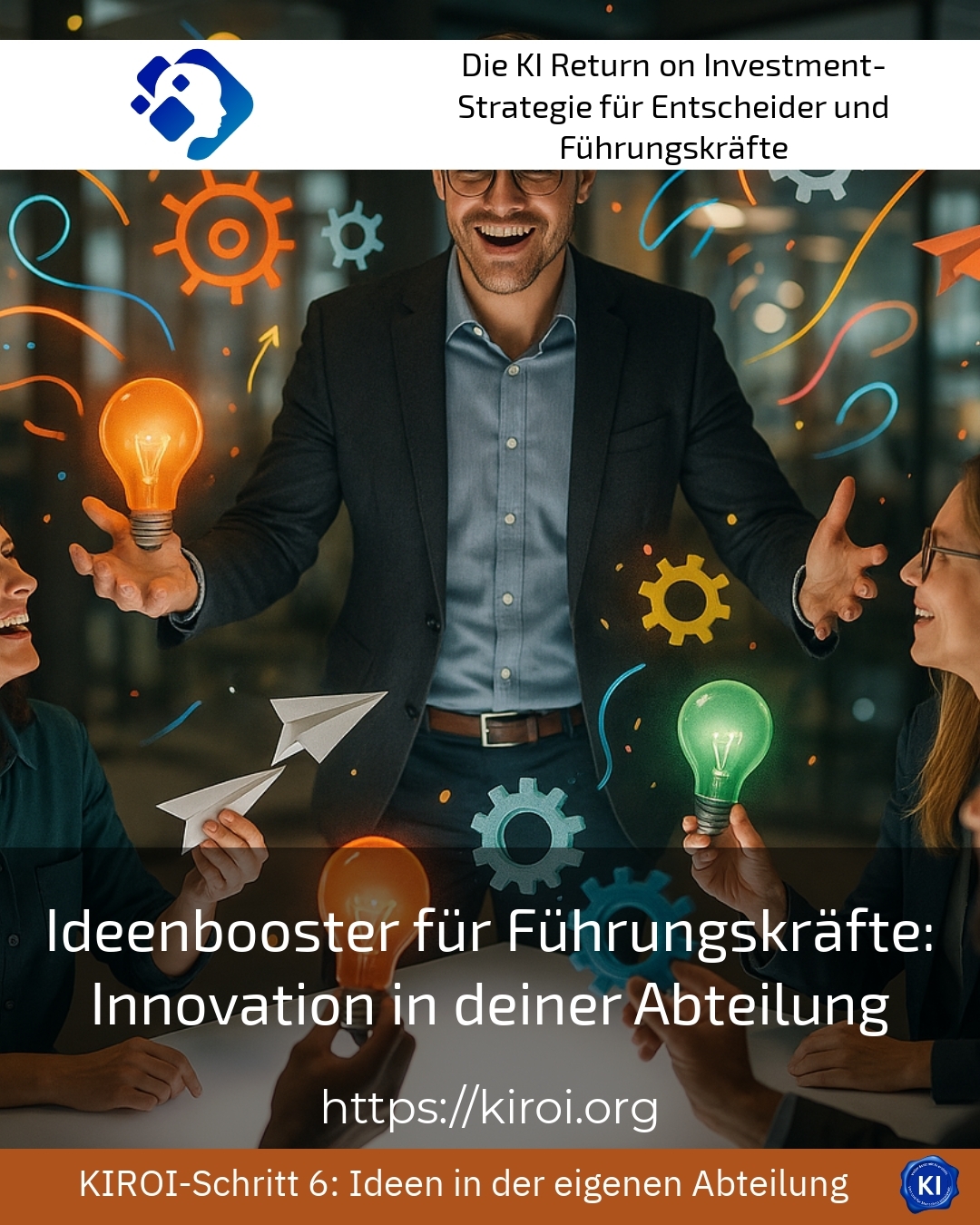
Have you ever wondered why some departments are always bursting with creative ideas while others have been stagnating for years and cannot produce any real innovations?
The answer often lies not in the lack of talent among employees. It is also not due to a lack of resources or unfavorable market conditions. Rather, a systematic approach is lacking. Ideas booster for leaders, which structures and sustainably anchors the creative processes. Many leaders report that while they want to promote innovation, they don’t know where to start. This is exactly where this article comes in and provides you with concrete impulses for your daily work. Transruptions coaching accompanies you as a reliable partner on this path of change.
Why classic methods are no longer sufficient today
The working world has fundamentally changed in recent years. Digital technologies now permeate every aspect of our professional lives. At the same time, customer and stakeholder expectations are continuously rising. In this environment, traditional brainstorming sessions often no longer suffice. They produce many ideas, but rarely truly actionable concepts.
For example, a manufacturing company in the mechanical engineering sector realized that its annual innovation workshops were producing little real results. The participants felt pressured and produced superficial suggestions. Only through a structured approach with clear questions and psychological safety did this fundamentally change. Similarly, a logistics company that regularly asked its drivers for suggestions on improvements experienced a long period of disappointing results. The reason was that no one believed that the suggestions would be taken seriously. A medium-sized software developer also struggled with this phenomenon. His development teams worked in isolation from each other and rarely exchanged ideas.
Best practice with a AIROI customer
A traditional family business in the food industry faced the challenge of accelerating its product development. The previous processes took an average of eighteen months from initial idea to market readiness. This simply became too long in the fast-paced consumer goods market. As part of the guidance provided by transruptive coaching, the management team first analyzed the existing structures and identified several bottlenecks in decision-making. Subsequently, the company implemented a new format called „Quick Test Friday,“ in which three selected ideas are evaluated in just two hours every Friday morning. The criteria are deliberately kept simple and focus on feasibility, customer benefits, and strategic fit. Within six months, the company was able to reduce the average development time by nearly forty percent. What was particularly remarkable was that the employees worked much more motivated on new projects. They finally experienced that their suggestions were heard promptly and turned into concrete decisions.
Idea boosters for leaders: The psychological dimension
Innovation does not happen in a vacuum and certainly not at the touch of a button. It requires an environment where people feel safe to express even incomplete ideas. Psychological safety forms the foundation for any creative performance in a team. Without this foundation, even the best methods remain ineffective.
For example, an insurance company recognized that its employees had numerous improvement ideas. However, these remained unspoken because the corporate culture traditionally viewed mistakes negatively. Through targeted coaching of the management team, this dynamic gradually changed. A similar pattern was observed at a hospital where nursing staff developed innovative solutions for everyday work. However, these ideas rarely reached the decision-making level. It was only when the station managers were trained as ambassadors for ideas that this changed in a significant way. A telecommunications provider also benefited significantly from this approach. The customer service employees possessed valuable knowledge about customer needs. This knowledge was now systematically recorded and fed back into product development [1].
The role of active listening
One Ideas booster for leaders It often begins with a simple change in behavior. Active listening may seem banal at first, yet it is often underestimated. It means giving the other person your full attention and asking questions to understand their point of view. Only then do employees feel truly heard and valued.
A trading company implemented so-called „listening sessions“ for its local branch managers. In these meetings, employees presented their ideas without time pressure or evaluation. The results surprised even skeptical executives due to their quality and feasibility. One automotive supplier even went a step further and introduced „reverse mentoring.“ In this arrangement, younger employees explained new technologies and trends to the managers. This unusual combination effectively promoted the exchange of ideas in both directions. A pharmaceutical company, in turn, consistently used structured feedback sessions after each project completion. In these discussions, not only successes were acknowledged but also potential for improvement were openly discussed [2].
Creating structures that enable creativity
Many leaders mistakenly believe that structures and creativity are mutually exclusive. However, the opposite is the case and has been repeatedly scientifically proven. Clear frameworks provide orientation and create space for genuine innovation. Without such guiding principles, creative energy often dissipates in unproductive discussions.
For example, an energy provider established fixed „innovation times“ for its technical teams. Every Wednesday afternoon, employees were allowed to work on their own projects. This seemingly simple measure led to several patentable inventions within a year. However, a media company set up physical creative spaces that were deliberately designed differently. Colorful walls, flexible furniture, and inspiring quotes characterized these special spaces. The employees used them intensively for brainstorming sessions and informal exchange of ideas among themselves. A chemical company, on the other hand, relied on digital platforms for idea collection and evaluation. Employees from all locations were able to submit suggestions and comment on them. The best ideas received resources for further development and implementation [3].
Best practice with a AIROI customer
An international consulting firm was looking for ways to better connect and utilize the expertise of its consultants. The previous knowledge management software was hardly used and was practically buried in the servers. Together with transruptions coaching, the management team developed a completely new approach to this problem. Instead of relying on technical solutions, they focused on human connections between the employees. So-called „Expertise Circles“ were created with eight to twelve people from different departments. These groups met virtually monthly and exchanged about current project challenges. The crucial difference to previous formats was the consistency and clear moderation of these meetings. Each meeting followed a structured agenda with time limits for each agenda item. At the same time, there was ample room for spontaneous discussions and in-depth exploration of interesting topics. After a year, seventy percent of the participants reported concrete improvements in their project work. Customer satisfaction measurably increased, and internal collaboration improved noticeably.
Idea boosters for executives: Using digital tools in a meaningful way
The digital transformation offers numerous opportunities to support creative processes in companies. Artificial intelligence can, for example, detect patterns in large data sets and provide inspiration. Collaboration platforms enable cross-location collaboration in real time without compromising quality. Nevertheless, these tools should always be viewed as support and not as a substitute for human creativity.
For example, a hotel chain systematically used text analysis software to evaluate guest feedback. The insights gained were directly incorporated into training programs for staff. A construction company, on the other hand, relied on virtual reality for visualizing project ideas. Architects and builders were able to „walk“ through and experience buildings that did not yet exist. This immersive experience accelerated decision-making processes and significantly reduced costly planning changes. A financial services provider, in turn, implemented an AI-based proposal system for its on-site advisors. Based on customer profiles, the system generated personalized product recommendations in seconds. Advisors maintained decision-making authority and were able to bring their own expertise to the table [4].
The leader as role model and motivator
No toolkit of methods or the most sophisticated technology can replace the guiding role of the leader himself. Employees observe very closely how their superiors handle their own mistakes and learn from them. They also register whether new ideas are actually welcome or merely remain lip service. These observations shape the behavior of the team more than any written policy could.
One airline specifically trained its executives on dealing with their own mistakes and uncertainties. The message was: Even experienced managers don’t always know the right answer immediately. This openness encouraged employees to make suggestions and take responsibility. A retail conglomerate regularly established so-called „Fail Forward“ sessions for its executives. In these sessions, managers openly discussed failed projects and the lessons learned from them. The initial skepticism quickly gave way to genuine enthusiasm for this unconventional format. A technology company went even further and annually awarded the „best productive mistake.“ This award honored employees who generated valuable learning effects for the company from setbacks [5].
My AIROI Analysis
The examination of numerous corporate examples reveals a clear pattern that has repeatedly been confirmed. A real Ideas booster for leaders It never arises through individual measures alone or isolated initiatives. Rather, it requires a combination of structural frameworks, cultural openness, and personal experience from the leadership level.
The most successful companies combine several approaches in a skillful manner. They create physical and temporal spaces for creative thinking and consistently protect them. They invest in the psychological safety of their teams through targeted leadership development. They use digital tools as support, without forgetting the human component.
The role of a culture of error in this context seems particularly noteworthy. Companies that view failure as a learning opportunity generate significantly more actionable ideas over time. However, this requires a real cultural change that does not happen overnight. Transruptive coaching can accompany and support this change through proven methods and tools.
The examples presented also illustrate that size and industry are not decisive factors for success. Both small and medium-sized enterprises as well as international corporations can successfully establish creative cultures. What is crucial, however, is the leadership’s consistent will to pursue this path in the long term.
For leaders who want to develop their department into a source of innovation, I recommend a step-by-step approach. Start with small experiments and carefully observe the reactions of your employees. Continuously adapt your methods and remain open to surprises. Celebrate initial successes visibly and communicate setbacks honestly within the team.
Further links from the text above:
[1] Harvard Business Review – Innovation Management
[2] McKinsey – Insights on Innovation
[3] MIT Sloan Management Review – Innovation
[4] Gartner – Innovation Insights
[5] Forbes – Innovation News and Trends
For more information and if you have any questions, please contact Contact us or read more blog posts on the topic Artificial intelligence here.






 Deutsch
 English (UK)