
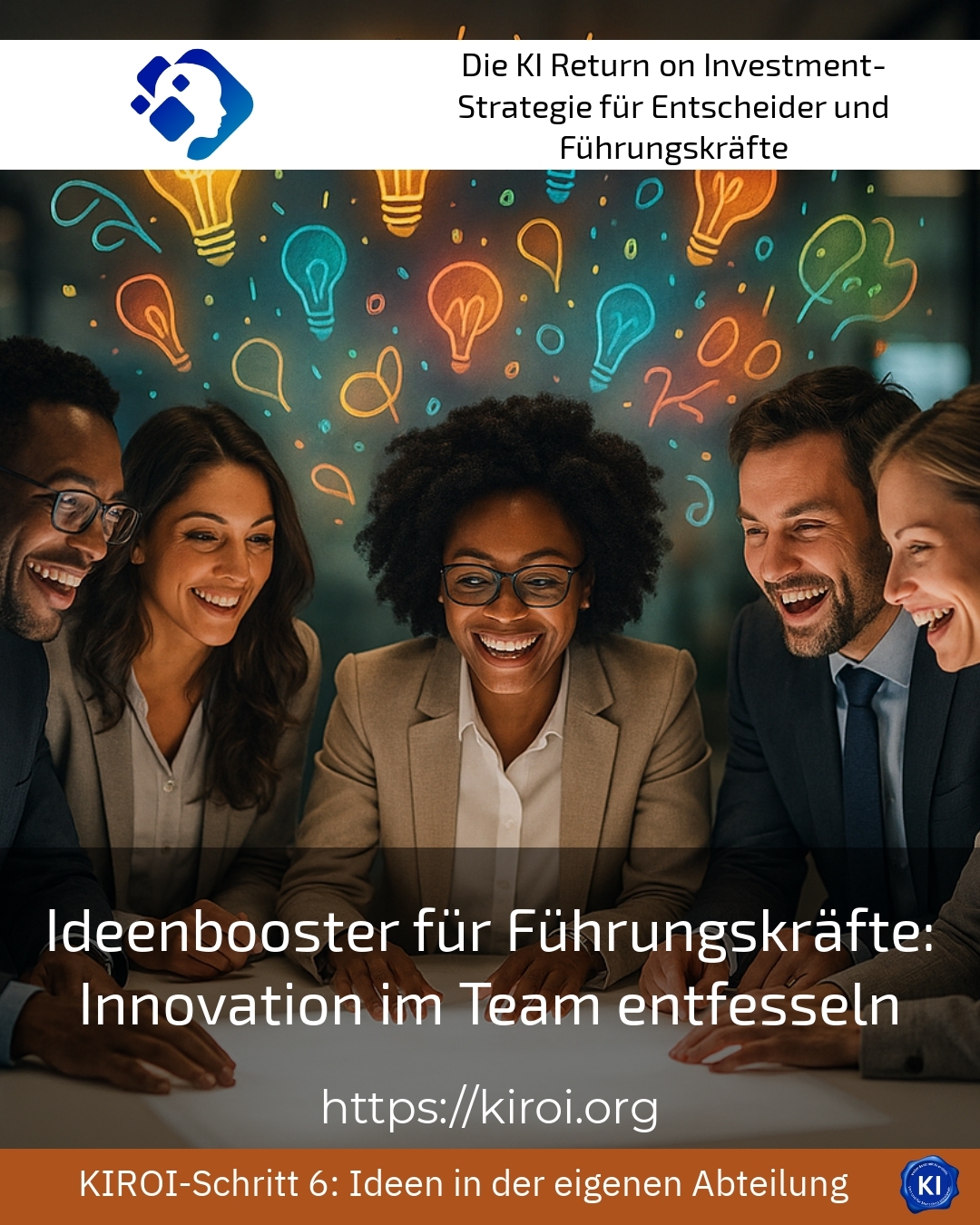
Imagine your team is brimming with groundbreaking ideas. Employees are putting forward proposals that will catapult your company forward. This is exactly what you achieve with a well-thought-out Ideas booster for leaders. However, many decision-makers struggle daily with ingrained thought patterns. They experience meetings that remain at a standstill. The good news is: creative energy can be sparked deliberately. This article shows you how to become a catalyst as a leader. You will learn which methods have a sustainable effect and which pitfalls you should avoid.
Warum klassische Ansätze oft scheitern und neue Wege nötig sind
For years, many companies have relied on tried-and-tested brainstorming sessions. However, these formats often only produce superficial results. The reason lies in group dynamics, which often suppress bold ideas. Introverted team members hold back, while dominant personalities dictate the conversation. Studies by the Fraunhofer Institute show that such sessions rarely lead to actionable concepts [1]. Managers often report frustration because good approaches fizzle out. Transruptions coaching supports companies with precisely these challenges. It helps to break down entrenched structures and introduce new impetus.
For example, a medium-sized mechanical engineering company was struggling with stagnant product development. Engineers were contributing hardly any suggestions for improvements. A pharmaceutical company noticed that its research department was only working incrementally. Radical innovations were absent, even though the market was clamouring for breakthroughs. A financial services provider realised that its teams were not recognising digital opportunities. These examples illustrate why a systematic Ideas booster for leaders has become indispensable.
The role of psychological safety in the creative process
Google conducted extensive research into team effectiveness. The outcome surprised even experienced managers: psychological safety was the most important factor [2]. Employees need to know that unconventional suggestions will not be laughed at. They need the certainty that mistakes are part of the learning process. Leaders bear the responsibility for actively shaping this atmosphere. This means openly addressing their own uncertainties and showing vulnerability.
An automotive supplier implemented so-called "failure parties" where failed projects were analysed. The insight was astonishing, because suddenly developers dared to take riskier paths. A telecommunications provider introduced anonymous idea portals, which increased participation by over fifty percent. A logistics company created protected experimentation spaces where teams could work without pressure to succeed. These measures show how important the right framework is for creativity.
The idea booster for managers as a strategic tool
An effective creativity boost doesn't happen by chance, but through conscious design. Leaders need concrete methods that they can apply immediately. The Design Thinking methodology has proven its worth in many industries [3]. It combines empathy for users with rapid prototyping and iterative improvement. The approach forces teams to leave their usual perspectives. This leads to solutions that are truly oriented towards needs.
An insurance group used this method to completely rethink its claims process. Instead of complicated forms, the teams developed an intuitive app solution. A retail company completely redesigned the in-store customer experience. Employees had never had the opportunity to contribute their own ideas so fundamentally before. An energy provider involved its technicians in the development of smart meters. The result was a product that actually met practical requirements.
Best practice with a AIROI customer
An internationally operating technology company approached us because their internal innovation rate had dramatically decreased. Executives reported a climate of resignation; employees felt that their suggestions wouldn't be heard anyway. "transruptions-Coaching" supported the company intensively over a six-month period. Initially, we analysed the existing communication structures and identified blockages. It became apparent that middle management acted as a filter, halting bold ideas. We implemented a direct pitch format, allowing teams to present their concepts to the board. Additionally, we trained all managers in an appreciative feedback culture. The results significantly exceeded expectations. Within four months, thirteen new projects were initiated, five of which are currently being implemented. Employee satisfaction measurably increased, and the company registered patents again for the first time in years. This case powerfully demonstrates how systematic support can break down ingrained structures.
Enhancing creative impulses through diverse perspectives
Homogeneous teams tend to produce similar solutions. Real breakthroughs occur when different ways of thinking collide. Research from the Harvard Business Review shows that diverse teams work more innovatively [4]. Leaders should therefore consciously bring together individuals from different backgrounds. This applies not only to gender and origin, but also to professional expertise.
A chemical company had its laboratory technicians work with marketing experts on new product ideas. The unusual combination led to completely novel marketing concepts. A media company involved representatives of Generation Z in strategy workshops, which brought fresh air to entrenched thought patterns. A construction company integrated tradespeople into the planning phase of new projects. The practical perspective prevented costly planning errors that had frequently occurred previously.
Practical methods for day-to-day leadership
Theory alone is not enough, which is why concrete tools make the difference. Edward de Bono's Six Thinking Hats method structures discussions productively. Each hat represents a particular way of thinking, allowing for systematic consideration [5]. Leaders can use this technique without extensive preparation. It is particularly suitable for decision-making situations where various aspects need to be taken into account.
A consulting firm integrated the method into all client projects. The quality of recommendations improved noticeably because blind spots were uncovered. A hospital used the approach to develop new treatment pathways. Doctors, nurses, and administration viewed problems from different perspectives. A software company used the technique in product development, which led to more balanced features.
The idea booster for leaders in a digital context
Modern technologies significantly expand the possibilities for creative collaboration. Digital whiteboards enable asynchronous brainstorming across time zones. Artificial intelligence can serve as a sparring partner for unconventional ideas. Leaders should actively integrate these tools into their processes. The combination of human creativity and technological support often produces surprising results.
A fashion company used generative AI to explore new design directions. The algorithms provided inspiration, which human designers then further developed. A food manufacturer experimented with virtual focus groups, enabling faster feedback on new products. A game developer relied on gamified idea platforms, where employees collected points for suggestions.
Best practice with a AIROI customer
A long-established family business in the manufacturing sector sought support with its digital transformation. The workforce was sceptical of change, and previous initiatives had failed. Transruptions coaching developed a multi-stage programme that involved all levels of the hierarchy. We began with future workshops, where employees could voice their concerns and hopes. This open communication built trust and readiness for new things. In the second step, we implemented digital collaboration tools that simplified the exchange of ideas. Establishing an innovation budget, which teams could manage autonomously, was particularly important. Managers learned to relinquish control and grant their employees more freedom. After eight months, the company had built a completely new business division based on digital services. Employees report increased motivation and a feeling of being heard. This transformation process illustrates the importance of patient guidance and a systematic approach.
Sustainable Implementation of Creative Cultures
One-off workshops rarely create lasting change. Leaders need to weave creative practices into the daily work routine. This requires patience and consistent role-modelling of the desired behaviours. Regular reflection sessions help to make progress visible. Small successes should be celebrated to maintain motivation.
An electronics manufacturer introduced weekly innovation hours, where teams could work on their own projects. A tourism company established monthly idea markets, where departments presented their concepts. A retail group embedded creativity goals into the performance reviews of its managers. These structural measures signal that idea generation is not a side issue.
Identifying and constructively addressing resistance
Changes almost always meet resistance, which is completely natural. Some employees fear that their previous work will be devalued. Others have had bad experiences with previous initiatives. Leaders should take these concerns seriously and address them. Coercion rarely leads to genuine involvement and often poisons the atmosphere.
A transport company appointed skeptics as ambassadors for innovations. These critical voices became valuable feedback providers, uncovering weaknesses. A publishing and media house created pilot groups that voluntarily tested new methods. The success of these pioneers gradually convinced even the hesitant. An industrial group explicitly allocated time for doubters in meetings, which significantly improved the discussion culture.
My AIROI Analysis
Guiding numerous companies through transformation projects repeatedly shows me certain patterns. Leaders often underestimate how much their own attitude influences the team. If they themselves don't exude enthusiasm for new approaches, the team will remain sceptical. At the same time, many overestimate the impact of individual measures such as workshops or new tools. Sustainable change requires a whole bundle of coordinated interventions that have an effect over a longer period.
The Ideas booster for leaders It isn't a magic wand, but rather a systematic approach. It includes creating psychological safety, implementing appropriate methods, and utilising modern technologies. The dimension of patience seems particularly important to me, as cultural changes take time. Companies that try to force quick results often achieve the opposite of their intentions. My experience shows that true transformation requires at least twelve to eighteen months of consistent work.
Transruption coaching supports organisations on this journey with tried and tested methods and fresh perspectives. We provide impetus, moderate difficult conversations and support the implementation of new structures. In doing so, we always respect the personal responsibility of the people involved. Change cannot be imposed from the outside, but must grow from within. Our role is to create the right conditions for this growth and to guide the process carefully.
Further links from the text above:
[1] Fraunhofer Institute for Industrial Engineering
[2] Google re:Work – Team Effectiveness
[3] IDEO Design Thinking
[4] Harvard Business Review – Diversity and Inclusion
[5] Edward de Bono – Six Thinking Hats
For more information and if you have any questions, please contact Contact us or read more blog posts on the topic Artificial intelligence here.









 Deutsch
  English (UK)