
Imagine your team suddenly comes up with ideas that could sustainably change your company. What if, as a leader, you could unleash exactly this creative energy? The right idea booster for leaders makes precisely this possible. It transforms rigid structures into vibrant innovation spaces. Many decision-makers struggle with the same problem every day. They know that innovation is important, but everyday life stifles all creativity. Yet, enormous potential slumbers in every team. This potential is just waiting to be awakened.
Why traditional approaches no longer work today
The world of work has fundamentally changed. Hierarchical structures often hinder the free flow of ideas. Employees don't dare to express unconventional suggestions. This fear of rejection blocks valuable innovations. Many companies have a culture of perfection. Mistakes are punished rather than seen as a learning opportunity. As a result, no groundbreaking innovations are emerging anymore.
Clients frequently report similar challenges in their daily lives. They experience teams stuck in routines. Creative meetings often end in endless discussions without outcome. Brainstorming sessions repeatedly produce the same ideas. Real innovative power is lost in the process. This is precisely where professional support comes in. It can provide impetus to break through entrenched patterns.
A medium-sized manufacturing company faced precisely this problem [1]. The management wanted to introduce digital processes. But the workforce blocked every suggestion for change. Fear of the unknown paralysed the entire team. The situation only changed through targeted workshops. The employees suddenly developed their own digital solution approaches. This transformation shows the power of true innovation support.
The idea booster for leaders as a catalyst for change
Innovation doesn't arise by chance or pure willpower. It requires a systematic approach and the right framework. A well-thought-out idea booster for leaders creates exactly these conditions. It combines proven creativity techniques with modern leadership concepts. This creates space for genuine innovation.
Transruption coaching supports leaders with precisely these kinds of projects. It accompanies the entire transformation process from the initial idea to implementation. It's not about ready-made solutions; instead, it focuses on empowering teams. Leaders learn to become innovation drivers themselves.
Best practice with a AIROI customer
An international service provider in the financial sector approached us with a complex challenge. The executive management recognised the need for digital innovation, but middle management systematically blocked every proposal for change. As part of the transruption coaching, we first analysed the existing structures and identified the points of blockage. Together, we developed an innovative workshop approach that involved all hierarchical levels. Participants worked in mixed teams on concrete innovation projects. This resulted in surprising alliances between young talent and experienced managers. After three months, the company had launched five concrete digital projects. Employee satisfaction rose measurably, and staff turnover decreased significantly. Particularly noteworthy was the change in the company's communication culture. Suddenly, even reserved team members dared to contribute their ideas. This transformation continues to have an effect to this day and has positively changed the entire company.
Practical Methods for Everyday Innovation
Theory alone does not generate innovation. Leaders need concrete tools for their daily work. These methods should be easy to apply. At the same time, they must be able to have a profound impact.
The reverse brainstorming technique shows impressive results here [2]. Instead of looking for solutions, you ask about problems. Teams consider how they could guarantee a project's failure. This unusual perspective resolves mental blocks. Afterwards, you reverse the insights and find surprising solutions.
A technology company successfully used this method in product development. The team identified all possible sources of error through reverse brainstorming. This resulted in innovative quality assurance processes that no one had considered before. The product became a market success and exceeded all expectations.
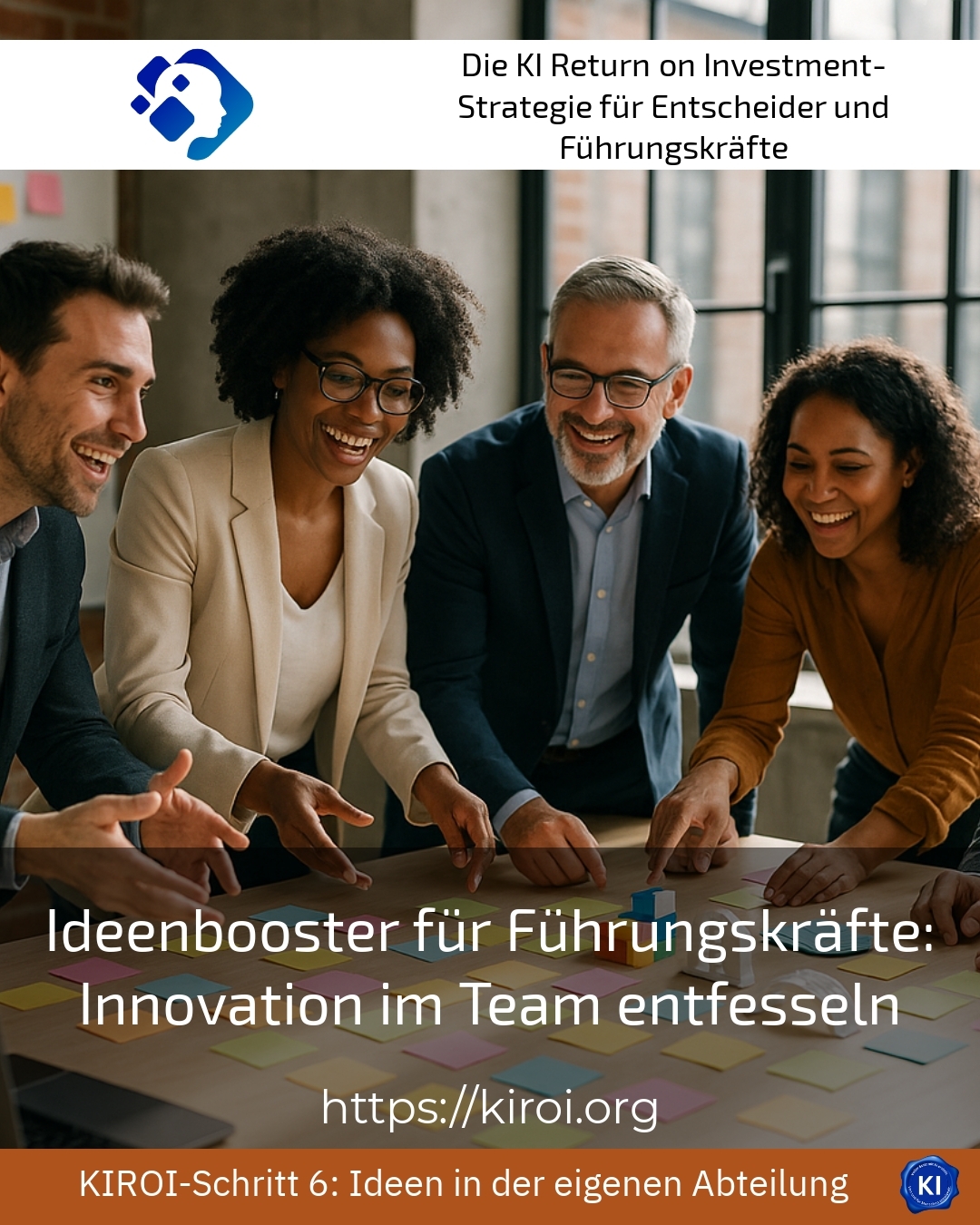
Another tried-and-tested method is so-called silent brainstorming. In this approach, all participants first write down their ideas in silence. Only then are the suggestions collected and discussed. This technique prevents dominant personalities from influencing the idea generation process. Introverted team members can also contribute their thoughts this way.
The role of the leader as an innovation enabler
Leaders need to redefine their roles. They are no longer the all-knowing decision-makers. Instead, they are becoming enablers of innovation. This shift requires a new self-understanding.
The idea booster for leaders starts with their own attitude. Those who do not allow mistakes themselves cannot create a culture of innovation. Leaders must show vulnerability and admit their own insecurities. Only then will employees dare to take risks too.
A retail company impressively demonstrates this transformation [3]. The managing director started speaking openly about his own wrong decisions. He encouraged his team to learn from these experiences. The effect was remarkable and exceeded all expectations. Within a few months, the number of submitted suggestions for improvement doubled.
Transruption coaching supports leaders precisely in this personal development. It's about more than methods and techniques. The inner transformation of the leadership personality is the focus.
Creating structures that foster innovation
Innovation requires freedom, but also clear structures. This apparent contradiction can be resolved. The right framework conditions enable both at the same time.
Time slots for creative work are among the most important structural elements. Many successful companies reserve fixed innovation times [4]. During these phases, teams work exclusively on new ideas. Day-to-day business is consciously excluded.
A logistics company introduced weekly innovation hours. Every Friday afternoon, the entire team experimented with new approaches. Several patentable improvements emerged from these sessions. The investment in creative time paid off multiple times over.
Physical spaces also play an important role in creativity. Creative areas with flexible furniture significantly promote the flow of ideas. Changing work environments stimulate the brain in new ways. Even small changes can have a big impact.
Best practice with a AIROI customer
A medium-sized company in the healthcare sector was looking for ways to increase its innovative capacity. The existing structures had grown over decades and had become very rigid. Together, we developed a comprehensive spatial concept that supports various working styles. We created areas for concentrated individual work, collaborative teamwork, and creative brainstorming. Employees could decide for themselves which area to use for which task. This autonomy led to significantly higher levels of personal responsibility across the entire team. Following the redesign, over eighty percent of the workforce reported increased creativity. The number of internal innovation projects more than tripled within a year. The change in collaboration between different departments was particularly impressive. Previously isolated teams suddenly began working together on cross-functional projects. The company has since established itself as an innovation leader in its industry.
The idea booster for leaders in the digital age
Digital tools open up completely new possibilities for innovation. Collaboration platforms connect teams across locations and time zones. Artificial intelligence can support and accelerate ideation processes. Virtual whiteboards enable asynchronous creative work for distributed teams.
At the same time, digitalisation also harbours risks for the culture of innovation. Constant availability and an overload of information can stifle creativity. Leaders must consciously counteract this and set boundaries. Digital detox periods are part of modern innovation promotion.
A consulting firm successfully combined analogue and digital methods. The teams started innovation projects with handwritten sketches on a whiteboard. Only later did they digitise the results for further processing. This hybrid method combines the best of both worlds.
Overcoming resistance and winning over sceptics
Every change evokes resistance, and that is completely normal. Skeptics on the team are not enemies of innovation. They can provide valuable input for improving ideas. Leaders should take these voices seriously and actively involve them.
Transruption coaching helps leaders constructively deal with resistance. It's about understanding the concerns behind the rejection. Often, legitimate worries or important experiences are hidden behind them.
An insurance company turned its biggest sceptics into innovation ambassadors. These experienced employees knew all the past pitfalls intimately. Their knowledge helped to develop realistic innovation projects. Acceptance throughout the company increased significantly as a result.
Communication plays a crucial role in overcoming resistance. Leaders should be transparent about goals and processes. Regular updates keep everyone involved up to speed. Successes should be celebrated together and communicated widely.
My AIROI Analysis
My extensive experience in innovation support reveals a clear pattern. Successful innovation depends less on brilliant individual ideas and more on systematic approaches. Leaders who truly empower their teams achieve sustainable results. They create cultures where innovation becomes the natural way of working.
The idea booster for leaders is not a one-off event or a quick seminar. It describes a continuous development process for individuals and organisations. This process requires patience, perseverance, and consistent action from all involved. However, the results clearly justify every effort invested.
The connection between personal and organisational transformation appears particularly important to me. Leaders cannot demand a culture of innovation that they themselves do not embody. Authenticity and role modelling are indispensable elements of successful innovation promotion. Transruption coaching therefore accompanies both dimensions simultaneously and links them together.
The companies that invest in their innovative capacity today will be successful tomorrow. They will see changes as opportunities and shape them proactively. Their teams will be intrinsically motivated to seek and find new paths. This future is achievable, and the path to it begins with the first step.
Further links from the text above:
[1] Harvard Business Review – Innovation Management
[2] IDEO U – Brainstorming Techniques
[3] McKinsey – The Eight Essentials of Innovation
[4] Forbes – Creating Innovation Time
For more information and if you have any questions, please contact Contact us or read more blog posts on the topic Artificial intelligence here.









 Deutsch
  English (UK)