
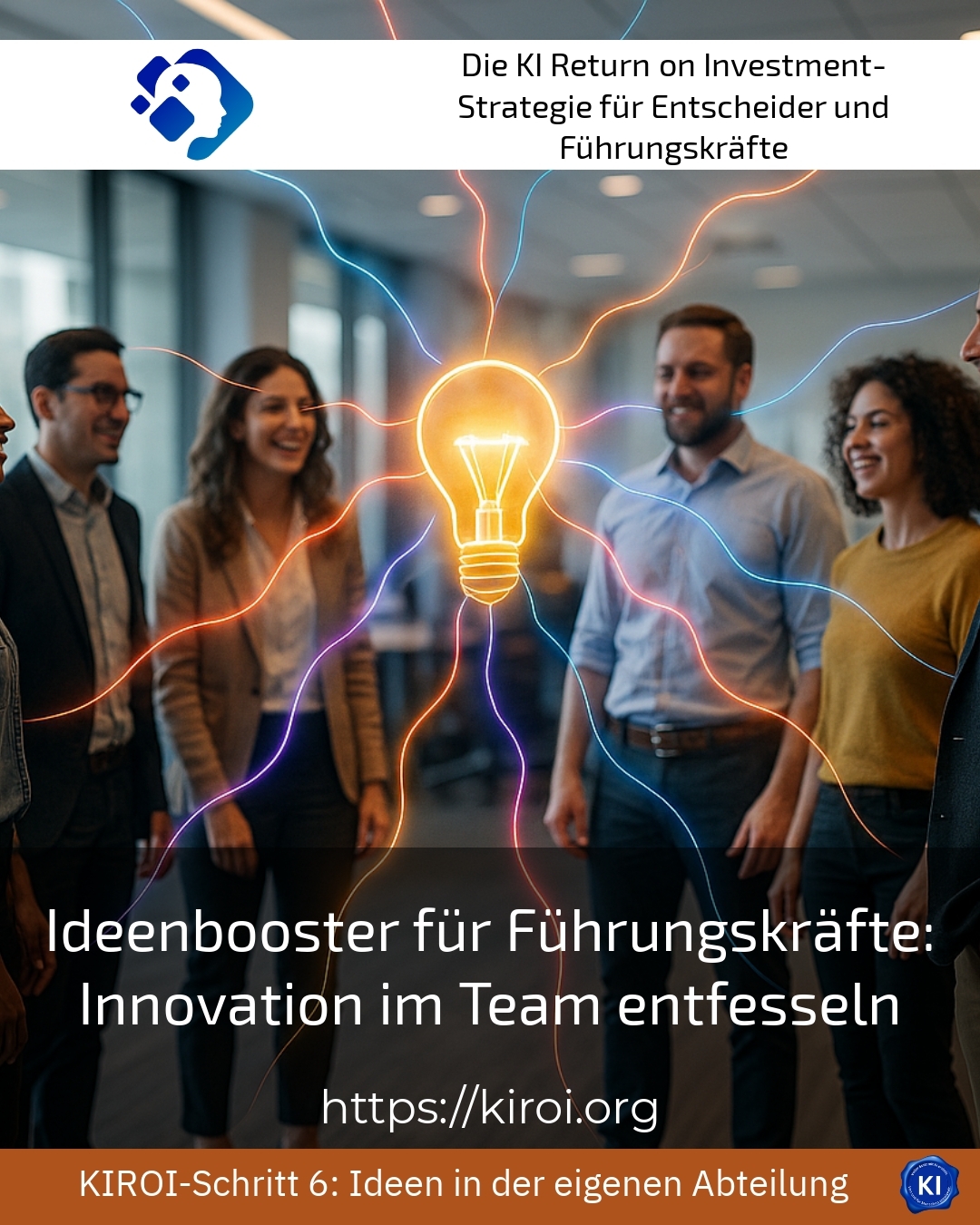
Imagine your team suddenly developing solutions that catapult your entire organisation forward. This is precisely what happens when leaders act as true idea boosters. But how do you unleash innovation within a team and unlock creative potential? In a rapidly changing world, companies need more than tried-and-tested strategies. They need people who bravely forge new paths. This article presents concrete approaches and proven methods, showing you how to become a catalyst for groundbreaking ideas as a leader.
Why creative impulses are indispensable today
The modern world of work presents leaders with entirely new challenges. Markets are changing faster than ever before. Technological developments demand continuous adaptation. At the same time, employees expect more opportunities for co-creation. Companies that rely on idea boosters for leaders create a decisive competitive advantage [1]. They establish a culture in which new ideas are welcomed. This leads to innovative products and services.
Let's consider the automotive industry, for example. Here, electromobility and autonomous driving are revolutionising established business models. A manufacturer of combustion engines had to rethink its entire product development. The leadership initiated regular innovation workshops. Teams from different departments worked together on future scenarios. The result was a completely new product line for urban mobility. Something similar happened with a supplier of classic drive technology. Management recognised the need for transformation. They actively encouraged ideas from the workforce. Several patentable innovations emerged within a short period. A logistics company also used this approach. Through employee suggestions, they developed data-based route optimisation.
Idea booster for managers: Understanding the basics
Before you can unleash innovation in the team, you need a solid foundation. Creativity doesn't happen at the push of a button. It requires certain conditions [2]. These include psychological safety and sufficient freedom. Employees must dare to voice unusual suggestions. They cannot be afraid of negative consequences. Only then does true innovative power flourish.
A financial services provider has consistently implemented this insight. The company established so-called "mistake culture rituals". In monthly meetings, teams shared their failed experiments. The best learnings were even awarded. This fundamentally changed the entire company culture. An insurance group went one step further. They set up their own innovation labs. There, employees could experiment freely, unburdened by everyday constraints. A private bank, in turn, used design thinking workshops. They developed completely new consulting concepts for young customers with them.
Best practice with a AIROI customer
A medium-sized company in the mechanical engineering sector found itself in a critical situation. The order book was healthy, but its innovative capacity had been stagnating for years. Management decided to engage transruption coaching. Together we analysed the existing structures and communication channels. In doing so, an interesting pattern emerged. Good ideas certainly existed within the workforce, but they found no path to implementation. There was a lack of clear processes and designated points of contact. We developed a multi-stage innovation management system. Each department was assigned an innovation officer. These individuals received specific training and were networked. Regular interdepartmental meetings fostered exchange. Within six months, over thirty concrete suggestions for improvement had been generated. Eight of these were implemented directly. Three led to significant cost savings. Employee satisfaction rose measurably. Today, the company reports a completely transformed innovation culture.
Methods for releasing creative energy
There are numerous tried-and-tested techniques for generating ideas. Everyone knows brainstorming, yet it is often applied incorrectly. Structured methods such as the Six Thinking Hats technique are more effective. They force participants to adopt different perspectives. The method of inverted questioning also yields surprising results. Teams consider how they could make a problem worse. From these insights, they derive positive solutions [3].
A telecommunications company used this method successfully. It developed new service offerings for business customers. An energy provider relied on rapid prototyping. Teams built initial product models within a day. These were immediately tested with customers. A software company established regular hackathons. Developers worked intensively on innovative projects. Several of these projects resulted in marketable products.
The role of the leader as an idea booster
Leaders critically shape the culture of innovation. Their behaviour sends clear signals to the team. If they are curious themselves, it inspires others. If they address mistakes openly, it encourages experimentation. Idea boosters for leaders also mean self-reflection. They should regularly question their own thought patterns. Only then can they avoid creative blockades within the team.
A trading company impressively demonstrated this. The CEO personally participated in creative workshops. He contributed his own ideas and listened actively. This role model fundamentally changed the entire corporate culture. A pharmaceutical company trained its executives in creative facilitation techniques. The quality of team meetings improved noticeably. A media company established reverse mentoring programmes. Junior employees coached experienced managers on digital topics. This significantly fostered intergenerational exchange of ideas.
Unlocking innovation in a team through targeted communication
Communication is the key to successful innovation work. Leaders should regularly ask for ideas. They should practice active listening. The right kind of feedback is also important [4]. Constructive criticism promotes the further development of ideas. Destructive comments, on the other hand, nip creativity in the bud. Therefore, teams need clear communication rules.
An architecture firm introduced so-called "idea surgeries". Employees could present suggestions directly there. The response was overwhelming. An engineering company used digital idea platforms. Anyone could submit suggestions for improvement there. The best ideas were awarded monthly. A consulting firm established storytelling as a communication method. Innovative projects were told as exciting stories. This increased emotional engagement with innovation processes.
Best practice with a AIROI customer
A long-established family business from the food industry approached us for transruption coaching. The challenge was a rigid company culture. New ideas were often dismissed with the phrase, "that's how we've always done it." The second generation wanted to fundamentally change this. Together, we developed a communication strategy for change. First, we held individual discussions with key personnel. During these, we identified hidden innovators within the company. These individuals became internal ambassadors for change. We established new meeting formats with clear rules. Criticism of ideas always had to be accompanied by an alternative suggestion. We also introduced an ideas pipeline. Every proposal went through defined evaluation stages. The transparency of this process created trust. Today, employees report a more open atmosphere. The number of submitted suggestions for improvement has tripled. The company is now independently developing innovative product variations.
Identifying and overcoming obstacles
There are numerous pitfalls on the way to an innovation culture. One of the most common is a lack of time. Teams get caught up in day-to-day operations. There's no capacity left for creative thinking. Therefore, leaders should consciously create free spaces. Hierarchical thinking can also block innovation. If only superiors are allowed to contribute ideas, valuable impulses are lost.
An industrial company recognised this problem in good time. It introduced weekly creative hours. During this time, regular work was officially forbidden. An IT company granted employees twenty percent innovation time. Similar to well-known technology corporations, groundbreaking projects emerged there. A retailer broke down hierarchies through cross-level teams. Trainees worked together with managing directors as equals. The diversity of perspectives led to surprising solutions [5].
Ideenbooster for Leaders: Tools and Resources
Modern technologies significantly support innovation processes. Collaboration tools enable brainstorming regardless of location. Digital whiteboards vividly visualise complex interrelationships. Artificial intelligence can even assist in generating ideas. It analyses large datasets and identifies patterns. Nevertheless, humans remain at the centre of creative processes.
A furniture manufacturer used virtual reality for product development. Designers could virtually experience new pieces of furniture. Customers tested prototypes before they physically existed. A chemical company relied on simulation software. This significantly accelerated the development of new compounds. A tourism company used crowdsourcing platforms. Customers contributed their own travel ideas. The best suggestions were actually realised.
Long-term embedding of innovation culture
One-off workshops are not enough. A genuine culture of innovation requires continuous nurturing. Leaders should establish routines. Regular brainstorming sessions should be part of everyone's calendar. Recognising innovation is also important. Successful ideas deserve public recognition. This motivates others to follow suit.
A healthcare company embedded innovation in its values. Every employee knew the importance of creativity. A construction company linked innovation to performance objectives. Managers were also assessed on their innovation achievements. A technology group created its own innovation awards. These were presented annually at a large ceremony. The winners received additional resources for further projects.
My AIROI Analysis
The intensive examination of this topic reveals clear patterns. Successful companies do not treat innovation as an optional add-on. They understand it as a strategic necessity. Leaders play a central role in this. They create the framework and embody values. At the same time, they must be able to relinquish control. Only then can teams fully unleash their creative potential.
My experiences from numerous accompanying projects confirm this. Companies that rely on transruption coaching report positive changes. They develop innovative solutions more quickly. Employee satisfaction often rises in parallel. However, the seriousness of the approach is crucial. Half-hearted attempts regularly fail. Real transformation requires time and commitment.
The connection between methodology and humanity seems particularly important to me. The best tools are of little use without the right attitude. Leaders should be authentically curious. They should show a genuine interest in their teams' ideas. This then builds trust as the foundation for innovation. The future belongs to organisations that internalise this principle.
Further links from the text above:
[1] Harvard Business Review: Innovation Management
[2] McKinsey: Essentials of Innovation
[3] IDEO: Brainstorming Techniques
[4] Forbes: Leadership Communication Strategies
[5] MIT Sloan Management Review: Innovation and Creativity
For more information and if you have any questions, please contact Contact us or read more blog posts on the topic Artificial intelligence here.










 Deutsch
  English (UK)