
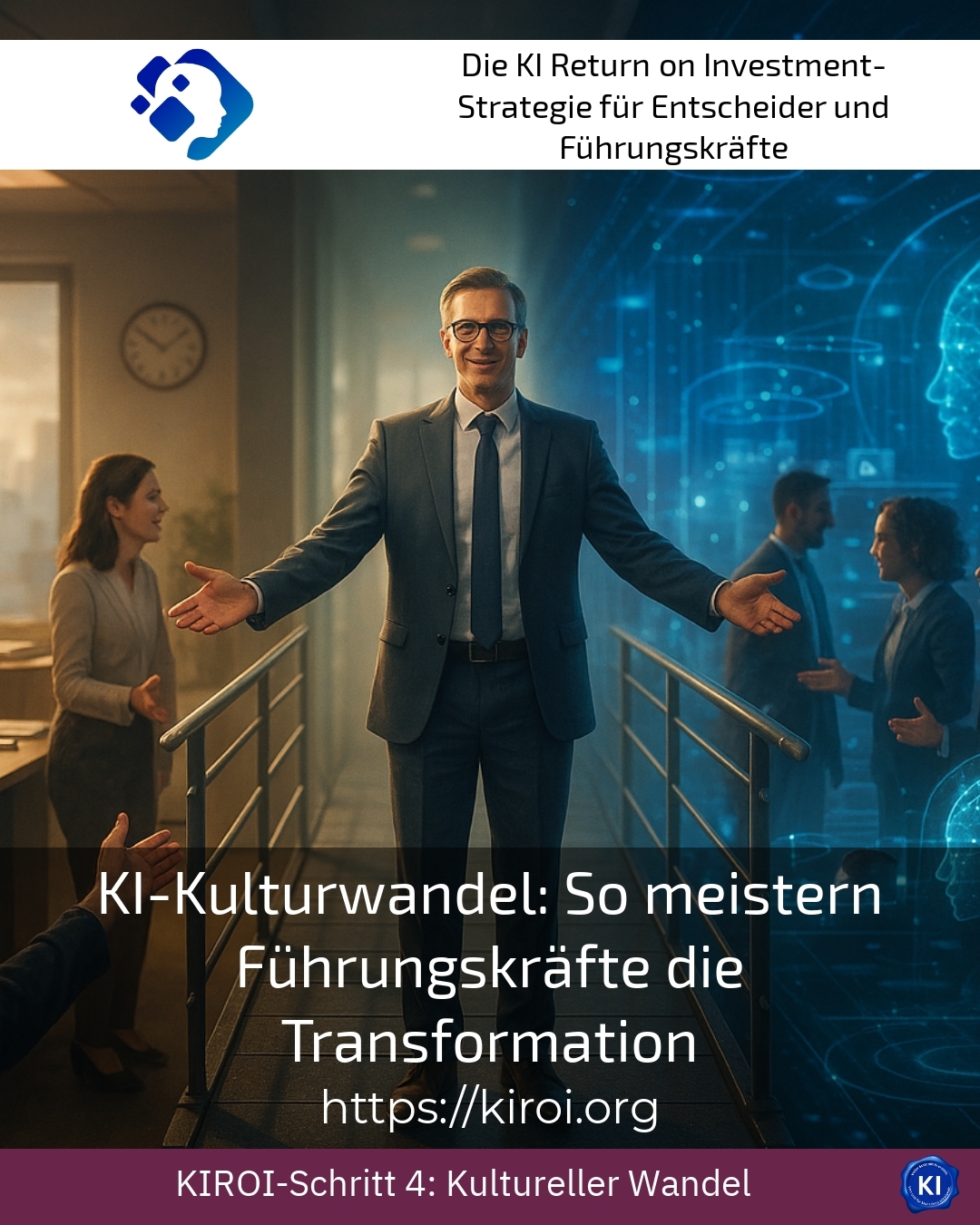
The digital revolution is fundamentally changing the entire economic landscape. But while many companies are still debating technology, true success is being decided elsewhere. The AI cultural change presents leaders with entirely new challenges. It is no longer just about software or algorithms. Instead, a profound transformation of corporate culture is at the heart of the matter. Those who actively shape this change will define the future. Those who ignore it risk falling behind. This article shows you how you, as a leader, can successfully master this transformation.
Why the AI culture shift requires more than just technology
Many decision-makers underestimate the human dimension of transformation. They invest millions in new systems and are surprised by the lack of results. The reason often lies in a neglected company culture. Employees feel overwhelmed or even threatened by the changes. Managers often communicate too technically, forgetting the emotional component. Yet, it is precisely the cultural readiness that determines the success or failure of any transformation.
For example, a medium-sized manufacturing company introduced intelligent quality control systems. The technology worked perfectly, but acceptance was lacking. Experienced skilled workers felt their expertise was not appreciated. Only a comprehensive accompanying programme could improve the situation. A logistics service provider experienced something similar when introducing automated route planning. The dispatchers suddenly felt their years of experience were being called into question. Here too, only a culturally sensitive approach that took concerns seriously helped. A retail company, on the other hand, initially failed due to a lack of leadership communication. Management had not sufficiently communicated the strategic importance [1].
Best practice with a KIROI customer A traditional family business in mechanical engineering faced a unique challenge. The workforce was proud of their craftsmanship and sceptical of any automation. For several months, transruption coaching intensively supported the management level. Initially, the genuine fears and concerns of the employees were systematically recorded. This revealed that many apprehensions were based on misinformation. Together with the management, the coaches developed a transparent communication strategy. Regular dialogue formats facilitated open, peer-to-peer exchange. The involvement of experienced skilled workers as multipliers was particularly important. They were trained as internal ambassadors for change. After six months, the mood had significantly shifted. The employees recognised the new tools as support for their work. Productivity rose measurably, and staff turnover dropped considerably. This example impressively demonstrates how cultural support can make a difference.
The Role of the Leader in AI Culture Change
Leaders must fundamentally redefine their roles. They move from being decision-makers to enablers of a learning organisation. This demands new competencies and often a changed self-perception. Many managers report uncertainty in dealing with these demands. They wonder how they can provide direction amidst constant change. At the same time, they themselves must first learn to handle new tools.
A sales director at a pharmaceutical company experienced this challenge up close. His team was supposed to use data-driven decision-making systems for customer support. He himself had little experience with such analytical methods. Instead of hiding his uncertainty, he communicated it openly. This authenticity built trust and encouraged others to be honest too. A department head in the healthcare sector chose a similar path. She made her own learning journey transparent to her team. This created a culture of shared growth rather than mutual blame. A plant manager in the automotive supply industry established weekly learning sessions. There, managers and employees exchanged experiences as equals [2].
Communication as the key to successful transformation
Without clear communication, every change initiative fails. Leaders must be able to explain the "why" before the "how". Employees want to understand the purpose of the transformation. They ask about the impact on their daily work. Abstract strategy presentations rarely reach people's hearts. Instead, concrete stories and tangible examples are needed.
An insurance group developed an internal storytelling programme for this purpose. Employees shared their initial experiences with intelligent assistance systems. These stories were shared across the company in various formats. The effect was remarkable: acceptance increased significantly faster than expected. A bank used similar methods for its transformation in customer service. Consultants reported positive experiences with predictive analytics tools. This made abstract technologies into concrete everyday aids. An energy supplier relied on regular town hall meetings with open Q&A sessions. Board members also personally addressed critical questions.
Understanding and constructively using resistance
Resistance to change is natural and even valuable. It shows where genuine concerns and unresolved issues lie. Savvy leaders use these signals as a source of information. They don't suppress criticism, but rather invite open discussion. In doing so, they distinguish between legitimate objections and knee-jerk defensive reactions. This differentiation requires empathy and patience in equal measure.
A media company encountered strong resistance when introducing automated text generation. Journalists feared for their creative autonomy and professional identity. Management responded with a participatory development process. Those affected could actively help shape how the new tools were used. An engineering firm faced similar challenges with planning automation. Experienced planners felt their expertise was threatened by algorithms. Management established a reverse mentoring programme. Younger, digitally savvy employees learned the trade from the experienced ones. In return, they imparted new digital skills to their mentors [3].
Best practice with a KIROI customer An internationally active chemical group had undergone several failed transformation attempts. The staff were consequently sceptical of new initiatives. The transruption coaching began with a comprehensive cultural analysis of the entire company. This revealed hidden blockages and informal power structures. It became apparent that middle managers were acting as a bottleneck. They felt caught between the demands from above and below. The support therefore initially concentrated on this important management level. In intensive workshops, fears were addressed and new perspectives developed. The participants recognised their key role as change catalysts for the transformation. They learned methods for moderating change in their teams. At the same time, they received more autonomy in implementing strategic objectives. This combination of empowerment and responsibility had a transforming effect. Within a year, all relevant employee satisfaction indicators had significantly improved. The cultural change had finally found a viable foundation.
The AI cultural shift as a continuous process
Transformation is not a project with a defined end. It is a permanent stance and capability of the organisation. Leaders must internalise and embody this realisation. This also means regularly questioning one's own certainties. Agility does not arise from methods alone, but from cultural embedding. Only in this way can a company remain adaptable in the long term.
A telecommunications provider established a permanent transformation team for this purpose. This team continuously works on developing the corporate culture. It identifies new requirements early and prepares the organisation for them. A retail group introduced regular culture audits in all branches. These audits measure not only key figures but also moods and attitudes. In this way, cultural change requirements are identified and addressed at an early stage. An auditing firm integrated reflection routines into all management meetings. At the end of each meeting, there is a joint reflection on how they work together [4].
My KIROI Analysis
Observations from numerous support projects reveal a clear pattern. Companies rarely fail due to the technology itself. They fail due to a lack of cultural readiness and insufficient leadership skills. AI cultural change requires a holistic consideration of all dimensions. Technical, organisational and human aspects must be considered together.
The significance of the middle management level is particularly striking. This group is often overlooked or viewed as a mere implementation mechanism. However, it is precisely they who determine the success or failure of any transformation. Leaders in this position require intensive support and genuine appreciation. They must be empowered to bridge the gap between strategy and day-to-day reality.
Equally important is the realisation that speed isn't everything. Many companies rush through transformation programmes without lasting impact. Cultural embedding requires time and patient support. Quick successes are possible, but they must be embedded in long-term development. Transruption coaching can provide valuable impetus and support processes here. It guides leaders in developing their own authentic leadership style. This creates a transformation that truly holds and has a lasting effect.
Further links from the text above:
[1] Harvard Business Review – Leadership and Management
[2] McKinsey Insights – People and Organisational Performance
[3] Forbes – Leadership Strategy
[4] MIT Sloan Management Review – Leading Change
For more information and if you have any questions, please contact Contact us or read more blog posts on the topic Artificial intelligence here.











 Deutsch
  English (UK)