
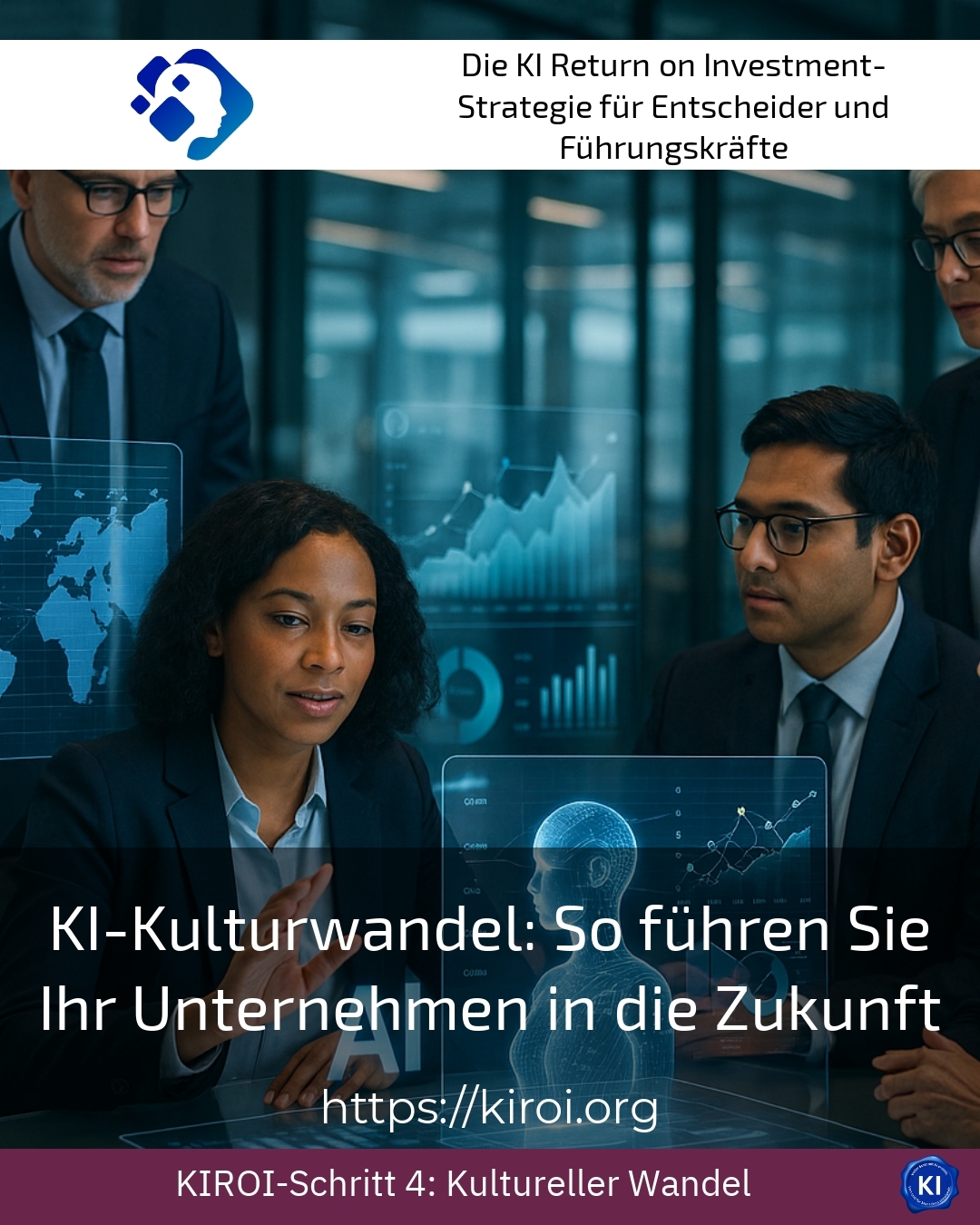
Imagine your company is at the crossroads of an epochal transformation. The question is no longer whether artificial intelligence will change your industry. The question is, rather, how you can actively shape this change. The AI cultural change This affects almost every organisation today. Many leaders feel the pressure to act quickly. At the same time, they often lack direction for this complex process. Clients frequently report uncertainty and feeling overwhelmed. These feelings are entirely understandable and justified. However, there are tried-and-tested methods that can accompany and support this change.
Why the AI cultural shift means more than just technology
Many companies initially view artificial intelligence purely as a technical project. They invest in software, algorithms, and computing power. However, this perspective falls significantly short. Technology alone does not change a company culture. People must be willing to adopt new ways of working. Processes must be adapted and structures rethought. For example, a financial service provider introduced an AI-powered risk analysis. The technology functioned perfectly. Nevertheless, employees hardly used it. The reason lay in a lack of acceptance and insufficient preparation. Another example shows a retail company with automated warehouse management. The introduction initially failed due to resistance from the workforce. Only after intensive support was successful integration achieved. A logistics group experienced something similar with AI-based route optimisation. Dispatchers initially trusted their own experience more. Transruption coaching can provide valuable impetus here [1].
Understanding the human dimension of change
Change initially causes uncertainty in most people. This reaction is evolutionarily ingrained and completely normal. Leaders should by no means underestimate this aspect. A mechanical engineering company introduced predictive maintenance systems. The technicians initially feared the loss of their expertise. Through open communication, scepticism turned into enthusiasm. A pharmaceutical company integrated AI into drug development. The researchers initially saw their scientific competence threatened. Through targeted involvement, they became advocates of the new methods. An energy provider also experienced similar dynamics in grid optimisation. The engineers ultimately recognised the advantages of intelligent support. These examples show the central importance of human factors.
Best practice with a AIROI customer A medium-sized manufacturing company faced the challenge of introducing intelligent quality control systems. Initially, the workforce reacted with considerable reluctance to the planned changes. Many employees feared that their many years of experience would be devalued. The company decided to provide accompanying support through transruptive coaching. In several workshops, the teams collaboratively explored the potential of the new technology. Employees actively contributed their expertise to the implementation. This participative approach led to significantly higher acceptance. The quality inspectors realised that AI would relieve them of routine tasks, freeing up time for more demanding analytical work. After six months, over eighty percent of those involved reported positive experiences. The error rate decreased measurably, while employee satisfaction increased. This example highlights the importance of cultural accompaniment for technical projects.
Strategic steps for successful AI cultural change
A well-thought-out strategy forms the foundation of every successful transformation. It's not about perfect planning, but about clear direction. Leaders should first conduct an honest assessment. Where does the company currently stand regarding digital maturity? What competencies are already present, and which are still missing? A media company comprehensively analysed its content production. The insights enabled targeted AI integration in text generation. An insurance group systematically reviewed its claims processing. The analysis revealed significant potential for intelligent automation. A telecommunications provider also benefited from a structured starting point. Customer service optimisation through AI was consequently much smoother [2].
Leaders as shapers of change
The role of leadership can hardly be overestimated. Leaders shape the entire corporate culture through their behaviour. They must not only announce change but also embody it. An automotive supplier experienced this when introducing AI design tools. The management demonstratively used the new tools themselves. This role-modelling significantly accelerated acceptance. A chemical company focused on intensive leadership development in AI. Managers were first familiarised with the possibilities themselves. They were then able to authentically support their teams. At a construction group, project managers actively supported BIM integration with AI components. Their commitment was infectious for the entire organisation. These examples underline the multiplier effect of engaged leadership.
Communication as the Key to AI Culture Change
Transparent and continuous communication forms the backbone of any transformation. Employees must understand why changes are happening and what they mean. Lack of clarity breeds rumours, fears and resistance. A food manufacturer communicated its AI strategy through various channels. Regular town hall meetings, intranet updates and team discussions created transparency. Employees felt informed and involved. A textile company used storytelling to convey complex contexts. Concrete success stories from within their own organisation were more convincing than abstract visions. An IT service provider also relied on narrative communication formats. This allowed the messages to reach employees who were less technically savvy. These approaches demonstrate the diversity of effective communication strategies [3].
Best practice with a AIROI customer A retailer with international operations wanted to implement AI-powered demand forecasting. The previous manual planning processes were to be supplemented by intelligent algorithms. The purchasing department initially reacted to this announcement with significant reservations, with many employees feeling their professional expertise was being questioned. The company subsequently initiated a structured communication process with the support of transruptions-coaching. Concerns could be openly voiced in moderated dialogue rounds. The project managers took these worries seriously and actively integrated feedback. The buyers were involved as experts in the algorithm development. Their expertise directly fed into the parameterisation of the forecasting models. This appreciation fundamentally changed the mood. After a year, most stakeholders viewed AI as a helpful partner. Forecasting accuracy improved significantly, while excess stock decreased. The success was largely based on the successful communication support.
Systematically design competence development
New technologies require new skills from employees. This skills development must be approached strategically and for the long term. One-off training sessions are not sufficient for sustainable change. A healthcare provider developed a comprehensive AI qualification programme for nursing staff. The training combined theoretical knowledge with practical applications. Employees gained confidence in using diagnostic support systems. An educational provider invested in the continuous professional development of its administrative staff, which led to the successful establishment of AI-assisted student administration. A cultural institution also benefited from systematic skills development, enabling its employees to confidently use AI tools for archive digitisation. These examples highlight the value of long-term qualification strategies.
Constructively use resistance
Resistance to change is not a disruption, but valuable information. It shows where fears exist and which questions remain unanswered. Clever leaders use resistance as a resource for improvement. A tourism company initially experienced rejection with AI-based booking optimisation. The travel agents feared the loss of personal customer relationships. Through intensive discussions, it became clear that the technology should support these relationships. A sports club met with scepticism regarding AI-driven training planning. The coaches doubted that individual player particularities would be considered. Their criticism led to refined algorithm development. It was a similar story with a hotel chain using AI-supported revenue management. The initial resistance resulted in better processes [4].
Small steps with a big impact
Transformations rarely succeed through revolutionary upheavals in a short period. Evolutionary approaches with manageable steps are often more sustainable. Pilot projects enable learning experiences without existential risks. A furniture manufacturer initially tested AI design assistants in one department. The positive experiences sparked interest in other areas. The organic spread happened almost by itself. A catering company piloted intelligent menu personalisation at a few locations. The successes convinced sceptical franchise partners. A property developer also relied on gradual implementation. AI-powered location analysis was initially used as a supplement. These examples illustrate the power of small successes.
My AIROI Analysis
The preceding considerations impressively show that the AI cultural shift goes far beyond technical implementations. Organisations that successfully shape this change invest consistently in their people. They create spaces for dialogue, learning and co-development. The AIROI perspective emphasises the importance of integrated approaches. Technology, processes and culture must be viewed as an interconnected system. Isolated measures rarely lead to sustainable results. Transruption coaching can offer valuable support in project design. The analysed examples illustrate several patterns of success. Leaders who authentically embody the transformation achieve greater acceptance. Participative approaches that involve employees as experts significantly reduce resistance. Transparent communication builds trust and minimises fears. Gradual implementations enable valuable learning processes without excessive risks. At the same time, the analysis shows that there are no universal recipes for success. Each organisation must find and shape its own path. The specific industry, company culture and starting point influence the optimal approach. External support and structured reflection can provide important impulses. The future belongs to companies that combine technology and humanity. Finding and maintaining this balance remains a continuous task. The AI cultural shift is not a one-off project with a defined end. It is rather an ongoing development process that requires attention and commitment.
Further links from the text above:
[1] Business Transruption Coaching
[2] Successfully shaping digital transformation
[3] Change communication in practice
[4] AI strategies for the mid-market
For more information and if you have any questions, please contact Contact us or read more blog posts on the topic Artificial intelligence here.










 Deutsch
  English (UK)