
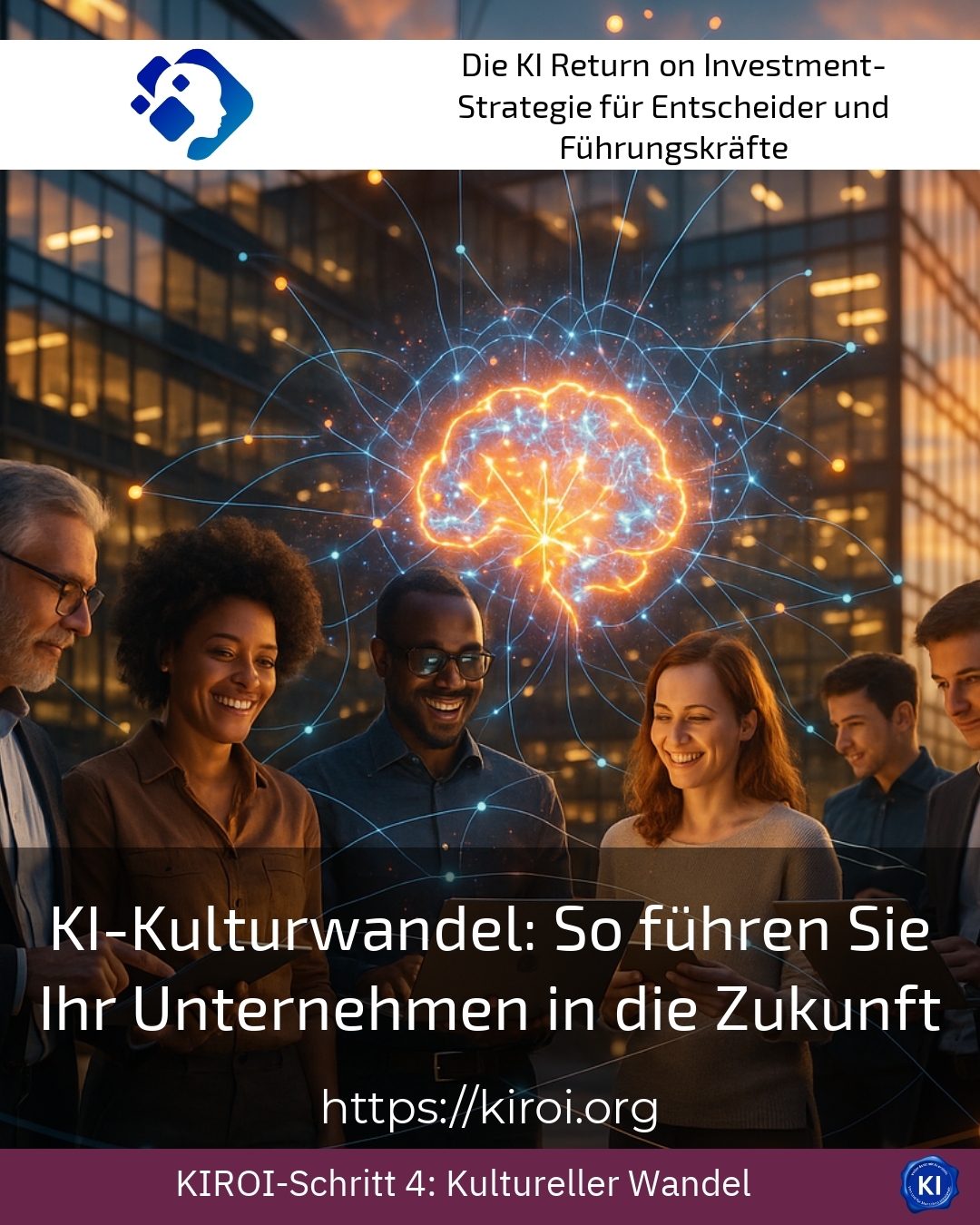
The digital revolution is changing everything. Companies are at a fundamental crossroads. AI cultural change This is far more than just a technological update. It affects people, processes, and the entire corporate DNA. Those who don't act now will be left behind. But how can this change actually be achieved? What steps lead to success? And why do so many transformation projects fail? These questions concern leaders worldwide. The answers are complex, but attainable. This article outlines concrete paths forward.
Why the AI culture shift is indispensable today
Technology alone does not create change. People must embrace and live it. This is precisely where the greatest challenge lies for modern organisations. Many companies invest millions in new systems. Yet, the hoped-for results often fail to materialise. The reason is simple, but far-reaching. Without cultural embedding, every technological innovation fizzles out. Leaders must understand that transformation begins in the mind. It requires new ways of thinking and changes in behaviour. Only then do digital tools unleash their full potential.
A medium-sized mechanical engineering company recognised these connections late. The company had introduced modern analysis tools, but employees hardly used them. Skepticism and fear dominated the workforce. The situation only changed after intensive support. Workshops and open dialogues created trust. Today, employees report tangible improvements in their work. Companies in the logistics sector are having similar experiences. There, too, the value of cultural preparation is evident. An automotive supplier went even further. They established internal ambassador teams for the change. These teams accompanied colleagues through the process.
Best practice with a AIROI customer A family-run business with a long tradition in the manufacturing sector faced enormous challenges in digitalising its production processes. Management had already made several attempts to integrate intelligent systems into production. Each time, the projects failed due to resistance from experienced skilled workers. transruptions-Coaching supported the company over several months during this sensitive transformation process. Initially, the specific concerns and reservations of the employees were recorded and documented in individual discussions. This revealed a surprising picture of fears and uncertainties. Many employees feared that their decades of expertise could suddenly become worthless. Others simply had no idea how their daily work would change. Based on these findings, the team developed tailor-made information formats and training concepts. The involvement of department heads as multipliers for cultural change proved to be particularly effective. Within six months, the mood throughout the company noticeably shifted for the better. The new systems are now actively used and appreciated by a large majority of the workforce.
Understanding the Human Dimension in the AI Cultural Shift
Change always generates emotions. These can be positive or negative. Savvy leaders take both sides seriously. They create space for honest conversations. At the same time, they communicate an inspiring vision of the future. It helps to clearly illustrate specific benefits. Abstract promises rarely convince anyone. Stories from successful colleagues, on the other hand, have a lasting impact. They show that change can be possible and enriching.
A financial services provider successfully used exactly this approach. The company systematically gathered positive testimonials. These were shared in internal newsletters and meetings. This created real role models for sceptical team members. An insurance company followed a similar path with great success. There, employees organised voluntary learning groups after work. Participation far exceeded the HR department's expectations. A third example comes from the healthcare sector. A hospital chain introduced monthly innovation discussions with the board. Every employee could ask questions and express concerns there. This transparency fostered enormous trust throughout the organisation. [1]
Recognising and constructively using resistance
Resistance is not a weakness. It signals commitment and concern for the company. Leaders should view it as valuable feedback. Often, important pointers to weaknesses are hidden behind rejection. A retail company discovered serious process gaps in its ordering system in this way. The critical employees had drawn attention to real problems. After these were rectified, acceptance of the new systems increased significantly.
A similar scenario occurred with a power company in southern Germany. There, technicians had expressed significant concerns about automated grid monitoring. Their objections led to important system adjustments. Ultimately, a solution was developed that convinced all parties involved. A telecommunications provider even systematically used criticism as a source of innovation. Every documented objection was analysed by a team of experts. The best suggestions for improvement were prioritised for implementation and acknowledged. This culture of constructive criticism continues to positively shape the company today.
Leaders as enablers of change
Without exemplary leadership behaviour, cultural change cannot be achieved permanently. Managers must become learners themselves. They should openly admit that they too have to learn new things. This attitude creates psychological safety in teams. Employees are then more likely to dare to ask questions. They experiment more boldly with new tools and methods. Mistakes are understood as learning opportunities, not assessed as failures.
A chemical company intensively trained all its leaders in front of the employees. The leaders were subsequently able to competently answer questions and alleviate concerns. A media company committed its entire top management to monthly practical exercises. The executive board demonstratively used new systems in their daily work. A construction company established regular reflection sessions for leaders at all levels. During these sessions, successes and failures of the transformation were openly discussed. This practice created a culture of shared learning throughout the entire company. [2]
Best practice with a AIROI customer An international logistics service provider sought support in realigning its leadership culture in the context of digital transformation. transruptions coaching initially supported the top leadership level in developing a shared future vision for the entire company. It quickly became apparent that even experienced managers had significant knowledge gaps regarding new technologies. This realisation was initially uncomfortable for many of those involved. However, it was precisely this honesty that enabled an authentic culture change from the top down. In a structured process, the leaders developed individual learning plans for themselves. They defined concrete milestones and regularly reported on their personal progress. This transparency radiated to all hierarchical levels and transformed the corporate culture in the long term. Employees later reported a completely new approach to mistakes and uncertainties. The willingness to experiment measurably increased throughout the company. At the same time, cross-departmental collaboration improved noticeably and sustainably. The company is now considered a pioneer for modern leadership culture in its industry.
Communication as the Key to AI Culture Change
Good communication is decisive for the success or failure of any transformation. Companies regularly and massively underestimate this factor. One-off announcements are never enough for sustainable change. Instead, continuous dialogue at all levels of the organisation is required. Messages must be repeated and conveyed in different formats. Different target groups need different approaches and content.
A consumer goods manufacturer developed a comprehensive communication strategy for its transformation. Videos, podcasts, and interactive workshops meaningfully complemented traditional information events. A software company set up an internal Q&A platform for transformation topics. Employees could anonymously articulate their concerns and questions there. Managers responded promptly and visibly to everyone. A pharmaceutical company successfully used storytelling formats for its change process. Real success stories from various departments were professionally prepared and shared. These emotional narratives were more convincing than any presentation with numbers. [3]
To establish structures and processes for change
Cultural change also needs to be structurally anchored within the organisation. New values must be reflected in processes and systems; otherwise, they remain empty buzzwords without practical relevance. For this reason, an electronics manufacturer revised its entire employee evaluation criteria. A willingness to learn and enthusiasm for innovation were declared key performance indicators. This change sent a strong signal to the entire workforce.
A transport company created its own time quotas for experiments and further training. Each employee could use ten percent of their working time autonomously. A food producer set up cross-departmental innovation teams for transformation topics. These had direct access to management and genuine decision-making powers. A textile company fundamentally and consistently reformed its meeting culture. Rigid hierarchies were replaced by agile formats with rotating moderation. These structural changes significantly and measurably accelerated the cultural transformation.
Strategically design and anchor further education
Qualification is a core component of any successful transformation within a company. People need new competencies for new tasks and challenges. This isn't just about technical skills alone. Soft skills such as adaptability and collaboration are gaining enormous importance. A mechanical engineer developed a modular training programme for all hierarchical levels. Employees were able to put together and complete their own individual learning path.
A retail company implemented peer-learning formats between different generations. Younger employees shared technical knowledge with experienced colleagues. In turn, the latter passed on their industry experience and customer knowledge. An engineering firm collaborated with universities on tailor-made continuing education programmes for its workforce. These partnerships brought current knowledge directly into the company. A financial services provider established internal certification programmes with high recognition within the company. Graduates received visible awards and preferential consideration for promotions. These incentives significantly and sustainably increased willingness to participate. [4]
My AIROI Analysis
The accompaniment of numerous transformation projects has provided me with important insights into AI cultural change This is conveyed. Successful companies fundamentally distinguish themselves from failing organisations in their approach. The decisive difference rarely lies in the choice of technology or budget alone. It is rooted in the attitude and commitment of the entire leadership team. Organisations that perceive transformation as purely a technical project regularly fail due to human factors. Those that place cultural change at the centre of their strategy achieve their goals more often. This experience is repeatedly confirmed across industries and regardless of company size.
Of particular importance, it seems to me, is the significance of patience and perseverance throughout the entire process. Cultural change takes time and cannot be arbitrarily accelerated. Quick successes are rarely sustainable and often lead to setbacks. Companies should plan realistic timeframes of several years for genuine transformation. At the same time, they need quick wins to maintain motivation. Achieving this balance between long-term goals and short-term milestones is challenging. Transruption coaching supports organisations in finding and maintaining precisely this balance. The guidance helps to avoid typical mistakes and apply best practices. This way, the AI cultural change from threatening upheaval to a manageable opportunity for all involved.
Further links from the text above:
[1] McKinsey Insights on Organisational Transformation
[2] Harvard Business Review on leadership in transition
[3] Gartner Research on Change Management
[4] World Economic Forum on the Future of Work
For more information and if you have any questions, please contact Contact us or read more blog posts on the topic Artificial intelligence here.







 Deutsch
  English (UK)