
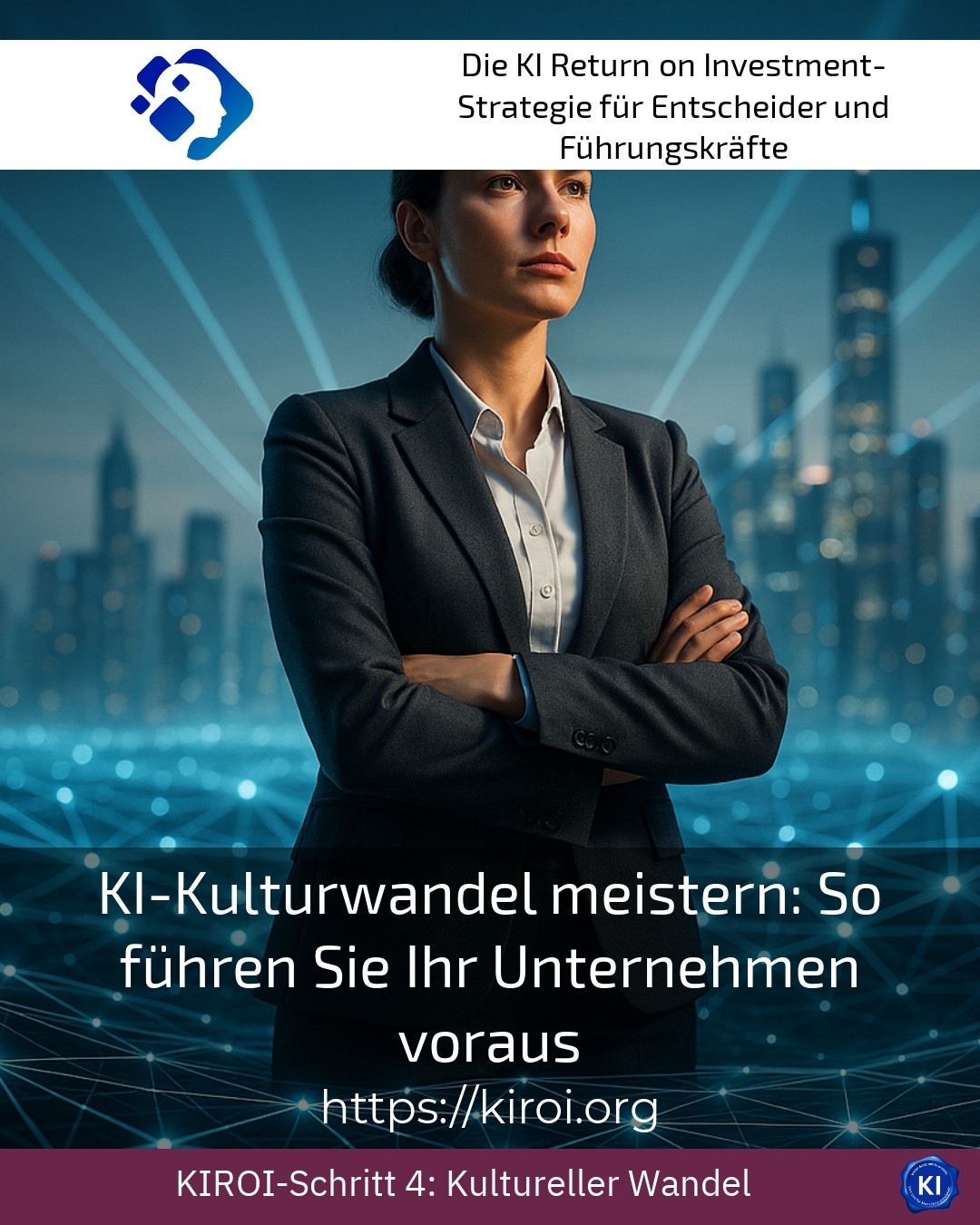
The digital transformation is fundamentally changing companies. Many leaders are facing a crucial question. How can we succeed in Mastering AI cultural change to be able to do? This isn't just about technology. It's about people, processes, and new ways of thinking. Those who don't act today will fall behind tomorrow. However, change also opens up enormous opportunities. In this article, you will learn how to successfully lead your company into the future.
Why the change is now inevitable
The business world is undergoing fundamental change. Automation and intelligent systems are increasingly shaping daily work. Companies of all sizes are feeling this pressure. Customer expectations are continuously rising. At the same time, competitive pressure is growing from various directions. Many organisations are struggling with outdated structures and processes. These challenges demand new approaches and fresh perspectives.
In the financial sector, for example, algorithmic systems are revolutionising lending. Banks use intelligent analytics for fraud detection and risk assessment. Insurance companies rely on automated claims processing to speed up procedures. These developments clearly show where things are heading. Those who don't keep up will lose market share in the long run. That's why proactive action is so important. Change doesn't wait for hesitant decision-makers.
In healthcare, intelligent diagnostic systems are already supporting doctors with complex decisions today. Hospitals are optimising their resource planning through predictive analysis. Pharmaceutical companies are considerably accelerating drug development. Much is also fundamentally changing in the logistics sector. Supply chains are becoming more transparent and efficient through real-time monitoring. Warehouses are increasingly working with autonomous transport systems.
Mastering the AI cultural shift through leadership
Successful transformation always begins at the top of the organisation. Leaders must not only support change, but actively lead by example. This means critically examining their own habits. It also requires courage to break new ground. Employees watch closely how their superiors handle change. If management hesitates, this uncertainty transfers to the entire team.
A medium-sized engineering company faced precisely this challenge. Management recognised the need for change. However, they didn't know where to start. This is where transruptions coaching comes in as effective support [1]. It helps leadership teams develop clear strategies. This leads to realistic roadmaps for organisational change.
Best practice with a AIROI customer
A long-established manufacturing company from the South German region wanted to modernise its production processes. Management had already launched several initiatives, but they had all petered out. The employees were sceptical of any new change. An atmosphere of uncertainty and mistrust prevailed. As part of the AIROI support programme, we first thoroughly analysed the existing corporate culture. We found that the previous communication strategies had been inadequate. Employees did not feel involved and did not sufficiently understand the goals. Together, we developed a multi-stage communication concept with regular dialogue formats. Managers learned to talk openly about uncertainties and answer questions honestly. After six months of intensive support, the mood had noticeably changed. The pilot projects for process automation were actively supported and driven forward by the teams. Today, those responsible report significantly higher acceptance of change processes throughout the company.
Similar dynamics are evident in the retail sector's transformation. Large retail chains are introducing intelligent inventory management systems. Smaller retailers are experimenting with personalised customer engagement online. Restaurants are utilising automated ordering systems to improve efficiency. All these changes require an adapted leadership culture.
The role of communication in cultural change
Open and transparent communication forms the bedrock of any successful transformation. Employees need to understand why changes are necessary. They require clear information about upcoming steps and their implications. Regular updates build trust and significantly reduce anxieties. It is also important to honestly report on setbacks [2]. Only then can an authentic culture of change emerge within the company.
In the banking sector, successful institutions communicate their digitalisation strategies particularly intensively. They explain how new systems will support the work of advisors. At the same time, they highlight the new career opportunities that can arise from this. In hospitals, hospital management informs their staff about planned technology introductions early on. Employees are given opportunities to ask questions and voice concerns.
Involve employees and overcome resistance
Change projects often fail due to a lack of employee involvement. Employees who feel overlooked quickly develop resistance. This resistance can take passive or active forms. Passive refusal manifests as a lack of commitment and delaying tactics. Active resistance expresses itself through open criticism or even sabotage. Both significantly jeopardise the success of the transformation.
The solution lies in early and genuine employee participation. Form cross-functional teams that can co-design change projects. Gather feedback and take it seriously. Celebrate small successes together with the teams involved. Create safe spaces for constructive criticism and honest exchange.
In the automotive industry, progressive manufacturers have set up innovation workshops. There, employees from various departments can develop and test new ideas. Similar concepts also work very well in energy companies and telecommunications firms. Municipal utilities train digitalisation teams comprising motivated employees from different areas. These teams become important multipliers for change within the company.
Mastering AI cultural change through targeted qualification
Skill-building is a key success factor for any transformation process. Employees need new skills to cope with changing requirements. This is not just about technical knowledge; skills such as critical thinking and adaptability are at least as important. Companies should develop and offer comprehensive further training programmes [3]. These programmes must be tailored to different target groups.
Best practice with a AIROI customer
A large logistics company faced the challenge of preparing its workforce for new ways of working. Many long-serving employees were hesitant about new technologies and digital tools. The previous training offers were not sufficiently effective for this target group. As part of our AIROI support, we developed an innovative peer-learning concept for the entire company. In this concept, tech-savvy younger employees were used as learning partners for experienced colleagues. These pairings worked closely together on specific projects for several months. The older employees contributed their valuable process knowledge and shared it generously. The younger colleagues patiently supported with technical questions and digital applications. This mutual exchange led to astonishing results in both groups. Acceptance of new systems increased significantly and exceeded our expectations. At the same time, understanding between different generations in the company improved considerably. The company has since expanded this concept to all sites and successfully established it.
In retail, advanced companies are training their sales teams in the use of digital tools. The hotel and catering industry is investing in training for new booking and service platforms. Insurance companies are qualifying their intermediaries to use analysis tools in consultations. All these measures contribute to successful transformation and strengthen competitiveness.
Rethinking structures and processes
Technological innovations often require organisational adjustments within companies. Rigid hierarchies can hinder and slow down innovation. Agile working methods enable faster reactions to changes in the market environment. Many companies are therefore experimenting with flatter structures and greater personal responsibility. It is important to find the balance between stability and flexibility.
In the software industry, agile methods have long since established themselves and proven effective. Other industries are increasingly adopting these approaches for their own needs. Banks are forming agile teams for the development of new digital services. Hospitals are setting up interdisciplinary innovation groups for process improvements. Industrial companies are creating interface roles between IT and business departments for better collaboration.
The redesign of processes offers enormous optimisation potential for any company. Routine tasks can often be automated, freeing up employees for more demanding activities. Data-driven decisions are increasingly replacing purely gut-feeling decisions in management. In manufacturing, predictive maintenance systems significantly optimise machine availability. In customer service, intelligent assistance systems enable faster and more precise responses to inquiries.
Consider ethical aspects
The deployment of new technologies also raises ethical questions that must be answered. How do we handle the data protection and privacy of customers and employees? Which decisions should continue to be made by humans? How do we ensure fairness and transparency in automated processes? These questions deserve serious consideration within any organisation.
In human resources, companies are intensely discussing the use of algorithms in application processes. Banks must ensure and document transparency in automated credit decisions. Healthcare facilities are very carefully defining clear boundaries for technology-assisted diagnoses. Insurers are developing guidelines for the fair handling and evaluation of customer data [4].
Anchoring change sustainably
One-off change initiatives are insufficient for long-term success. Transformation must be understood and lived as a continuous process. Companies need structures that enable permanent learning and adaptation. The willingness to change should become and remain part of the company culture. Only in this way can organisations remain permanently competitive in a changing environment.
In the telecommunications sector, leading providers have established innovation management as a core competency. Pharmaceutical companies are continuously investing in the further development of their digital capabilities. Automotive suppliers are setting up permanent transformation teams to guide and drive change. Energy providers are developing roadmaps for the long-term technological development of their organisations.
Best practice with a AIROI customer
A medium-sized trading company had successfully completed its first transformation cycle and was proud of it. However, after a few months, there was a risk of slipping back into old patterns and behaviours. The initial enthusiasm waned, and everyday life caught up with the employees again. As part of our AIROI support, we implemented a system for the sustainable anchoring of change. We established quarterly reflection workshops where teams openly discuss their progress and challenges. An internal network of change agents ensures continuous impetus and fresh ideas. These employees are distributed across all departments and meet regularly to exchange experiences. They identify potential for improvement and initiate small projects for continuous development in everyday work. Management regularly participates in dialogue formats, clearly demonstrating their commitment. Key figures on transformation maturity are integrated into corporate governance and regularly reviewed. Today, the company has developed a genuine learning culture that views change as normal and actively embraces it.
Guidance from experienced partners can make the difference between success and failure. Disruption coaching provides impetus and effectively supports in overcoming obstacles. It helps to recognise blind spots and develop new perspectives. Many companies report significant progress through external support for their transformation projects. The investment in professional support usually pays for itself many times over.
My AIROI Analysis
Analysis of numerous transformation projects reveals clear patterns of success and recurring challenges. Companies that have Mastering AI cultural change, are characterised by several common features. They have a clear vision that is supported and communicated by the entire leadership level. They consistently invest in the development of their employees and their skills. And they create structures that enable and promote continuous learning and experimentation.
At the same time, I frequently observe avoidable errors in many organisations. Too many companies focus exclusively on the technological aspects of change. They underestimate the human dimension of transformation and its complexity. Communication deficits lead to uncertainty and resistance among employees. A lack of patience results in abandoned initiatives, which then leave behind frustration.
The AIROI approach addresses these challenges holistically and systematically. It combines strategic planning with practical implementation support at all levels. The human being always remains at the centre of all considerations and actions. Technology is important, but it is only a tool to achieve greater goals. The real key to success lies in the organisation's cultural transformation.
My experience shows that sustainable change requires time and perseverance. Quick successes are possible, but profound transformation needs several years of consistent work. Companies that embrace this long-term commitment are rewarded with higher competitiveness. They gain more engaged employees, more satisfied customers, and better economic results. The path is challenging, but the goal is worth striving for.
Further links from the text above:
[1] Transruptions-Coaching Overview
[2] AIROI Blog on Change Processes
[3] Business coaching
[4] Ethics and artificial intelligence
For more information and if you have any questions, please contact Contact us or read more blog posts on the topic Artificial intelligence here.







 Deutsch
  English (UK)