
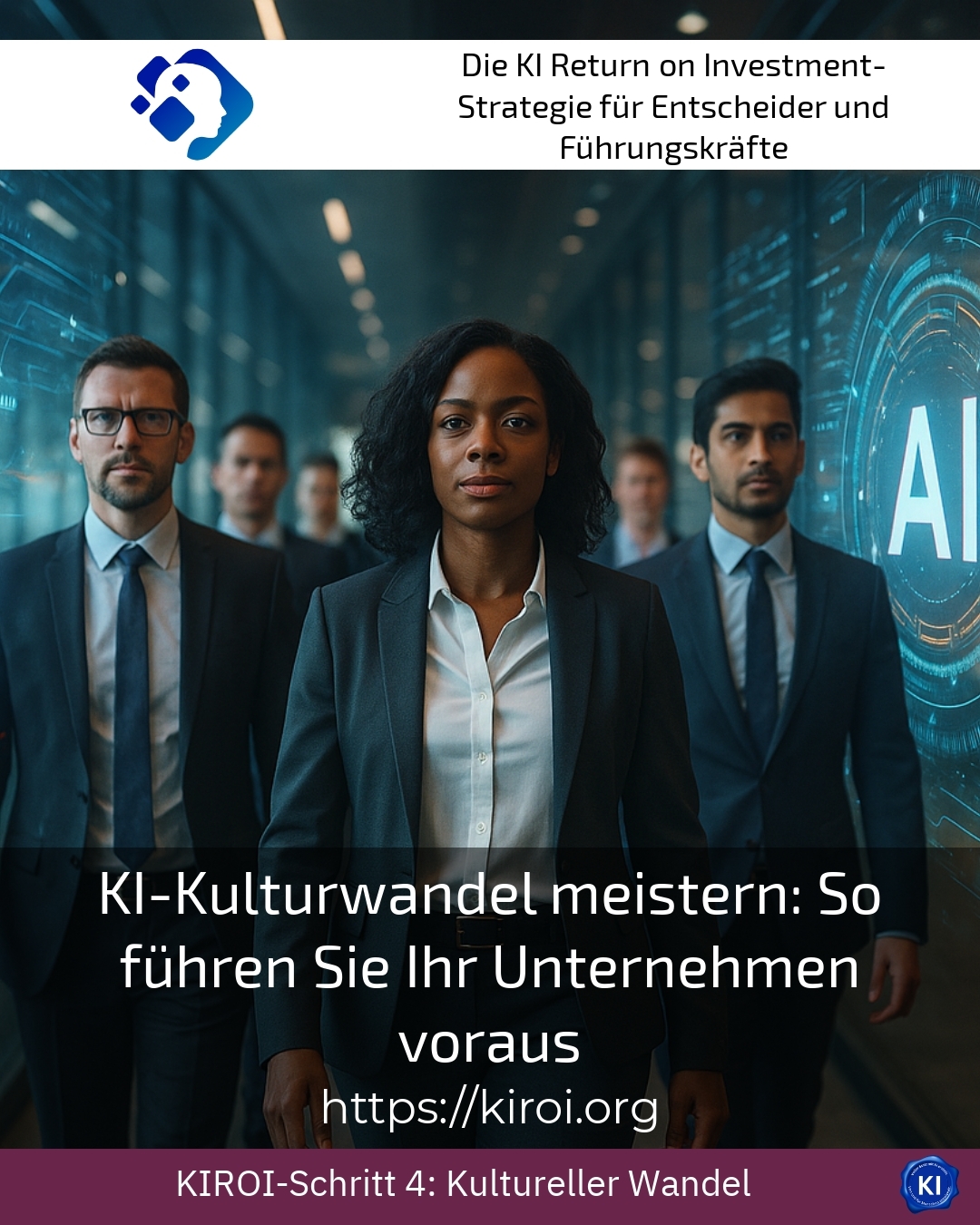
Have you ever wondered why some companies seemingly manage technological change effortlessly, while others, despite enormous investments, fail and fall behind? The answer rarely lies in the technology itself, but rather in the way organizations support their employees through this transformation and ensure that they are prepared for the future. Mastering AI cultural change, This is much more than just introducing new systems. In an era where intelligent algorithms increasingly support decision-making processes and automated solutions shape everyday work, it becomes clear that the true key to success lies not in servers or software, but in the minds and hearts of those who must work with these tools on a daily basis.
Understanding the invisible dimension of digital transformation
When executives discuss the integration of intelligent technologies, they often focus on measurable metrics such as implementation costs, efficiency gains, or return on investment, overlooking a crucial factor that determines success or failure. The human component, namely the readiness of the workforce to adopt new work practices and continuously develop their skills, forms the foundation of any successful transformation. Companies that neglect this dimension often face resistance, frustration, and ultimately the failure of their initiatives.
For example, a medium-sized manufacturing company invested substantial sums in predictive maintenance systems that were intended to predict machine breakdowns. The technology worked flawlessly. Yet the maintenance technicians systematically ignored the system recommendations. They preferred to rely on their decades of experience. Only when management began actively involving employees in the change process and valuing their expertise did the situation change fundamentally.
A similar situation occurred with a logistics company that implemented automated route planning systems without adequately preparing the drivers and integrating their practical knowledge. The drivers regularly circumvented the system because they knew the local conditions better. In retail, on the other hand, a warehouse management system with intelligent order automation initially encountered resistance from the store managers. They felt disempowered and gave in. These examples illustrate that technological excellence alone is never enough.
Best practice with a AIROI customer
An internationally operating machine engineering company with several thousand employees faced the challenge of integrating intelligent assistance systems into its production processes, with initial skepticism from the workforce being significant and project managers facing significant communication challenges. The transruptions coaching accompanied the company over a period of eighteen months and helped establish a culture of shared learning in which mistakes were viewed as opportunities for development rather than personal failure. The creation of so-called technology teams, in which each member was a technically skilled employee and an experienced expert in the field, was particularly effective, with each team jointly testing new working methods and combining their different perspectives in a profitable way. This approach not only led to a significantly higher acceptance of the new systems, but also generated valuable improvement suggestions from practice that fed into the further development and continuously optimized the system. The executives often reported that precisely this participatory approach made the crucial difference and created an atmosphere of trust that was invaluable for subsequent transformation projects.
Mastering AI cultural change through authentic leadership
The role of leaders in transformation processes cannot be overstated, as their own behavior shapes the entire organization’s attitude towards change and thus sets the framework for everything that follows. When supervisors themselves show apprehension about new technologies or use them half-heartedly, they send unmistakable signals to their teams. In this context, authentic leadership means openly addressing one’s own uncertainties and going through the learning process together with the employees.
In the automotive industry, we regularly observe how production managers have to introduce new quality control systems based on machine learning. Successful leaders take the time to understand the functioning of these systems. They ask questions and show curiosity. Less successful managers completely delegate the topic and thereby lose touch with the situation. In banking, on the other hand, branch managers have to teach their teams how intelligent consulting tools can support customer service. Those who are competent themselves in handling these systems enjoy significantly more credibility.
A hospital network implemented a system for intelligent resource planning that was intended to optimize service schedules. The nursing service managers who actively engaged with the system were able to convincingly convey the benefits to their teams. They understood the logic behind the recommendations. Other executives who only knew the system superficially, however, generated distrust and rejection among their employees.
Mastering psychological safety as a fundamental prerequisite for the transformation of AI culture
People only change their behavior in a sustainable way when they feel secure and do not have to fear negative consequences. Therefore, creating an atmosphere of psychological safety is one of the most important tasks of leadership. In environments where mistakes are punished and ignorance is considered a weakness, employees will never take the risk of trying out new ways of working and possibly failing in the process. The best technologies remain ineffective if the organizational culture implicitly prevents their use.
An insurance company implemented intelligent damage processing systems that were intended to support claims handlers in assessing cases. Initially, only a few employees used the new features. The fear of errors was too great. It was not until management explicitly communicated that learning errors were welcome that behavior changed. In the energy sector, we observed a similar phenomenon with the introduction of intelligent grid control systems.
The situation was particularly dramatic at a pharmaceutical company that wanted to support laboratory processes through intelligent analysis systems. The highly skilled scientists feared for their expertise and their status. They saw the systems as a threat, not as a support. Only through intensive workshops and open dialogues was it possible to change this perception.
Best practice with a AIROI customer
A leading telecommunications company faced the challenge of equipping its customer service department with intelligent support systems, with employees fearing that their jobs were at risk due to automation and that these concerns led to considerable resistance. As part of the transruptive coaching, a comprehensive communication strategy was developed that not only addressed the technical aspects of the change but also placed the emotional needs of the affected parties at the center and showed them concrete development perspectives. The management publicly committed to not taking any layoffs due to the introduction of the technology and backed up this promise with an extensive training program that enabled the employees to acquire new competencies and take on more demanding tasks. Clients often reported that it was precisely this combination of clear communication, concrete guarantees, and genuine development opportunities that represented the turning point in acceptance and enabled a fundamentally positive attitude towards change. In the following months, the company not only recorded a significantly improved system utilization but also a measurably higher employee satisfaction.
Skills development as a strategic priority
The speed of technological developments often exceeds the adaptability of traditional training concepts. Therefore, companies must fundamentally rethink how they prepare their employees for the demands of the future, taking into account both technical and cross-functional competencies. Offering one-time training sessions is no longer sufficient. Continuous learning must become an integral part of the work culture. Only then can organizations develop the flexibility they need.
A chemical company developed an innovative learning concept in which employees can spend ten percent of their working time on self-directed training. Topics range from data analysis to creative problem solving. A mechanical engineering company established internal learning circles where employees share their knowledge with each other. In the food sector, a company is experimenting with playful learning formats that convey technical knowledge.
Approaches that integrate learning directly into the workday are particularly successful. A logistics company uses short learning modules that employees can complete between tasks. A retail company relies on peer learning, where experienced users train their colleagues. These formats are often more effective than traditional seminars because they are immediately applicable.
Master the AI cultural transformation through sustainable structures
Cultural changes require time, patience, and above all lasting structures that support the change and remain effective beyond short-term project phases. Without such structures, there is a risk that organizations will revert to old patterns as the initial enthusiasm wanes. Successful companies establish mechanisms that enable continuous reflection and adaptation. They understand transformation as a continuous process.
A media company established a permanent transformation office to coordinate and support change initiatives [1]. This team works across departments. It has direct lines of reporting to the management. A construction company established regular retrospectives in which teams reflect on their experiences with new technologies. In healthcare, clinics use structured feedback loops to measure the acceptance of digital solutions.
The introduction of ambassador networks has proven successful in many industries. In the financial sector, selected employees train their colleagues on how to use new systems. In production, technology champions serve as the first point of contact for questions and problems. These informal structures complement formal hierarchies and significantly accelerate the transfer of knowledge.
Best practice with a AIROI customer
A traditional family business in the textile industry with several production sites across Europe was having difficulty motivating its long-standing employees to adopt new digital work practices, with the generation over 50 showing particular reservations and feeling overwhelmed by the speed of change. Transruptive coaching worked intensively with leaders at all levels to develop a generational program that took into account the different learning styles and needs of the different age groups and specifically built on the strengths of each generation. Younger employees took on the role of technical mentors, while experienced colleagues brought their deep process knowledge, allowing both parties to learn from each other and develop mutual respect. This mutual appreciation fundamentally changed the entire corporate culture and created an environment in which technological innovations were no longer perceived as a threat but as a shared opportunity. Productivity increased significantly, and employee turnover decreased significantly, which management valued as a clear indication of the success of the approach.
Communication as the key to transformation
The way organizations communicate about changes significantly influences how these changes are perceived and accepted. Therefore, a well-thought-out communication strategy is one of the indispensable elements of any successful transformation. It is not just about conveying information; it is about building trust and creating shared meaning. People need to understand why changes are necessary.
An electronics manufacturer uses regular townhall meetings to report on the progress of transformation initiatives. The management also answers critical questions. A consumer goods company produces short video messages in which employees share their experiences. In the transportation sector, a company relies on interactive workshops that promote dialogue.
Consistency in messaging across all channels and levels of hierarchy is particularly important. A steel manufacturer intensively trained its leadership to speak the same language. A software company developed a common vocabulary for transformation. These measures prevent misunderstandings and strengthen confidence in the seriousness of the change efforts.
My AIROI Analysis
The intensive engagement with numerous transformation projects in a wide variety of industries has shown me that the decisive success factor lies not in the technology itself, but in the ability of organizations to bring their people along on this journey and to create a culture that understands change as an opportunity. Companies that embrace change Mastering AI cultural change, They share several common characteristics: they consistently invest in the development of their employees, create psychological safety for experiments and learning processes, and they communicate transparently about goals, progress, and setbacks. The role of leaders cannot be overstated, as they shape the entire organization’s attitude towards change through their own behavior and thus set the framework for everything that follows. At the same time, my observations have confirmed that there is no one-size-fits-all solution and that each organization must find its own path that fits its specific culture, history, and workforce structure. Transruptive coaching can provide valuable insights and support companies on this journey, but the actual work must come from within and be carried out jointly by all involved parties. Anyone who wants to be successful in the long term must understand transformation as a continuous process and not as a one-time project with a defined end point. The companies that have understood this and implement it consistently will remain ahead in the future.
Further links from the text above:
[1] Harvard Business Review – Leading Change
For more information and if you have any questions, please contact Contact us or read more blog posts on the topic Artificial intelligence here.







 Deutsch
 English (UK)