
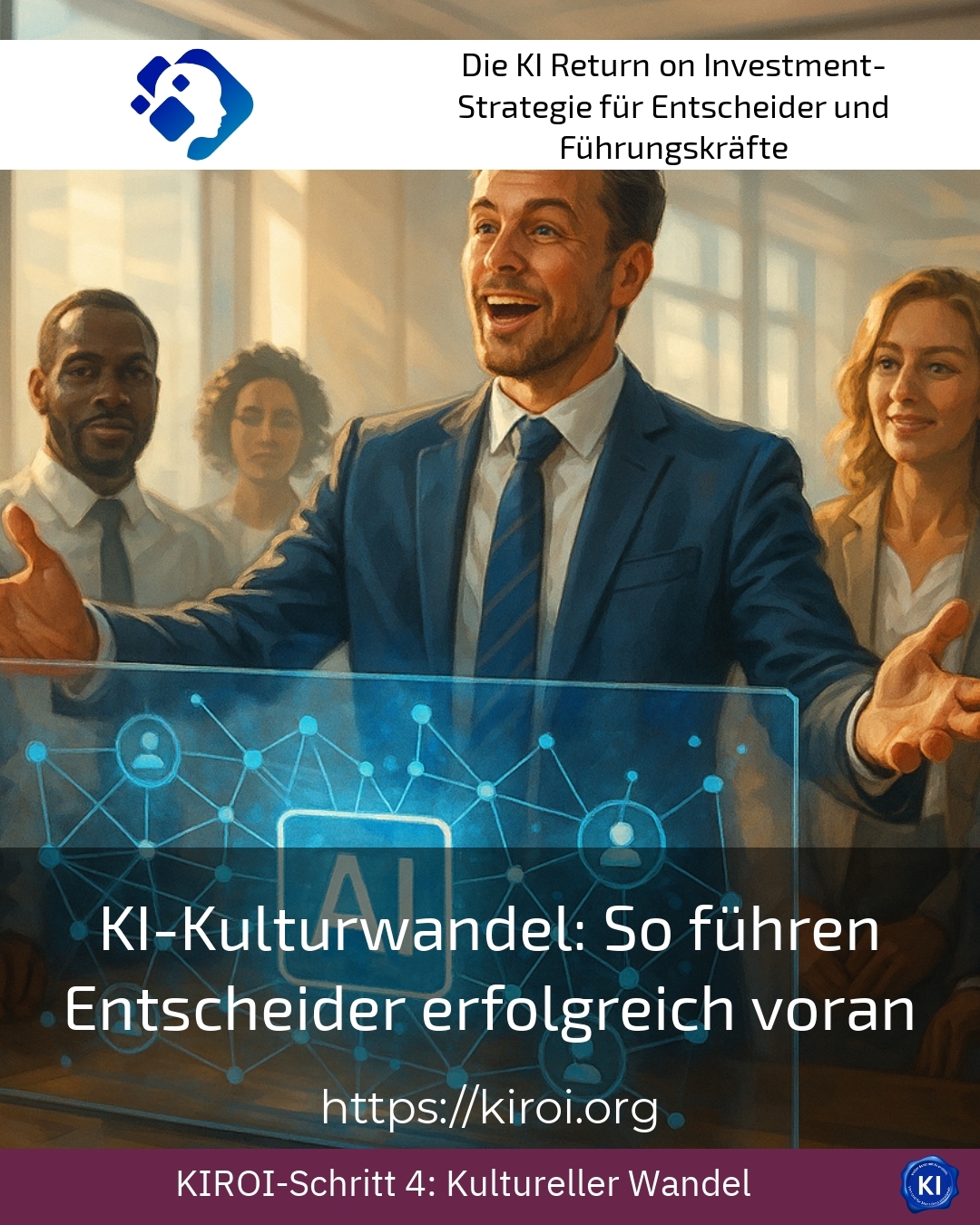
The digital transformation is changing companies at a rapid pace. Leaders face a particular challenge in this regard. They must not only introduce new technologies. The real AI culture change: How decision-makers can lead successfully concerns people, processes, and deep-seated beliefs. Many organisations fail not because of the technology itself, but due to a lack of understanding of the human dimension. This article shows in a practical way how leaders can actively shape change.
Why the AI culture shift starts with mindset
Technological innovations alone do not create sustainable progress. Employee attitudes determine success or failure. Decision-makers often underestimate the emotional component of change processes. Fears, uncertainties, and resistance characterise the daily work life of many teams. Therefore, conscious support from experienced partners is needed. Transruption coaching supports managers precisely in this area.
A medium-sized mechanical engineering company from Southern Germany wanted to introduce intelligent systems. The technical implementation initially went smoothly, but acceptance among the workforce was lacking. Employees felt overlooked and inadequately informed. Only through intensive workshops and open dialogue formats was a turning point achieved. An automotive supplier experienced something similar when implementing automated quality controls. Plant employees feared job losses. Transparent communication and further training offers gradually resolved these blockades. A manufacturer of precision tools also reports initial resistance. The introduction of an intelligent planning system met with scepticism. Intensive training and early involvement of those affected fundamentally changed the situation.
Communication as the Key to AI Culture Change
Open and honest communication forms the bedrock of any successful transformation. Leaders should regularly provide updates on progress and challenges. It is important to openly address setbacks as well. Employees value authenticity more than sugar-coated portrayals. AI-driven cultural change will only succeed through continuous dialogue at all levels.
A manufacturer of industrial robots introduced weekly update meetings. These brief gatherings greatly fostered a shared understanding. Questions and concerns found a safe space there. A manufacturer of conveyor technology established digital feedback channels. Employees could anonymously submit concerns and suggestions. This information flowed directly into project management. A specialist in packaging machinery also relied on intensive communication. Regular town hall meetings with management sustainably strengthened trust.
Best practice with a KIROI customer
An internationally operating drive systems manufacturer faced a complex challenge. The company wanted to introduce predictive maintenance systems in its production halls. The technical infrastructure was already in place and functional. Nevertheless, the project stagnated for several months. The cause was not in the technology, but in the corporate culture. Experienced maintenance technicians felt replaced by the new systems. Their expertise, built up over decades, suddenly seemed to become worthless. Transruption coaching supported the management team in redesigning the approach. Together, they developed a strategy that integrated the technicians' expert knowledge. The intelligent systems were positioned as support tools, not as replacements. Workshops enabled the technicians to feed their knowledge into the algorithms. This resulted in a hybrid system with human expertise and machine precision. Acceptance increased significantly within a few weeks. Today, the maintenance teams report a noticeable easing of their workload. They can concentrate on complex tasks while routine monitoring runs automatically. The project is now considered an internal success story for successful transformation.
Developing leadership skills for the digital era
Change requires new skills and mindsets from leaders. Traditional management methods are reaching their limits in dynamic environments. Agility, empathy, and digital competence are becoming increasingly important. Decision-makers must learn to deal productively with uncertainty. They should empower teams to act independently and experiment.
A producer of hydraulic components invested specifically in leadership development. External coaches intensively supported the management for twelve months. The focus was on emotional intelligence and change competence. A manufacturer of machine tools established an internal mentoring programme. Experienced managers supported younger colleagues in building competence. A specialist in automation technology also relied on continuous professional development. Regular learning formats on digital topics became an integral part of everyday work.
Understanding and constructively using resistance
Resistance to change is not a weakness, but a valuable signal. It shows that employees are engaging with the issue. Leaders should not suppress resistance, but actively explore it. Often, legitimate concerns or unanswered questions are hidden behind it. Transruption coaching provides impulses for constructively dealing with such situations [1].
Employees at a compressed air system manufacturer openly voiced their concerns. The management subsequently organised moderated discussion rounds. These formats facilitated a respectful exchange of different perspectives. A clutch system manufacturer used employee surveys for a sentiment analysis. The results were directly incorporated into the adjustment of the transformation strategy. An industrial valve manufacturer also recognised the value of resistance. Critical voices were specifically integrated into project teams. Their perspective helped to uncover blind spots in the planning.
AI Culture Change: How decision-makers successfully lead through role modelling
Leaders significantly shape company culture through their daily behaviour. Their actions carry more weight than any PowerPoint presentation. When decision-makers themselves use new technologies, employees are more likely to follow. Authentic role-modelling builds trust and provides direction in uncertain times.
The managing director of an electric motor manufacturer uses intelligent assistance systems in his daily life publicly. He regularly shares his experiences with the entire company. This transparency motivates employees to try out new tools themselves. At a manufacturer of linear guides, management actively experiments with new technologies. Managers openly report on the successes and failures of their learning journey. A specialist in vacuum technology also relies on authentic role models. The leadership team completed an intensive further training course on digital competencies together [2].
Best practice with a KIROI customer
A family company with a rich tradition in the field of conveyor technology was struggling with digital transformation. The third generation had taken over management and wanted to modernise. However, long-serving employees were sceptical of the changes. The established structures and tried-and-tested processes seemed to be under threat. Transruption coaching intensively supported the new management for eighteen months. Together, they developed an approach that combined tradition and innovation. Experienced employees were involved in innovation projects as knowledge carriers. Their expertise flowed directly into the development of new solutions. At the same time, younger team members were given space for fresh ideas and experiments. Management communicated transparently about its vision and planned steps. Regular company-wide meetings created opportunities for questions and discussions. The company also established an internal innovation lab with mixed teams. Several successful pilot projects emerged there within a year. Today, employees report a positive change in the company culture. Collaboration between generations has significantly improved. The family business is now a sought-after employer in its region.
Creating structures for continuous learning
Change does not end with the successful implementation of new systems. Companies must create structures that enable and promote continuous learning. Rigid hierarchies and entrenched processes hinder the necessary adaptability. Agile working methods and open learning cultures significantly support sustainable transformation.
A manufacturer of injection moulding machines established regular learning circles in production. Employees exchange experiences with new technologies there and learn from each other. A producer of measuring technology introduced a company-wide knowledge management system. Best practices and lessons learned are systematically documented and shared there. A specialist in surface technology also invests in continuous professional development. Every employee has a personal learning budget available for self-selected further training [3].
My KIROI Analysis
Successful business transformation requires far more than technological investment. The real change happens in the minds and hearts of people. Leaders play a crucial role as both architects and role models. They must learn to tolerate uncertainty and deal with it productively. At the same time, they need the ability to bring other people along on this journey.
The examples described from industry clearly show recurring patterns. Successful transformations are characterised by intensive communication and genuine involvement. Employees are not viewed as passive recipients of change. They are active co-creators of the transformation and contribute valuable knowledge. This attitude makes the decisive difference between failure and success.
Transruption coaching effectively supports companies precisely at these critical junctures. The aim is not to present ready-made solutions or offer simple recipes. Instead, tailor-made approaches for the specific situation emerge through collaborative work. Clients often report surprising insights during the process. Blockages dissolve, and new perspectives suddenly open up. The investment in cultural transformation pays off many times over in the long run. Companies become more adaptable, innovative, and attractive to talent. The path to achieving this requires courage, perseverance, and professional support from experienced partners.
Further links from the text above:
[1] Leadership Transruptions Coaching
[2] Understanding Digital Key Technologies
[3] KIROI Methodology for Cultural Change
For more information and if you have any questions, please contact Contact us or read more blog posts on the topic Artificial intelligence here.











 Deutsch
  English (UK)