
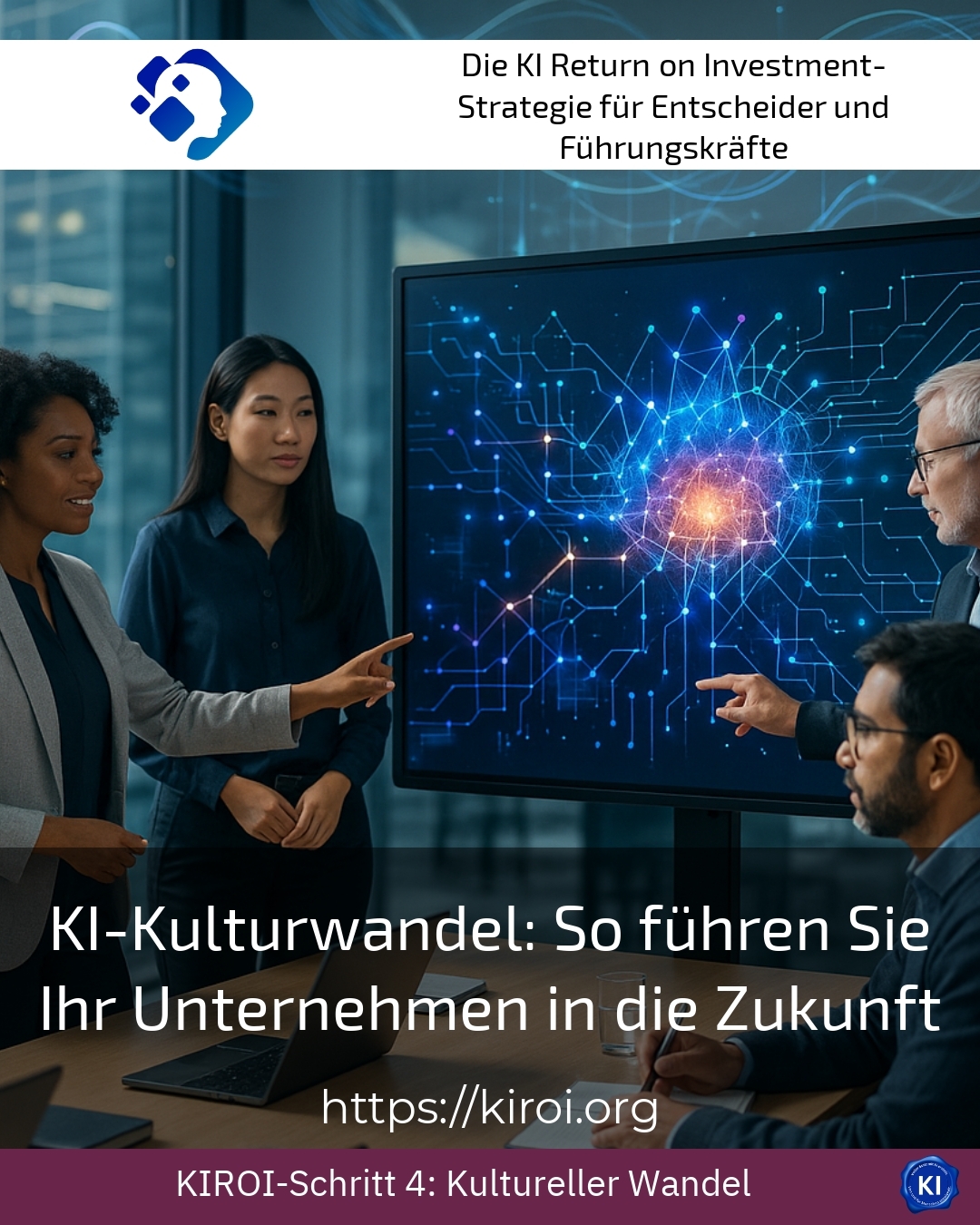
Imagine your company transforming from a traditional business into an agile innovation leader within just a few months. The AI cultural change makes precisely that possible. While many organisations are still hesitating, courageous leaders have long recognised that technological transformation without human transformation is doomed to fail. The introduction of intelligent systems changes not only processes and structures, but also the entire self-perception of an organisation. This article shows you how to successfully navigate your company through this fundamental change.
Understanding the human dimension of the technological revolution
Technology alone does not solve problems. Rather, it creates new possibilities that people must utilise. Many companies invest substantial sums in state-of-the-art systems. At the same time, they neglect the development of their workforce. The result is often frustration on both sides. Employees feel overwhelmed or even threatened. Managers do not understand why the expected results fail to materialise. A real AI cultural change therefore always starts with people.
In the automotive industry, we are experiencing this challenge particularly intensely. Engineers who have spent decades optimising internal combustion engines are suddenly expected to work with algorithms. Production staff must learn to interact with collaborative robots. Sales teams are faced with the task of developing data-driven sales strategies. These changes require far more than training; they demand a fundamental realignment of the corporate culture.
Best practice with a AIROI customer
A medium-sized automotive supplier from southern Germany was facing a massive transformation. For decades, the company had been manufacturing high-precision components for internal combustion engines. The management recognised early on that electromobility would threaten the entire business model. Within eighteen months, the transruptions coaching team, together with the workforce, developed a completely new direction. The employees were actively involved in the design process. Fears and concerns found a safe space in moderated workshops. Step by step, a culture of continuous adaptation emerged. Today, the company produces intelligent sensor technology for autonomous vehicles. The workforce reports a new sense of self-efficacy. Staff turnover fell by forty per cent. Productivity increased significantly. This success shows how transruptions coaching can effectively support companies in such change projects.
Redefining leadership in the age of intelligent systems
Traditional management models are reaching their limits. The speed of change exceeds the capacity of hierarchical structures. Decisions need to be made more quickly. At the same time, the complexity of the factors to be considered is increasing. Leaders can no longer control everything. They must learn to place trust and share responsibility.
This shift is particularly evident in the banking sector. Branch managers must empower their teams to work with intelligent advisory systems. Investment advisers complement their expertise with algorithmic analyses. Risk managers interpret complex data models. The AI cultural change requires new skills from leaders. Emotional intelligence is becoming more important than technical expertise. The ability to endure uncertainty is becoming a core competency.
A traditional Frankfurt bank illustrates this development impressively. The management initially invested exclusively in technological solutions. However, the expected efficiency gains failed to materialise. It was only when the company began to systematically develop its leaders that the situation changed. Support through transruptions coaching helped to identify blind spots. Leaders learned to reflect on their own fears. They developed the ability to guide their teams through uncertainty.
AI cultural change as a continuous learning process
Learning works fundamentally differently in the digital age. Knowledge becomes obsolete faster than ever before. Formal qualifications are losing importance. The willingness for lifelong learning is becoming crucial. Companies must create structures that enable continuous learning. This requires time, resources and a corresponding culture.
Retail is facing particular challenges in this area. Sales staff must learn to connect digital and physical customer experiences. Buyers work with predictive analytics for assortment planning. Logistics teams optimise supply chains with intelligent systems. These competencies do not develop overnight. They emerge through patient guidance and continuous practice.
A major fashion retailer is showing how this change can be achieved. The company established so-called learning partnerships. Experienced employees regularly exchange ideas with younger colleagues. The older ones contribute experience and people skills. The younger ones share their digital knowledge. Both sides benefit from this exchange. The corporate culture is noticeably changing as a result.
Best practice with a AIROI customer
A drugstore chain with over three hundred branches approached us with a specific problem. The introduction of an intelligent merchandise management system led to massive resistance. Employees felt controlled and patronised. The atmosphere in the branches deteriorated dramatically. Together with the leadership team, we thoroughly analysed the situation. It became apparent that communication prior to the rollout was inadequate. The employees did not understand the benefits of the new system. They only saw the additional control. We developed a comprehensive communication strategy. Success stories from individual branches were shared. Employees who were already using the system became ambassadors. Their experiences convinced sceptical colleagues. After six months, acceptance had improved significantly. Productivity increased measurably. Clients frequently report similar experiences. Good guidance makes all the difference.
Understanding and constructively using resistance
Resistance to change is natural and human. It signals that people have recognised the significance of the change. Leaders should not fight resistance. They should use it as valuable information. Behind every resistance lies a legitimate need. Understanding this need is the first step towards a solution.
In the healthcare sector, we encounter particularly stubborn resistance. Doctors have studied for years. They have built up expertise that is now being supplemented by systems. The worry of being replaced is understandable. Nursing staff fear that technology will crowd out human empathy. These fears must be taken seriously. Only then can genuine change succeed.
A hospital in the Ruhr region illustrates this point impressively. The introduction of a diagnostic support system met with massive rejection. Experienced medical professionals felt their competence was being attacked. Younger colleagues were curious, but unsettled. The hospital management reacted wisely. They actively invited sceptical voices into the development process. Their expertise improved the system considerably. This involvement turned critics into advocates.
Communication as the key to successful AI cultural change
Communication is crucial in any transformation. During cultural change, this applies particularly. People need orientation in uncertain times. They want to understand where the journey is heading. They would like to know what role they play in the new world. These questions must be answered honestly.
The logistics industry demonstrates how important good communication is. Warehouse workers hear about autonomous robots. Freight forwarders read about self-driving lorries. Dispatchers learn about intelligent route planning systems. Without context, anxiety and rumours arise. With transparent communication, trust is built. Companies that communicate openly win the support of their workforce.
A logistics service provider from Hamburg developed an exemplary approach. The management communicates monthly in video messages. Employees can ask questions anonymously. These are answered honestly and promptly. In addition, there are regular face-to-face events at the locations. The dialogue creates trust and confidence. Transruptions coaching has accompanied this process for years. The impulses help to continuously improve communication.
Adapting structures for sustainable change
Cultural change requires suitable structures. Old hierarchies often hinder new ways of working. Rigid departmental boundaries prevent necessary collaboration. Outdated remuneration systems set the wrong incentives. These structural obstacles must be identified and removed.
The insurance industry is struggling particularly with this problem. Traditional division by line of business prevents holistic customer service. Long decision-making paths slow down innovation. Risk-averse cultures stifle the joy of experimentation. These structures have historical reasons. They used to make sense. Today, they hinder the necessary change.
A regional insurance company is demonstrating how structural adaptation can succeed. The company dissolved rigid departmental boundaries. Cross-functional teams now handle holistic customer requests. The hierarchy has been made significantly flatter. Decision-making authority has been devolved to lower levels. Employees report greater personal responsibility and job satisfaction. Customer satisfaction increased alongside employee satisfaction.
Best practice with a AIROI customer
An engineering company from the Black Forest came to us with a complex issue. The introduction of predictive maintenance systems required a completely new way of working. In future, service technicians were expected to work preventatively rather than reactively. This fundamentally changed their entire job profile. Many technicians defined themselves through their ability to solve tricky problems on-site. The new way of working supposedly stripped them of this source of identity. In intensive workshops, we jointly developed a new self-image. The technicians realised that their expertise was more valuable than ever. They became consultants, helping customers to avoid breakdowns. Their knowledge was fed into the improvement of the systems. This repositioning created motivation and pride. Acceptance of the new technology increased significantly. Customer retention improved measurably. This example impressively demonstrates how transruption coaching can support such profound changes.
The role of external support in the transformation process
External perspectives are valuable during complex changes. Operational blindness often prevents the recognition of obvious problems. Established power dynamics make internal criticism difficult. External support can provide important impetus here. It helps to resolve entrenched situations.
The target groups that come to transruptions coaching are diverse. Managing directors are looking for guidance for their transformation strategy. Executives want support with team development. HR managers need concepts for competence development. Works councils are looking for constructive ways to participate in shaping things. What they all have in common is the desire for professional guidance.
Accompanying projects involving the introduction of technology requires a special sensitivity. It is not just about processes and systems. It is about people with hopes and fears. It is about biographies and identities. Taking this dimension seriously makes all the difference. This is precisely where transruptions-Coaching positions itself as a reliable partner.
My AIROI Analysis
The analysis of numerous transformation projects shows clear patterns. Successful companies invest at least as much in people as they do in technology. They begin cultural change early rather than only after technical implementation. They communicate transparently and continuously. They create safe spaces for fears and concerns. They actively involve employees in design processes.
At the same time, the examples illustrate typical pitfalls. Underestimating emotional resistance regularly leads to failure. A lack of leadership development sabotages even the best strategies. Structural adjustments are often neglected. Communication frequently remains too superficial. These mistakes are avoidable with the right guidance.
The AI cultural change is no longer an option. It is a necessity for future-proof businesses. The good news is: this change can succeed. It can even be fun and release new energy. The crucial thing is to put people at the centre. Technology then serves as a tool for unlocking human potential. This is how you successfully lead your company into the future [1] [2] [3].
Further links from the text above:
[1] McKinsey: Culture eats strategy for breakfast
[2] Harvard Business Review: Organizational Transformation
[3] World Economic Forum: Artificial Intelligence Agenda
For more information and if you have any questions, please contact Contact us or read more blog posts on the topic Artificial intelligence here.







 Deutsch
  English (UK)