
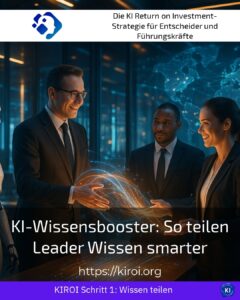
The ability to systematically embed knowledge about intelligent systems within organisations is crucial for the future viability of companies today. AI knowledge transfer This is the crucial lever that many decision-makers still underestimate. Because while some leaders hesitate, others are already actively shaping change. They create structures that build competence sustainably. They develop teams that do not fear technological change, but use it. This article shows which strategies really work. It provides impulses for practical implementation. And it highlights why now is the right time to act.
Why systematic AI knowledge transfer is becoming a leadership task
The integration of intelligent technologies into business processes presents organisations with fundamental challenges. Leaders frequently report uncertainty within their teams. Employees often don't know how to make meaningful use of new tools. At the same time, the pressure to realise efficiency potentials and remain competitive is growing. In this situation, the transfer of expertise becomes a strategic success factor. Companies that invest early create a significant advantage for themselves. This is because knowledge about intelligent systems quickly becomes outdated. Therefore, continuous learning processes are needed at all levels.
For example, a medium-sized mechanical engineering company implemented an internal knowledge centre. There, experienced users share their findings with colleagues. The result was significantly faster adoption of new tools. A logistics service provider established regular exchange formats between IT and specialist departments. This led to practical use cases directly from operational business. A retail company relied on external support through coaching formats. This developed a deeper understanding among management for technological possibilities. These examples show the diversity of possible approaches.
Best practice with a AIROI customer A family-run business with a rich tradition in the manufacturing industry faced the challenge of preparing its workforce for new technological requirements. Management recognised early on that one-off training sessions would not be sufficient. Instead, the company collaborated with transruptions-coaching to develop a comprehensive skills development program. This program encompassed multiple levels and target groups within the organisation. Initially, managers received intensive support to become multipliers themselves. They learned to contextualise technological developments and leverage them strategically. Subsequently, cross-departmental learning groups were established for regular exchange. Employees report significantly increased confidence in handling new systems. Management observes noticeably higher acceptance rates for change projects. The combination of a strategic perspective and practical application was particularly valuable. The coaching helped to reduce anxieties and foster curiosity. After one year, a measurably increased willingness to innovate was evident across all areas of the company.
Structuring for Success: Strategically Embedding AI Knowledge Transfer
Sustainable skills development requires established structures and clear responsibilities. Many organisations fail at this point because they view learning as a one-off event. However, technologies are constantly evolving. Therefore, learning formats must also be dynamic and adaptable. Leaders play a central role here as role models and enablers. They must create space for experimentation and view mistakes as learning opportunities. At the same time, clear goals and measurable progress are needed.
An energy provider established its own digital transformation department [1]. This unit coordinates all activities related to intelligent systems. A financial services provider developed a mentoring programme for junior managers. Experienced colleagues support younger employees in their onboarding with new technologies. A healthcare provider established a rotating expert network. Specialists from various fields share their insights in changing constellations. These structural measures significantly support the continuous flow of knowledge.
The role of managers in AI knowledge transfer
Leaders significantly shape the learning culture within a company through their behaviour. If they themselves show interest in new technologies, it motivates their teams. Conversely, disinterest or scepticism inhibits a willingness to change. Support from transruption coaching helps leaders to fulfil this exemplary role. They receive impulses for their own further development and practical tools for everyday leadership. Clients often report a changed perspective on technological possibilities. They recognise opportunities where previously they only saw risks.
The managing director of a medium-sized company participated in an intensive coaching process. This helped him develop a clear vision for the digital future of his business. He successfully communicated this vision to his management team. A department head in an industrial company learned to explain technological topics in an understandable way [2]. This made him an important intermediary between IT and production. A division manager in the service sector recognised her own knowledge gaps. She used coaching support to systematically build up competencies.
Practical formats for effective knowledge transfer
The choice of suitable formats depends on company culture and learning habits. Not every format suits every organisation. Therefore, a thorough analysis of the current situation is worthwhile. Combinations of different approaches have proven effective. Face-to-face formats enable direct exchange and promote team cohesion. Digital offerings provide flexibility and also reach decentralised teams. Informal formats such as learning circles or brown bag sessions lower inhibitions.
A technology company introduced weekly „Learning Lunches“. During these, employees present short practical examples from their daily work. A construction company uses an internal video platform for explainer videos. These are created and shared by the users themselves. A consulting firm established regular „Failure Fridays“. Here, failed experiments are openly discussed and lessons learned are derived [3]. Such formats sustainably support an open learning culture.
Best practice with a AIROI customer An internationally operating trading company was looking for ways to disseminate technological expertise within the organisation. Previous training programmes only reached a small part of the workforce. Many employees felt overwhelmed by the complexity and withdrew. The company decided to work closely with transruptions-coaching on this change project. Together, a multi-stage programme was developed that appeals to different learning types. It includes self-directed online modules for foundational theoretical knowledge. These are supplemented by practical workshops where specific use cases are addressed. The peer learning groups, which met between workshops, were particularly effective. Here, employees exchanged experiences and supported each other with challenges. Managers were prepared for their role as learning facilitators in separate sessions. They received tools to actively support learning processes within their teams. Feedback from participants was consistently positive. Many reported a new approach to technological topics. As a result, the organisation was able to significantly increase acceptance of new systems.
Overcoming barriers and constructively using resistance
Resistance to change is a natural reaction and should not be ignored. Instead, leaders can use it as a valuable source of information. Resistance often highlights where communication or involvement is lacking. It clarifies the concerns and fears that exist within the workforce. Professional guidance helps to constructively address this resistance. Clients often report that open discussions can de-escalate the situation. Small successes also contribute to winning over sceptics.
A manufacturing company initially faced strong resistance when introducing new systems. The workforce feared for their jobs and felt insufficiently informed. Management responded with transparent communication and additional participatory formats. An insurance company relied on change agents within the specialist departments. These multipliers answered questions and took concerns seriously. A pharmaceutical company established an anonymous feedback channel. This allowed employees to voice their worries without fear of repercussions [4].
Develop long-term perspectives
Successful knowledge transfer is not a project with a defined end. It requires continuous commitment and regular adjustments. Leaders should therefore develop and communicate long-term perspectives. This provides orientation and motivates sustained engagement with new topics. At the same time, resources for learning activities must be permanently allocated. Time for learning is not a waste, but a strategic investment.
A media company firmly embedded learning objectives into the performance agreements of all managers. This makes continuous development a measurable success criterion. A car parts supplier established a career development path that rewards technological expertise. Employees with advanced knowledge are specifically supported and developed further. A software company allocates 10% of working hours to self-directed learning. This investment pays off through increased innovative strength.
My AIROI Analysis
The systematic transfer of knowledge about intelligent systems is no longer an optional extra. Instead, it is a central leadership responsibility in a rapidly changing economic world. My observations from numerous projects clearly show that early investments in building competence pay off sustainably. Companies that act now gain a lead that will be difficult to catch up later. This is not about perfection, but about continuous learning and adaptation.
Organisations that understand learning as an integral part of their culture achieve the greatest successes. They create structures that encourage exchange and enable experimentation. Leaders play a key role as role models and enablers. Their own willingness to learn inspires teams and reduces resistance. At the same time, external impulses and professional guidance are needed to recognise blind spots. Collaboration with experienced coaches supports the development of individual solutions.
The connection between a strategic perspective and practical application seems particularly important to me. Knowledge that does not lead to concrete actions remains ineffective. Therefore, all measures should always include practical training opportunities. This is how genuine competencies are developed that stand the test of everyday life. My recommendation to managers is therefore: Start now with small steps. Gain experience and scale successful approaches. And seek out partners who will accompany you on this path.
Further links from the text above:
[1] McKinsey: Rewired to Outcompete – Shaping Digital Transformation
[2] Harvard Business Review: Insights on Leadership
[3] Gartner: Artificial Intelligence Insights
[4] World Economic Forum: AI and Robotics
For more information and if you have any questions, please contact Contact us or read more blog posts on the topic Artificial intelligence here.








 Deutsch
  English (UK)