
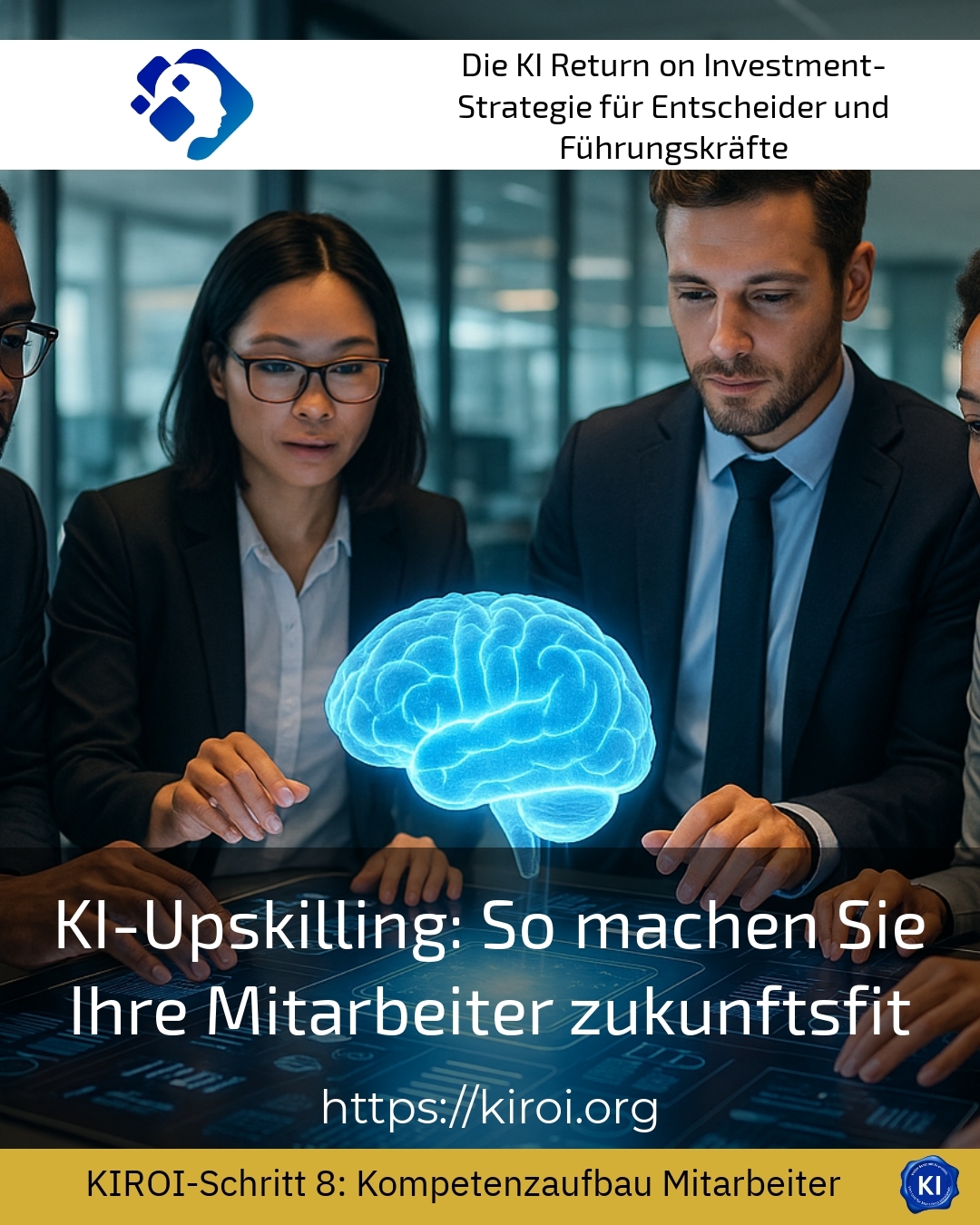
Digital transformation is changing workplaces at a rapid pace. Companies are facing the challenge of preparing their teams for new demands. AI Upskilling: How to Make Your Employees Future-Ready – this question occupies managers across all industries. Those who do not invest in competence development today risk falling behind tomorrow. However, the good news is that with the right strategy, transformation can be achieved sustainably and with motivation. Let yourself be inspired by concrete approaches that numerous organisations have already successfully implemented.
Why the continued development of skills is essential today
The world of work is undergoing a fundamental transformation. New technologies are permeating all areas of business and fundamentally changing established processes. Employees therefore continuously need new skills to remain productive and innovative. Companies that actively support their workforce through this development often report increased motivation and better results. At the same time, staff turnover decreases because people feel valued and recognise development opportunities.
For instance, a car parts supplier faced the task of modernising its production lines. The introduction of intelligent manufacturing systems demanded entirely new qualifications from machine operators. Through targeted training programmes, employees were not only able to operate the new equipment but also to independently suggest optimisations. A medium-sized mechanical engineering company, in turn, seized the opportunity to bring together young and experienced employees in mixed teams. Knowledge transfer worked in both directions: older colleagues shared their experience, while younger ones contributed their digital affinity. A third example showcases a logistics company that familiarised its dispatchers with modern planning tools. Initial scepticism quickly gave way to enthusiasm when the time savings became noticeable.
Strategies for Successful AI Upskilling in Practice
A well-thought-out approach determines the success or failure of further training initiatives. First, it is essential to honestly analyse the current skill level and identify any gaps. Subsequently, tailored learning paths can be developed that take individual strengths into account. It is important that managers actively support and lead by example in these measures. Only in this way can a learning culture be created that goes beyond individual training and has a lasting impact.
A pharmaceutical company relied on peer-learning groups where employees trained each other. Laboratory assistants learned from IT specialists and vice-versa, leading to a deeper understanding of processes. In a craft business, experienced master craftsmen were trained as internal coaches who systematically passed on their knowledge. The effect was remarkable: the error rate decreased while job satisfaction increased. A financial services provider experimented with microlearning units that employees could flexibly integrate into their daily work routines. These short, focused learning units proved particularly effective for imparting technical fundamentals.
Best practice with a AIROI customer
An internationally active manufacturer of industrial components approached transruptions-coaching because their digital transformation had stalled. The leadership had developed ambitious plans, but the workforce was showing reluctance and scepticism. Together, we analysed the situation and identified the main cause: a lack of communication and employee involvement. As part of the support, we developed a multi-stage programme that included both technical training and change management workshops. Establishing feedback channels for employees to voice their concerns was particularly important. These inputs were directly incorporated into the adaptation of the implementation strategy. After six months, a significant change was evident: acceptance of new tools had measurably increased, and initial pilot projects were successfully completed. Employees frequently reported a newfound confidence in using digital tools. The company subsequently established a continuous learning process that continues to this day and is regularly evaluated.
The role of leaders in AI upskilling
Leaders play a key role in the competence development of their teams. They must not only provide resources but also act as role models and demonstrate their own willingness to learn. At the same time, it is their task to take fears seriously and deal with them constructively. Many employees worry about their professional future and need guidance and confidence. Transruptions coaching can provide valuable impetus here and support leadership teams in shaping this change [1].
An energy supplier specifically trained its team leaders in coaching techniques to better facilitate change processes. The investment paid off: conflicts were recognised earlier and resolved constructively. In a media company, managers established regular learning cafes where new technologies were explored together. The informal atmosphere lowered inhibitions and encouraged open exchange. A construction company opted for reverse mentoring: young employees coached experienced managers in the use of digital planning tools [2]. This unusual constellation proved to be extremely fruitful for both sides.
Overcoming obstacles and securing sustainable success
The path to a learning organisation is rarely straightforward. Resistance can come from various directions and have different causes. Some employees doubt their own ability to learn, others don't see the benefit, or fear increased workload. These concerns deserve respect and should not be ignored. Instead, it's important to build trust through small successes and make the advantages tangible.
A textile company had positive experiences with the approach of initially forming voluntary pilot groups. The participants became ambassadors who authentically spread their positive experiences. In a public authority, practical examples from their own daily work helped to make the abstract benefits tangible. The training sessions were conducted directly on real processes, which significantly increased the transferability of the learning. A retailer combined technical training with workshops on personal resilience because many employees reported feeling overwhelmed [3]. This holistic approach was met with great enthusiasm and sustainably improved the working atmosphere.
Measurement and continuous improvement of upskilling measures
Investments in further training should be regularly reviewed for their effectiveness. This involves not only hard performance indicators but also qualitative factors. How has employee confidence developed? Are new skills actually being applied in daily work? Questions like these provide valuable insights for optimising future programmes. An open feedback culture, where critical feedback is also welcome, is important.
An insurance company conducted regular pulse surveys to gauge sentiment during the change process. The results allowed for swift adjustments before frustration became entrenched. In a technology group, learning progress was documented and made visible through practical application projects. These successes motivated further engagement with new topics. A care service developed a simple system enabling employees to self-assess their newly acquired competencies. This reflection fostered an awareness of their own learning progress and strengthened their sense of self-efficacy.
Best practice with a AIROI customer
A medium-sized company in the food industry sought support in introducing intelligent quality control systems. The challenge was to engage long-serving employees with the new technologies without devaluing their valuable experience. Transruption Coaching accompanied the project from the analysis phase through to successful implementation. Together with the management team, we developed a communication strategy that highlighted the benefits for each individual. In workshops, we addressed the specific fears and hopes of the various departments. These insights were incorporated into bespoke training concepts that considered both technical and human aspects. The involvement of experienced employees as quality experts, whose knowledge was integrated into the new systems, proved particularly effective. This appreciation of their skills transformed initial scepticism into active engagement. The company is now experiencing significantly higher product quality alongside increased employee satisfaction. The collaboration illustrates the importance of holistic support in such transformation projects.
Developing future prospects for competent teams
The ability for continuous learning is becoming the most important skill for the future. Organisations that establish this culture today secure long-term competitive advantages. This is not about one-off training measures, but about a permanent change in self-perception. Employees should see themselves as active shapers of their professional development. The responsibility for AI upskilling lies equally with management and employees [4].
A tourism company established an in-house academy offering flexible learning opportunities for all skill levels. Participation is voluntary, but encouraged and recognised through incentives. In an engineering firm, communities of practice were created where professionals could exchange ideas across departments. These informal networks significantly accelerated knowledge transfer and fostered innovative solutions. A healthcare provider developed career paths linking technical further training with opportunities for advancement. This clearly demonstrates that learning is worthwhile and contributes to professional progress.
My AIROI Analysis
The development of employee skills in the context of new technologies represents one of the most significant leadership tasks of our time. My experience from numerous support projects shows that success is largely dependent on the attitude of management. When boards of directors and management teams see further training as a strategic investment and not as a cost factor, astonishing dynamics emerge. The technical side of transformation can be implemented relatively easily, while the human dimension represents the real challenge.
The realisation that resistance to change is often rationally justified and understandable seems particularly important to me. Employees who fear for their jobs or feel overwhelmed do not need persuasion, but honest communication and concrete support. Transruption coaching can provide valuable impetus here and support processes that have a sustainable effect. The examples described illustrate that there is no one-size-fits-all solution and that every organisation must find its own way. However, what applies universally is that appreciation, patience and clear perspectives form the foundation for successful competence development. Companies that treat their employees as partners in change will master the challenges of the future better than those that rely on pressure and dictate [5].
Further links from the text above:
[1] Transruptions-Coaching: Support for digital transformation projects
[2] Reverse Mentoring in Practice
[3] Developing resilience and change management skills
[4] Designing the learning organisation
[5] The AIROI Method for Sustainable Transformation
For more information and if you have any questions, please contact Contact us or read more blog posts on the topic Artificial intelligence here.








 Deutsch
  English (UK)