
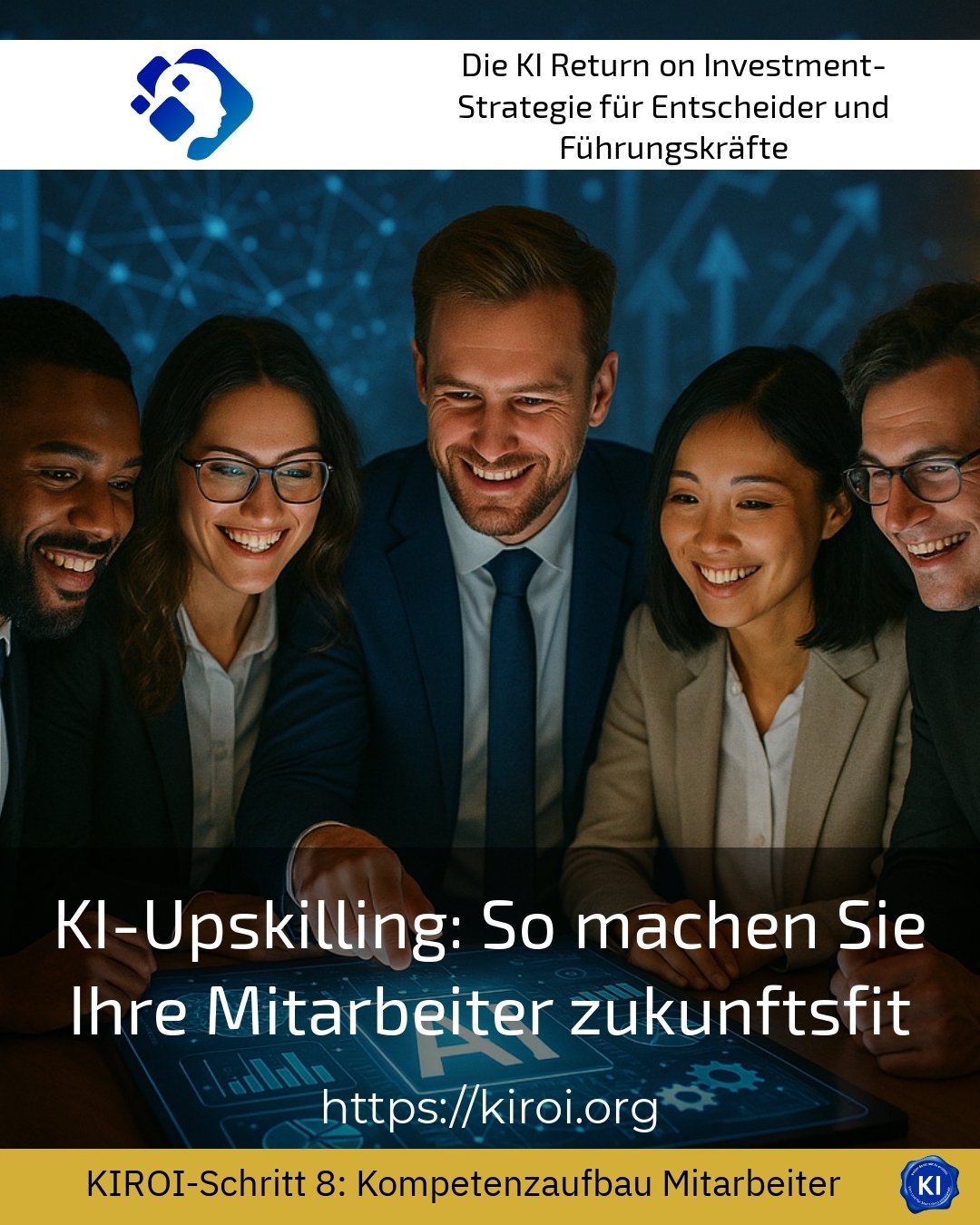
The digital transformation is rapidly changing the world of work. Companies face a crucial challenge: they must equip their workforce for the future. AI Upskilling: How to Make Your Employees Future-Ready – this is a question that concerns managers worldwide. Those who fail to act now risk being left behind. The good news, however, is that there are tried-and-tested strategies and methods available. These can help you successfully develop your teams. In this article, you will learn what specific steps you can take. We draw on tried-and-tested approaches and real-world experience.
Why AI upskilling has become indispensable today
The world of work is undergoing fundamental change. Automation and intelligent systems are increasingly taking over repetitive tasks. At the same time, entirely new job profiles and skill requirements are emerging. Companies often report difficulties in recruiting staff. This is frequently due to a lack of digital skills. A study by the World Economic Forum reveals alarming figures [1]. According to the study, over 50 per cent of all employees require comprehensive further training. This trend affects almost all sectors and levels of the organisation.
The financial sector, for example, is undergoing massive changes. Algorithms analyse portfolios and identify risks. Client advisors need to understand how these systems work. Only then can they offer their clients genuine added value. In the healthcare sector, intelligent diagnostic tools support doctors. Care staff are increasingly working with automated documentation systems. The retail sector is relying on personalised recommendation systems and stock optimisation. These examples illustrate the scale of the transformation.
The human factor remains crucial
Despite all the technological advances, people remain at the heart of it all. Machines can perform certain tasks more efficiently. However, they cannot show genuine empathy or come up with creative solutions. This is precisely where the potential for your employees lies. Through targeted AI upskilling helps your staff stay ahead of the curve for this hybrid working environment. People and intelligent systems will then work together as a team. This combination creates synergies that neither could achieve on their own.
Best practice with a AIROI customer
A medium-sized company in the logistics sector approached us with a specific concern. The staff felt overwhelmed by the new technologies and were showing clear signs of resistance. Staff turnover had risen noticeably, and the atmosphere within the team had deteriorated significantly. As part of the transruptions coaching programme, we worked together to develop a structured training plan. This took into account the individual prior knowledge of each team member. We supported the project over several months and provided regular guidance. Managers learnt how to guide their teams through change processes. After six months, the clients reported a significantly improved acceptance of the new systems. Productivity increased measurably, and employee satisfaction reached new highs. This example impressively demonstrates how important professional support can be in such transformation projects.
Strategic approaches for successful AI upskilling
A successful training strategy starts with an honest assessment of the current situation. What skills are already in place, and where are the gaps? This analysis forms the basis for all subsequent steps. You should take into account both technical and soft skills. Communication, critical thinking and emotional intelligence are becoming increasingly important. Purely technical training is no longer sufficient today.
This approach is particularly evident in the manufacturing industry. Machine operators do not need to become programmers. However, they should understand how automated systems make decisions. In the marketing sector, teams use intelligent analytics tools to optimise campaigns. Employees need a basic understanding of data interpretation and statistical thinking. Legal departments are increasingly relying on automated contract analysis systems. Lawyers are learning to use these tools to support their work.
Learning formats for different needs
Not everyone learns in the same way. Some prefer structured courses with clear learning objectives. Others benefit more from practical workshops and hands-on experience. Still others learn best through mentoring and peer-to-peer exchange. An effective training strategy combines different formats. This allows you to reach the widest possible range of your workforce.
Microlearning modules are becoming increasingly popular in companies [2]. These short learning modules can be easily integrated into the daily work routine. Employees can absorb new content during breaks or whilst waiting. Gamification elements boost motivation and learning outcomes. Peer-learning groups encourage the exchange of knowledge within teams. More experienced colleagues support their teammates in developing their skills.
Identifying obstacles and overcoming them constructively
Change often makes people feel uneasy at first. This is a completely natural reaction to the unknown. As a manager, you should take this resistance seriously. Ignoring or downplaying it usually only makes the situation worse. Instead, open communication about fears and concerns is helpful.
In customer service, we frequently encounter such situations. Employees fear being replaced by chatbots. In reality, however, experience shows a different picture. The technology handles routine enquiries, creating space. Service employees can concentrate on complex issues. Their work becomes more demanding and, at the same time, appreciated. In the banking sector, we are experiencing similar developments in credit checks. Clerks now review the systems' recommendations and make informed decisions.
Best practice with a AIROI customer
An insurance company approached us with a specific problem. The claims handlers had significant reservations about a new analysis system. Management had pushed ahead with the roll-out without sufficiently involving the staff. This resulted in falling usage rates and passive resistance in day-to-day work. As part of the transruptions coaching programme, we first organised facilitated dialogue sessions with all stakeholders. Staff were able to voice their concerns and were listened to. Together, we developed a tailored implementation plan with intensive support. So-called change agents from within the organisation took on role model functions. These colleagues received special training and supported their teams on the ground. After a few weeks, the initial scepticism gave way to constructive cooperation. The clients reported a significant improvement in collaboration between people and the system.
The role of leaders in AI upskilling
Managers play a key role in shaping a company’s learning culture. Their behaviour sends important signals to the entire workforce. If managers do not engage in professional development themselves, this has a demotivating effect. Role models, on the other hand, inspire others and create a positive learning environment. AI Upskilling: How to Make Your Employees Future-Ready – this process starts with the managers themselves.
In the pharmaceutical industry, we are seeing some interesting developments in this regard. Research managers are learning how intelligent systems can accelerate drug development. They pass this knowledge on to their teams and encourage experimentation. In Human Resources, HR managers are using intelligent matching algorithms. They understand their limitations and supplement the recommendations with human judgement. Sales managers analyse customer data with the support of automated forecasting models. Their teams benefit from this knowledge transfer and develop new skills.
Psychological safety as a prerequisite
People learn best in an environment where they are not afraid of making mistakes. Psychological safety means that employees are allowed to ask questions. They can admit when they don’t understand something. Mistakes are seen as opportunities to learn and are not punished. This culture does not develop on its own. It must be actively encouraged and modelled.
Clients often describe situations in which they felt overwhelmed. A production manager described his uncertainty when dealing with new analytics dashboards. With support from transruptions coaching, he was able to overcome this hurdle. A marketing manager reported initial difficulties with automated content systems. The structured induction and regular feedback helped her enormously. These personal development stories demonstrate the importance of individual support.
Measurable successes and continuous improvement
Every training programme should define clear criteria for success. Without measurable objectives, it is impossible to assess progress. This is not just about quantitative metrics; qualitative aspects such as employee satisfaction also play an important role. Regular feedback loops enable adjustments to be made as the process unfolds.
An automotive supplier measures the success of its training initiatives on several levels [3]. The number of completed learning modules provides an initial indication of engagement. More important, however, are the actual instances of application in day-to-day work. How often do employees use the new tools independently and competently? In the energy sector, one company systematically evaluates the ROI of its training programmes. Comparing productivity metrics before and after the training provides valuable insights.
My AIROI Analysis
Developing expertise in the field of smart technologies presents companies with complex challenges. My analysis shows that technical training alone is not enough. Ultimately, the human factor determines the success or failure of such initiatives. Organisations that establish an open learning culture achieve more sustainable results. Involving employees from the outset significantly reduces resistance.
The AIROI model provides a structured framework for these transformation processes. It takes into account both strategic and operational aspects of skills development. Managers receive concrete recommendations for action tailored to their specific situation. The methodology has proven its worth across numerous sectors and organisations of all sizes. At the same time, it remains flexible enough to be adapted to individual needs.
Experience shows that sustainable change takes time. Quick wins are possible, but genuine cultural change requires patience. transruptions coaching guides companies through these various phases. It provides impetus when the process stalls and celebrates progress together. This support helps teams to realise their full potential. Investing in people always pays off in the long run.
Further links from the text above:
[1] World Economic Forum – The Future of Jobs Report
[2] McKinsey – Insights on People and Organisational Performance
[3] Harvard Business Review – Employee Development
For more information and if you have any questions, please contact Contact us or read more blog posts on the topic Artificial intelligence here.








 Deutsch
  English (UK)