
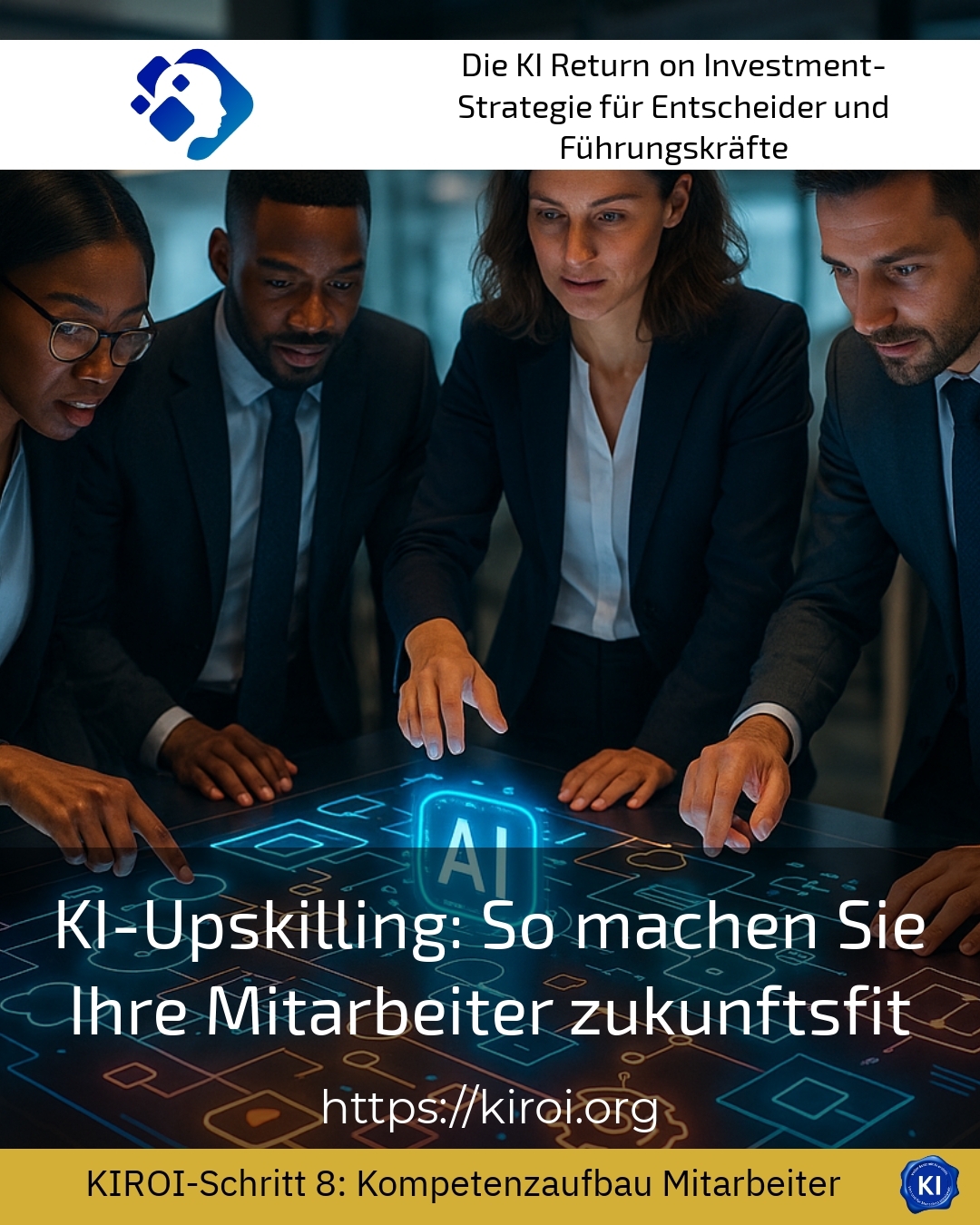
The digital revolution does not wait for latecomers, and those who wish to set the course for tomorrow today must take their workforce on a journey marked by fundamental changes. AI Upskilling: How to Make Your Employees Future-Ready – this question occupies managers and HR professionals in virtually all industries, as intelligent automation is permeating all business processes with a speed that surprises even tech-savvy decision-makers. While some companies are still hesitant, others have already recognised that the systematic development of their teams' skills represents a decisive competitive advantage. In this comprehensive article, you will learn how your organisation can strategically prepare for the challenges of algorithmic transformation.
The strategic importance of AI upskilling for modern organisations
Businesses face a fundamental challenge. They must empower their employees to collaborate with intelligent systems. This requires a rethink at all levels of the organisation. Traditional training concepts are no longer sufficient. The development of new competencies must be continuous and integrated into everyday work [1]. This need is particularly evident in production-oriented companies. Machine operators are increasingly working with predictive maintenance systems. Quality inspectors are using image-based recognition technologies. Logistics planners are relying on algorithmic optimisation methods. Each of these applications requires specific knowledge and skills. The workforce must understand how these systems work and where their limitations lie.
Implementing learning programmes presents many companies with organisational challenges. Time is short, and resources are limited. Nevertheless, clients often report that investing in skills development pays off quickly. Employees gain confidence in using new technologies. They develop an understanding of the possibilities of algorithmic support. Furthermore, a culture of innovation and continuous learning emerges. This cultural transformation is often more valuable than the technical skills themselves. It creates the foundation for sustainable competitiveness.
Best practice with a AIROI customer
A medium-sized company in the industrial manufacturing sector faced the challenge of preparing its growing workforce for the use of image-based quality inspection systems. The employees, many of whom had been with the company for decades, initially showed considerable reservations towards the new technology. As part of a transruption coaching project, we jointly developed a stepwise learning programme that honoured the existing expertise of experienced specialists while building new competencies. The training took place directly at the workplace, allowing theoretical knowledge to be immediately applied in practice. The establishment of 'twinning' pairs, where younger, tech-savvy employees worked together with experienced production specialists, was particularly successful. This arrangement facilitated a reciprocal transfer of knowledge that enriched both parties. After six months, acceptance of the new systems had significantly increased, and the error rate in quality inspection measurably decreased. Management reported a noticeably increased willingness to innovate throughout the entire workforce.
Practical approaches to effective AI upskilling in everyday work
Successful teaching of skills in dealing with intelligent systems requires well-thought-out didactic concepts. Abstract theory teaching frequently misses its mark. Employees learn most effectively through practical application. They need concrete examples from their work environment [2]. An administrative clerk benefits from different content than a maintenance technician. This differentiation is crucial for learning success. All too often, qualification programmes fail due to a lack of relevance for the participants. The content appears abstract and detached from daily business.
In the finance department, algorithmic systems support invoice verification. They identify anomalies and suggest entries. Employees need to learn to critically assess these suggestions. They require a basic understanding of how the systems work. At the same time, they should know when human judgment is required. This balance between trust and critical distance is difficult to convey. It requires time and accompanying reflection. Something similar applies to customer service, where chatbots and assistance systems are increasingly handling standard enquiries. Human employees focus on complex issues. For this, they need advanced problem-solving skills.
The HR department uses intelligent systems for pre-selecting applications. Recruiters must understand the criteria these systems operate by. They should be able to identify algorithmic biases [3]. This critical competence protects against discriminatory decisions. It ensures fair selection processes. In marketing, too, the requirements are changing fundamentally. Campaigns are increasingly optimised through data analysis. Marketing experts require analytical skills to interpret these insights. They must combine creative intuition with data-driven decision-making.
Learning formats that support sustainable competence development
The choice of the right learning format significantly influences success. Classic seminar formats have their purpose, but they are not sufficient. Blended learning approaches sensibly combine various methods. Online modules enable time-flexible learning. Face-to-face events promote personal exchange and reflection. Practical practice phases consolidate acquired knowledge within the work context. This diversity caters to different learning types. It also takes into account company requirements regarding time budgets.
Peer-learning formats have proven to be particularly effective. Employees learn from each other and develop solutions together. This not only promotes knowledge transfer but also team cohesion. Experienced colleagues become multipliers. They pass on their knowledge to others and deepen it themselves in the process. Informal learning communities emerge in many organisations. These communities of practice drive continuous development. They are a valuable supplement to formal training programmes.
Best practice with a AIROI customer
A service company with several thousand employees wanted to prepare its entire workforce for the use of intelligent assistance systems. The challenge was to develop a scalable concept that took into account different qualification levels. As part of our support as a transruption coaching partner, we designed a three-stage programme. The first stage provided basic orientation for all employees, regardless of their role. The second stage offered role-specific in-depth training for various specialist areas such as sales, service, and administration. The third stage was aimed at managers and dealt with strategic aspects of technology integration. Each stage combined online self-learning modules with moderated group workshops. Between workshop dates, participants worked on practical tasks in their work environment. An internal network of learning facilitators provided support with questions and difficulties. After completion of the programme, surveys showed a significantly increased sense of self-efficacy among employees when using the new systems. The usage rates of the provided technologies increased measurably.
Managers as pioneers in AI upskilling
The attitude of leaders determines the success or failure of qualification initiatives. Managers must actively communicate the importance of learning. They should also act as role models and demonstrate their own willingness to learn. If leaders present training as a tedious chore, employees will adopt this attitude. Conversely, if they show genuine interest, it is motivating [4]. Creating time slots for learning activities is one of the most important tasks for leaders. Without explicit release from duties, further training often falls by the wayside.
Leaders also bear responsibility for shaping work contexts. They can create experimental spaces where employees can test new competencies. Mistakes should be understood as learning opportunities. A fear-free atmosphere encourages a willingness to try new things. Regular reflection discussions help to process and deepen learning experiences. Leaders should ask about the application of what has been learned. They can identify obstacles and support their removal.
Incorporating learning objectives into performance reviews highlights their importance. This makes skills development an integral part of the regular performance appraisal process. At the same time, care must be taken not to create undue pressure. Learning takes time and does not thrive under stress. Striking the right balance between support and challenge is a leadership skill. Experienced managers develop a sense of when support and when expectations are appropriate. They guide their staff through the change process with empathy.
Understanding and constructively addressing resistance
Not all employees welcome new technologies with enthusiasm. Resistance is normal and understandable. It can stem from a fear of losing one’s job. Some employees worry that they will not be able to cope with the demands. Others feel that their existing expertise is being devalued. These concerns deserve serious attention. Simply ignoring them leads to demotivation and passive resistance. Instead, managers should listen actively and take these fears seriously.
Transparent communication about the goals of change builds trust. Employees want to know what is coming their way. They want to understand what role they will play in the future. If these questions remain unanswered, rumours and uncertainty arise. Clear statements about job security can reduce anxieties. Emphasising that human skills remain in demand is reassuring. Technology does not replace people, but rather changes their tasks.
Participatory approaches increase acceptance of change. When employees are able to play a part in designing training programmes, they identify more strongly with them. Pilot groups can test new concepts and provide feedback. This feedback is incorporated into the further development of the programmes. This creates an iterative improvement process. Employees see themselves as active contributors rather than passive recipients. This experience boosts their self-efficacy and willingness to embrace change.
Best practice with a AIROI customer
A long-established trading company was planning to introduce algorithmic systems for assortment optimisation and demand forecasting. The experienced buyers, who had previously made decisions based on their years of market knowledge, showed considerable resistance to this change. They perceived the new systems as a threat to their expertise and professional identity. As part of the "transruptions coaching" support, we developed a concept that valued existing human expertise and integrated it with algorithmic support. The buyers were involved as experts, whose knowledge was indispensable for calibrating the systems. They learned to use the algorithmic recommendations as an additional source of information, not as a substitute for their judgment. In moderated workshops, the teams jointly reflected on their experiences with the collaboration between humans and algorithms. Gradually, an understanding developed of how both sides can benefit from each other. After a year, most buyers reported that they would not want to be without the technical support because it takes over routine tasks and creates capacity for more strategic activities.
My AIROI Analysis
The systematic development of skills in working with intelligent systems is one of the key management tasks of our time. Organisations that rise to this challenge gain a sustainable competitive advantage. They safeguard their capacity for innovation and ensure their employees are equipped for the future. Ultimately, investing in human skills is more valuable than any technological acquisition. After all, technology only delivers its full benefits when used competently.
From my experience in numerous consulting projects, some fundamental success factors can be derived. Firstly, qualification must be strategically anchored and not viewed as an isolated personnel development measure. Secondly, a realistic assessment of the required timeframes is needed, as profound competence development doesn't happen overnight. Thirdly, the involvement of those affected in the design of the programmes is essential for their acceptance and effectiveness.
The role of transruption coaching in such transformation projects is to provide impetus and guide processes. We support organisations in developing and implementing suitable concepts, taking into account the specific circumstances of each company. There are no one-size-fits-all solutions, only tailored approaches. The combination of methodological expertise and industry-specific experience enables effective interventions. Clients often report that external support helps them to recognise blind spots and adopt new perspectives.
In conclusion, I would like to emphasise that the development of human skills is an ongoing process. It does not end with the completion of a training programme. Rather, structures must be put in place that enable and encourage lifelong learning. The organisations that understand and implement this will be the winners of the algorithmic transformation. They will not be driven by technology, but will actively shape their own future.
Further links from the text above:
[1] McKinsey – Future of Work Insights
[2] World Economic Forum – The Future of Jobs Report
[3] Bitkom – Artificial Intelligence Topic Area
[4] Harvard Business Review – Leadership
For more information and if you have any questions, please contact Contact us or read more blog posts on the topic Artificial intelligence here.








 Deutsch
  English (UK)