
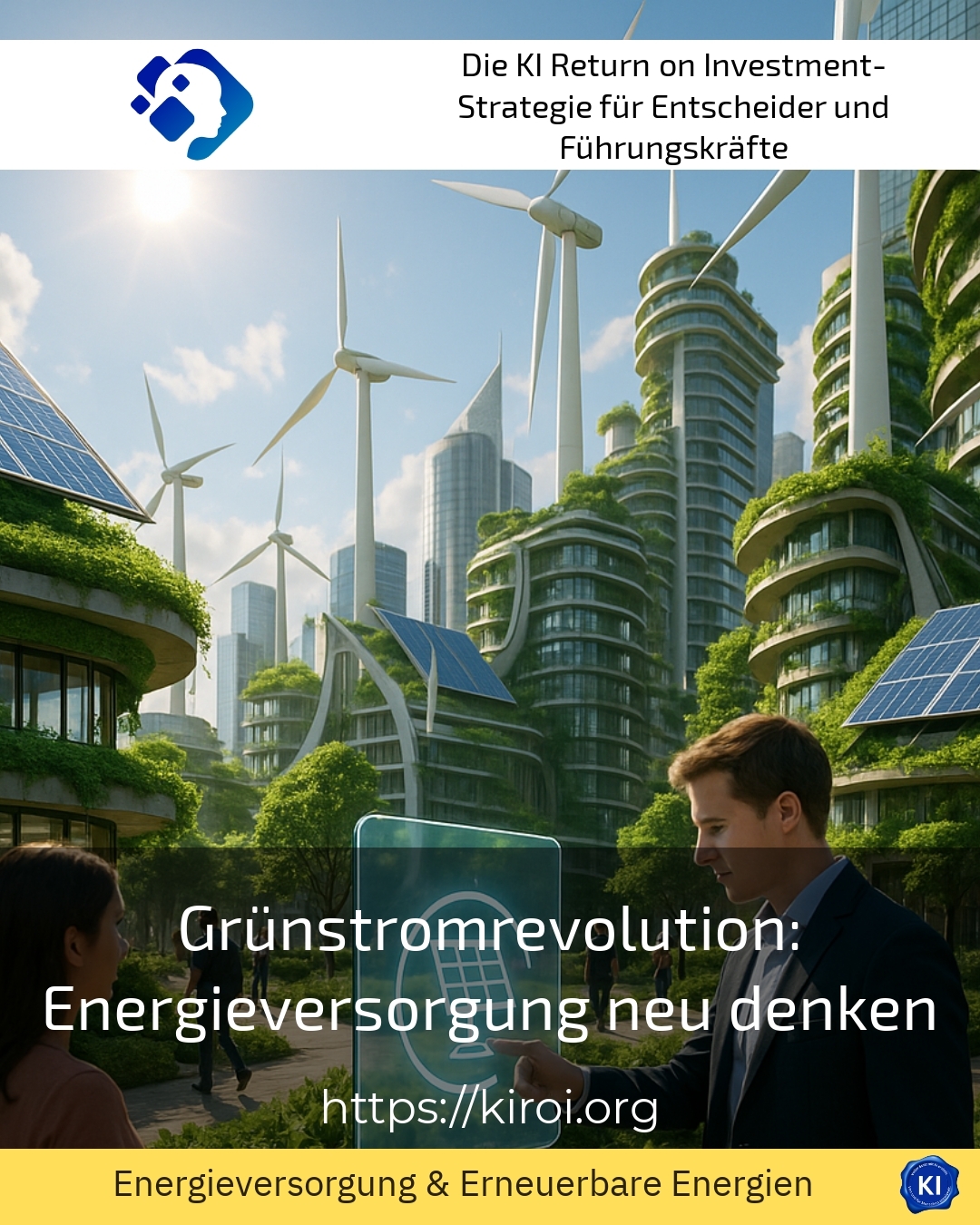
Have you ever wondered why some companies seem to effortlessly steer towards a sustainable future, while others still cling to outdated structures? The answer often lies in a fundamental change of mindset that goes far beyond technical innovations and permeates the entire corporate culture. Green electricity revolution It is currently changing not only the way we generate and distribute electricity, but it is transforming entire business models, supply chains, and customer expectations fundamentally. In this article, you will learn what concrete steps organizations are taking to make their supply structures future-proof, and how professional guidance can help them successfully implement transformation projects.
Understanding the transformation of the healthcare landscape
The current change in the electricity supply sector presents companies with complex challenges. Traditional energy providers must fundamentally rethink their business models. Decentralized generation facilities, intelligent networks, and storage-based solutions require entirely new competencies. For example, a medium-sized machine manufacturer from Baden-Württemberg recognized early on that installing its own photovoltaic systems on factory premises not only reduces costs but also increases the attractiveness as an employer. At the same time, a major automotive supplier in Lower Saxony implemented enterprise-wide load management that automatically adapts production processes to the availability of renewable resources. A logistics company from the Ruhr region also invested in its own hydrogen refueling infrastructure for its truck fleet, thereby positioning itself as a pioneer in the industry.
The complexity of this transformation initially overwhelms many organizations. Management teams often report uncertainty in the face of the multitude of technical options. This is where transruptive coaching comes in and helps teams gain clarity. The methodology supports decision-makers in setting priorities and using resources purposefully. A structured process helps them constructively address resistance within the company and transform it into productive energy.
Why the green energy revolution requires new ways of thinking
The transition towards sustainable supply structures is much more than a technical project. It touches on core questions of corporate identity and self-perception. A traditional steel producer from North Rhine-Westphalia faced the challenge of making its energy-intensive blast furnace processes climate neutral without compromising competitiveness [1]. The solution lay in a combination of process innovation, strategic partnerships with wind farm operators, and a comprehensive training initiative for the workforce. A chemical company on the Rhine developed an innovative power-to-X process that converts surplus electricity from renewable sources into chemical raw materials. And a medium-sized textile manufacturer from Saxony now uses waste heat from neighboring data centers for its production processes.
Best practice with a AIROI customer
A leading manufacturer of industrial components with multiple production sites in Germany approached our team because management realized that the current approach to transforming the supply chain was not achieving the desired results. The various departments were working separately on partial solutions, without developing a shared understanding of the overarching goals. As part of the transruptive coaching, we initially guided the senior management team in formulating a coherent vision that integrated both ecological and economic aspects. Subsequently, we moderated cross-departmental workshops in which concrete areas of action were identified and prioritized. The procurement department developed new criteria for supplier selection, while the facility management department developed a roadmap for the gradual transformation of the building technology. After six months of intensive support, the company not only achieved measurable progress in reducing its dependence on fossil resources, but also established a new culture of cross-sectoral collaboration that extends far beyond the original project.
Strategic realignment in the green energy revolution
The strategic dimension of change is often underestimated. Many companies initially focus on technical individual measures without taking into account the long-term implications. For example, a food company from Bavaria integrated the issue of security of supply into its overall location strategy and examines the local availability of renewable resources when making every investment decision [2]. A pharmaceutical company from Hesse concluded long-term power purchase agreements with wind farm operators, thereby securing stable conditions for the coming decades. An electronics manufacturer from the Black Forest went one step further and directly participated in an offshore wind project in the North Sea to secure its supply chain.
These strategic decisions require a deep understanding of one’s value chain. They also require courage to leave established paths. This is where we start with our transruptive coaching and provide impulses that go beyond the day-to-day business. The guidance helps identify blind spots and develop new perspectives. Clients often report that through this process they recognize connections that were previously hidden from them.
Technological building blocks for sustainable supply concepts
The technological landscape today offers a wealth of opportunities. Battery storage systems enable the smoothing of volatile generation and the mitigation of load peaks. A car manufacturer in Stuttgart is using worn-out vehicle batteries as stationary storage in its plants, thereby significantly extending their life cycle. Virtual power plants connect decentralized generation facilities and optimize their use in real time. A city utility in Schleswig-Holstein is thus coordinating thousands of private solar panels and small wind turbines into a flexible network [3]. Smart building controls automatically adjust consumption to the availability of cheap, clean electricity. An insurance company in Munich implemented such a solution at its headquarters and reduced its consumption from conventional sources by more than half.
Selecting and integrating these technologies presents companies with complex decisions. Not every solution fits every application. Professional guidance helps here by asking the right questions and making informed decisions. The trick is to align technical capabilities with operational requirements.
Involving employees as drivers of change
Every transformation depends on the people who implement it. Engaging the workforce is therefore a critical success factor. A machine tool manufacturer from Thuringia initiated a comprehensive training program that provides all employees with basic knowledge about sustainable supply chains. A consumer goods manufacturer from North Rhine-Westphalia established an internal idea management system that systematically incorporates and implements improvement suggestions from the workforce. An IT service provider from Berlin connects its employees via an app that visualizes the current power mix in the office building and encourages conscious behavior.
Best practice with a AIROI customer
An internationally operating retail company with numerous branches in the German-speaking region faced the challenge of implementing its ambitious sustainability goals while maintaining employee motivation. While previous top-down initiatives had achieved technical improvements, they had hardly generated any resonance at the operational level, leaving many potential opportunities untapped. As part of our support, we developed a multistage engagement concept together with the client that made branch managers ambassadors of change and gave them concrete scope for action. We facilitated regional workshops in which local teams developed their own initiatives and took responsibility for their implementation, leading to a noticeable increase in identification with the company’s goals. The results exceeded expectations significantly; not only did consumption in the participating stores drop significantly, but employee satisfaction also increased measurably, which had a positive effect on turnover. The company now plans to expand this concept to all international locations and has asked us to continue to support this expansion.
Taking advantage of the green energy revolution as a competitive advantage
Companies that actively shape change reap tangible benefits. They reduce their dependence on volatile commodity markets and strengthen their resilience. A furniture manufacturer from Westphalia is successfully marketing its sustainable production as a differentiator from international competitors. A plant builder from Saarland regularly wins tenders because it meets the strict sustainability requirements of large clients [4]. A software company from Hamburg is positioning itself as a climate-neutral employer, thereby attracting talented professionals who value meaningful work.
Communicating these benefits requires a delicate touch. Excessive promises damage credibility. Authenticity and transparency, on the other hand, build trust. Transruptions coaching helps organizations tell their story credibly, while openly addressing both achieved progress and remaining challenges.
My AIROI Analysis
The transformation of the supply chain is not an isolated technical task, but a comprehensive change project that affects all areas of an organization. My analysis of various customer projects shows that success depends significantly on three factors: first, a clear vision that integrates environmental and economic goals; second, a consistent involvement of all stakeholders from the management level to the operational level; and third, a realistic assessment of one’s own resources and capabilities. Companies that take these factors into account achieve sustainable results and avoid costly missteps. Experience has shown that the biggest obstacles are not technical limitations but organizational barriers, ingrained mindsets, and a lack of communication between departments. Here, professional support can make a crucial difference by uncovering blind spots, enabling constructive dialogues, and focusing on the essentials. Green electricity revolution offers enormous opportunities for companies of all industries and sizes, but it also requires courage, perseverance, and the willingness to leave familiar paths and embark on new paths.
Further links from the text above:
[1] Federal Ministry of Economy – Energy Transition Dossier
[2] German Energy Agency – Energy sector
[4] Federal Environmental Agency – Climate and Energy
For more information and if you have any questions, please contact Contact us or read more blog posts on the topic Artificial intelligence here.








 Deutsch
 English (UK)