
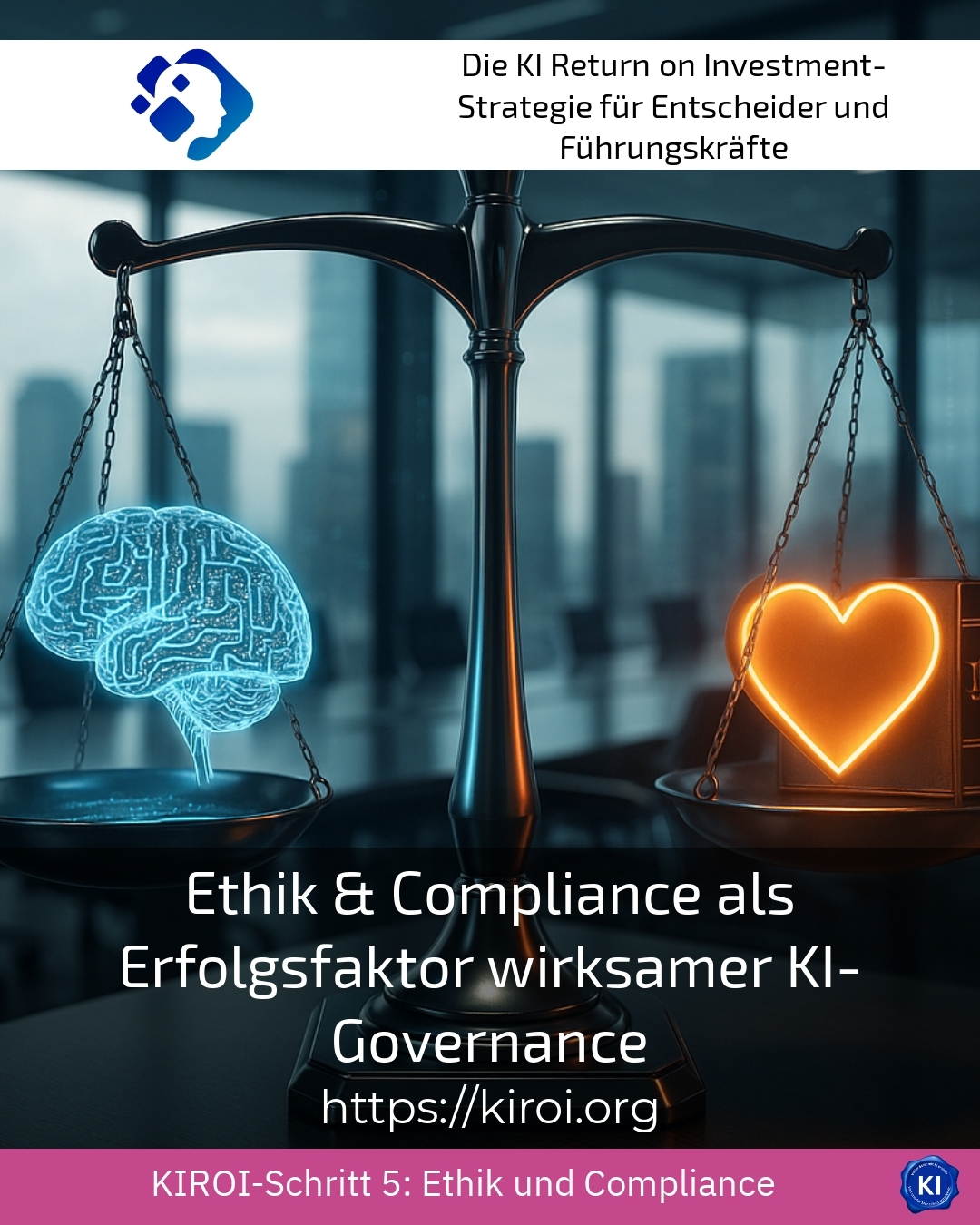
Imagine an automated system making decisions about credit applications or medical diagnoses – without any human understanding why those decisions were made. This is precisely where the critical importance of Ethics & Compliance as a Success Factor for Effective AI Governance for modern organisations. The rapid development of intelligent systems presents companies with challenges that go far beyond technical issues and require fundamental value decisions.
Why moral guardrails for intelligent systems are indispensable
Intelligent algorithms now permeate almost every business area. They analyse customer behaviour and optimise supply chains. They support personnel decisions and control production processes. This comprehensive integration presents enormous opportunities, but also significant risks. An algorithm can unintentionally discriminate by adopting problematic patterns from historical data. A recommendation system can reinforce filter bubbles and promote extreme content. Such scenarios illustrate why technical excellence alone is not enough.
For example, financial institutions use scoring models to decide on creditworthiness. These models must operate transparently and comprehensibly. Otherwise, banks risk not only regulatory sanctions but also massive reputational damage. Insurance companies use predictive analytics for risk assessment. Here, there is a risk that certain population groups may be systematically disadvantaged. In the healthcare sector, diagnostic systems support doctors in their decision-making. However, responsibility for misdiagnoses remains a complex ethical and legal question.
Ethics & Compliance as a Success Factor for Effective AI Governance in Everyday Business
The practical implementation of ethical principles requires concrete measures and clear structures. Companies must define responsibilities and establish processes. They need mechanisms for continuous monitoring and adaptation of their systems. This begins in the development phase and continues throughout the entire lifecycle.
A trading company implemented a dynamic pricing system that balanced supply and demand in real-time. Initially, the system worked flawlessly from a technical standpoint. It then emerged that it systematically overcharged certain postcode areas. These areas were predominantly inhabited by lower-income groups. The company not only had to rework the system but also manage significant damage to its reputation. A logistics group used route optimisation that pushed drivers to their physical limits. The algorithmic increase in efficiency came at the expense of employee health. Only after public criticism were humane working conditions integrated into the optimisation parameters.
Best practice with a KIROI customer
A medium-sized manufacturing company approached the transruptions coaching team because it was facing a complex challenge. The company had introduced an automated quality control system designed to continuously evaluate production data and minimise scrap rates. However, it emerged that the system was systematically classifying certain production batches as faulty, even though they met quality standards. The root cause lay in training data that originated from a production phase with temporary machine errors. As part of the KIROI support, the company developed a comprehensive governance framework that included regular audits of the training data and defined clear escalation paths for algorithmic anomalies. Furthermore, employees from various departments were brought together in an interdisciplinary ethics committee, which is consulted on critical system decisions. The continuous support from transruptions coaching helped the company establish a sustainable culture of algorithmic responsibility and consistently link technical decisions with human judgment.
Regulatory frameworks and their strategic importance
The European regulatory landscape is evolving dynamically. New regulations impose mandatory requirements for transparency and traceability. Companies should not view these provisions as an obstacle, but rather as a strategic opportunity. Those who establish robust governance structures early on will gain a competitive advantage. They will win customer trust and minimise legal risks.
Telecommunications providers use automated systems for customer communication and contract design. The traceability of these decisions is increasingly being demanded by regulations. Energy suppliers use intelligent grids that analyse consumption data and predict peak loads. The protection of this sensitive data requires sophisticated compliance mechanisms. Car manufacturers are developing driver assistance systems that react autonomously in hazardous situations. This raises fundamental ethical questions about prioritisation in unavoidable accidents.
Practical Implementation of Ethics & Compliance as a Success Factor for Effective AI Governance
The implementation begins with a thorough inventory of all deployed systems. Which algorithms make decisions with an impact on people? Which data feed into these decisions? How transparent are the underlying models? These questions form the starting point for a structured governance programme.
Recruitment agencies use applicant tracking systems that automatically analyse and pre-select CVs. Such a system can unknowingly discriminate against certain applicant groups. Gaps in a CV may be systematically assessed negatively, even though these gaps can have a variety of legitimate reasons. Media companies use recommendation algorithms that provide users with personalised content. These algorithms can reinforce echo chambers and promote extreme opinions. Retail companies implement demand forecasting that automates purchasing decisions. Incorrect forecasts lead to overstocking or supply bottlenecks with significant economic consequences.
Best practice with a KIROI customer
A financial services provider approached the transruptions coaching team with a complex concern because its automated customer service system was increasingly generating complaints. Customers felt misunderstood by the standardised responses and were escalating to human agents more frequently. The KIROI analysis revealed that while the system was technically sound, it did not adequately consider emotional nuances in customer inquiries. Together, the team developed a new approach that integrated empathy indicators into the algorithmic processing and proactively involved human support at certain triggers. Furthermore, the company established a regular feedback system where customer responses were systematically evaluated and fed back into the system's continuous development. The support from transruptions coaching enabled a holistic view, combining technical optimisation with human-centred design, thereby significantly improving both customer satisfaction and employee workload.
Cultural transformation as the basis for sustainable governance
Technical measures alone are not sufficient to ensure responsible system use. Organisations must develop a culture that makes ethical reflection a matter of course. Leaders must embody these values and integrate them into decision-making processes. Employees need training and awareness of algorithmic risks.
Pharmaceutical companies employ data-driven approaches in drug development and clinical research [1]. The ethical implications range from data privacy issues to the equitable distribution of medical innovations. Educational institutions are utilising adaptive learning systems that personalise curriculum content. This raises questions about equal opportunity and the protection of minor users. Security authorities are implementing analytical systems for hazard prevention. The balance between public safety and individual liberties requires careful ethical consideration.
Embedding Ethics & Compliance as a Success Factor for Effective AI Governance in Practice
Successful organisations establish dedicated committees and roles for algorithmic accountability. An ethics board can assess critical use cases and develop guidelines. Data protection officers extend their remit to algorithmic fairness. Compliance departments integrate technical competence into their audit processes [2].
Property companies employ valuation algorithms that predict market prices and support investment decisions. These systems can amplify price fluctuations and promote social segregation. Tourism companies use dynamic pricing models that reflect real-time demand variations. The perception of unfair pricing can irreparably damage customer relationships. Agricultural businesses implement precision agriculture with data-driven resource management. Reliance on proprietary systems raises questions about digital sovereignty.
My KIROI Analysis
A comprehensive review of Ethics & Compliance as a Success Factor for Effective AI Governance clearly shows that technological progress and moral responsibility are inseparably linked. Organisations that ignore this connection not only risk their reputation but also face the danger of regulatory sanctions and a loss of trust from customers and employees. The examples from various industries illustrate that algorithmic systems, despite their technical brilliance, do not automatically consider human values. Conscious design and continuous monitoring are required to ensure that these systems operate in accordance with societal norms.
The KIROI methodology offers a structured framework for systematically addressing these complex requirements. It combines technical expertise with ethical reflection and regulatory knowledge. Transruption coaching supports organisations in shaping this transformation sustainably. Success lies not in short-term adjustments, but in the long-term embedding of responsible practices. Companies investing in robust governance structures today lay the foundation for sustainable success in an increasingly algorithm-driven economy. They position themselves as trusted partners and gain competitive advantages through ethical differentiation [3].
Further links from the text above:
[1] European Medicines Agency – Research and Development
[2] Federal Commissioner for Data Protection and Freedom of Information
[3] Bitkom – Artificial Intelligence
For more information and if you have any questions, please contact Contact us or read more blog posts on the topic Artificial intelligence here.











 Deutsch
  English (UK)