
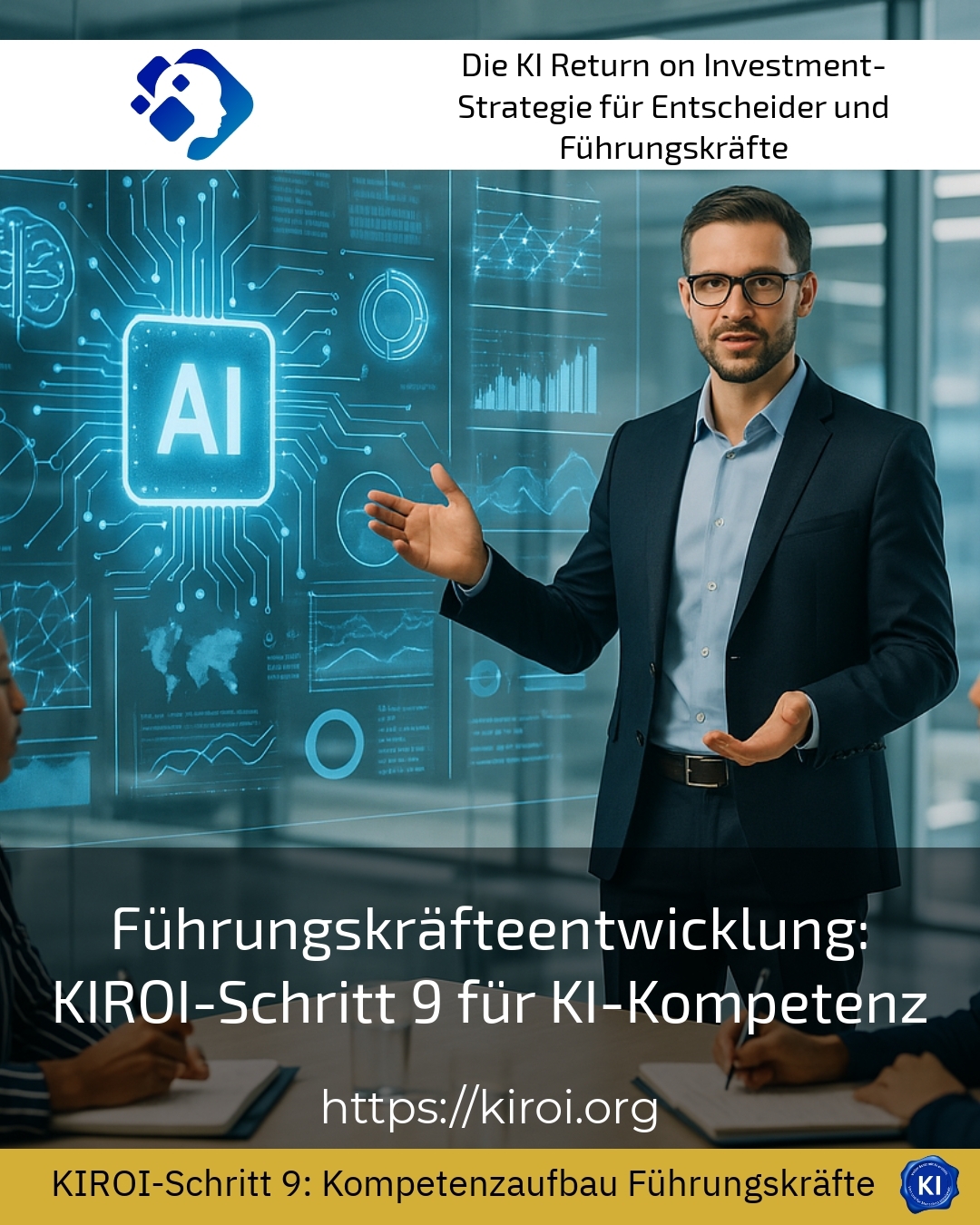
Leadership development is a key building block for sustainable business success. Specifically, the KIROI Step 9 plays an important role in equipping leaders with skills in Artificial Intelligence (AI). In today's dynamic world of work, it is crucial that managers not only impart traditional leadership qualities but are also able to actively support and implement technological changes.
AI competence as a key in leadership development
AI technologies are increasingly permeating business processes and fundamentally changing leadership tasks. Leaders therefore need in-depth knowledge of AI applications and their impact on workflows. AI ROI Step 9 focuses precisely on this ability: leaders are supported in recognising AI potential, using it strategically, and steering teams accordingly.
An example from the financial sector shows how CRM systems with AI-powered customer analysis optimise portfolio management. Leaders learn to competently integrate appropriate tools and guide employees in their use. In production, the focus is often on implementing predictive maintenance to minimise downtime. Here, leadership development requires expanding technical understanding and change management. In retail, leaders benefit from AI-powered data analysis when developing personalised marketing strategies.
Practical implementation within the scope of leadership development
The path to AI competence is ideally achieved through a combination of different methods to make learning sustainable. KIROI Step 9 includes both formal training courses and practical learning phases.
For example, companies support managers through targeted coaching to reflect on individual challenges in AI implementations and develop solutions. At the same time, workshops and interactive training sessions offer concrete tools and methods on how to manage AI projects. Learning on the job remains indispensable, with managers actively involved in the implementation of AI applications in everyday operations.
A manufacturing company designed a multi-stage development programme for its department heads, combining digital learning modules with in-person workshops and peer coaching. This helped to increase acceptance of AI technologies and successfully support their implementation within the team.
BEST PRACTICE with a client (name withheld due to NDA): As part of an AIROI-based programme, healthcare executives received individual coaching and topic-specific workshops to equip them with practical tools for using AI in patient data analysis. Participants reported that this empowered them to communicate data-driven decisions more transparently and to foster innovation processes.
Integration of KIROI Step 9 into existing leadership programmes
To ensure leadership development remains effective overall, AI competency development should be seamlessly integrated into existing programmes. This avoids isolated learning islands and ensures sustainable embedding in daily work.
For instance, on-the-job methods such as job rotation can be used to allow managers to gain experience in various fields related to AI. Mentoring programmes, where experienced managers and AI experts collaborate, also support practical learning. Furthermore, digital learning platforms offer flexible opportunities to work through AI-specific content in a needs-driven and self-directed manner.
In the automotive sector, executives benefit from the integration of classic leadership training with in-depth modules on AI-assisted process optimisation in manufacturing. In the service sector, networking meetings facilitate the exchange of experiences regarding challenges in customer service digitalisation.
Tips for successfully applying the KIROI step 9
Focus on individual development plans that include AI skills as an essential component.
– Combine classic methods such as coaching or mentoring with innovative formats such as digital learning modules and peer learning.
– Involve managers in real AI projects early on so that learning is directly relevant to everyday work.
– Create spaces for reflection to facilitate critical discussions on the opportunities and risks of AI, in order to promote acceptance.
– Focus on continuous monitoring and evaluation to make development progress measurable and to adjust as needed.
My analysis
Leadership development takes on a new dimension with KIROI Step 9. The targeted impartation of AI competencies supports leaders in proactively shaping technological changes and successfully managing their teams. Practice-oriented and diverse learning formats are crucial for learning success. The better companies integrate AI topics into their leadership development, the more they benefit from sustainable innovative capability and future-oriented management.
Further links from the text above:
How does leadership development succeed? – Methods, concepts and examples
Leadership Development: Comprehensive Guide with Methods
Measures and concepts of leadership development
Leadership Development: The HR Guide
Methods & Practice Tips for Leadership Development
For more information and if you have any questions, please contact Contact us or read more blog posts on the topic Artificial intelligence here.











 Deutsch
  English (UK)