
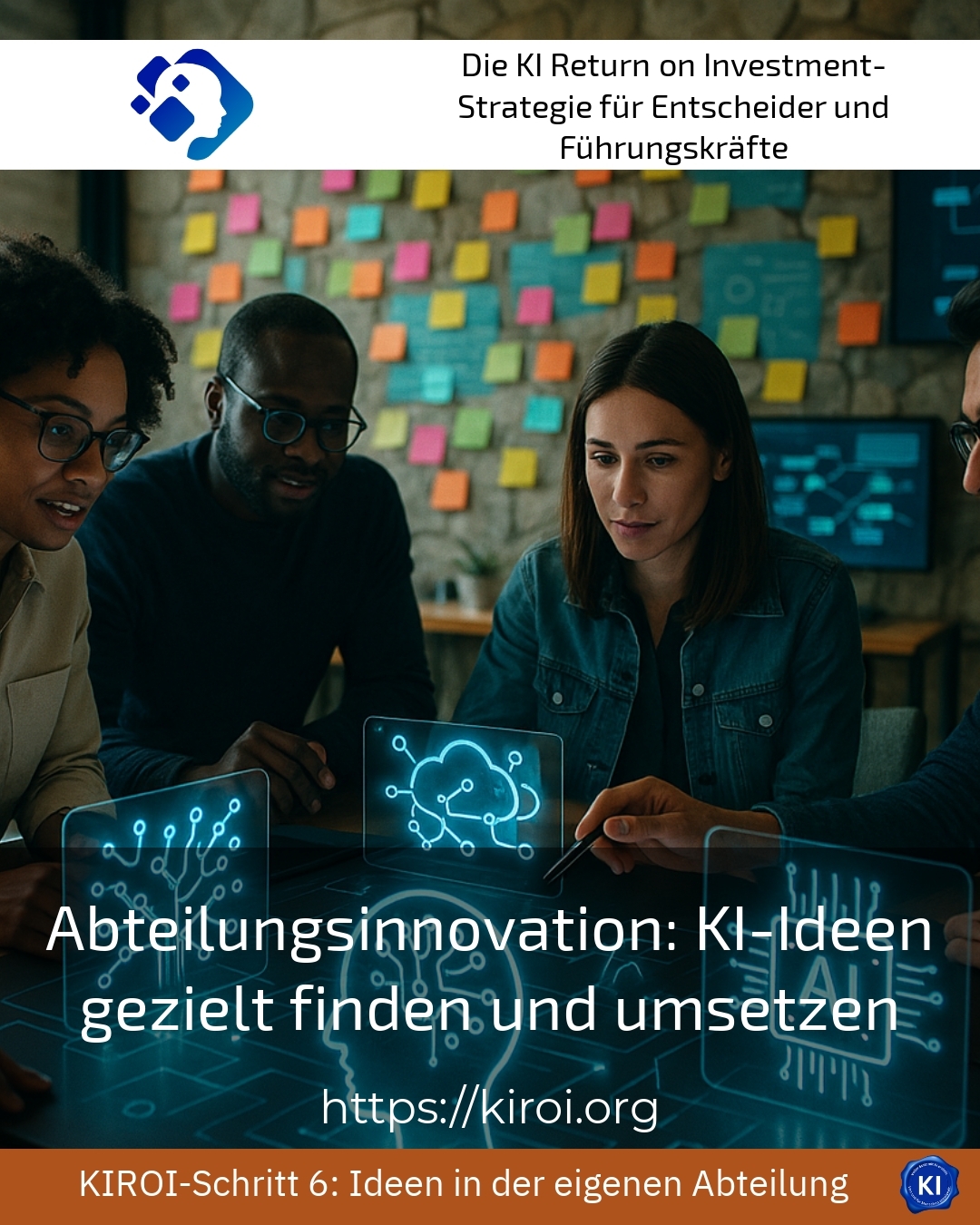
Have you ever wondered why some teams in your company seem to develop innovative solutions effortlessly, while other departments have been stuck in a rut for years and have to discuss the same problems over and over again? The answer often lies in the structured approach to problem solving. Departmental innovation: Targeting and implementing AI ideas, Because without clear methodology, even the best ideas remain unused in drawers. In a time when intelligent systems can revolutionize almost every business sector, it is crucial not to simply buy technology; rather, it is essential to identify tailored applications for one’s own processes and systematically integrate them into everyday work.
Why traditional approaches to innovation are no longer sufficient today
The classic approach, in which executives hold an innovation workshop once a year and employees write their ideas on colorful sticky notes, has become outdated in many organizations. This method does not take into account the rapid technological development or the specific challenges of individual departments that are confronted with concrete bottlenecks and inefficiencies on a daily basis. Instead, a continuous process is needed that combines the expertise of employees with the capabilities of modern technologies and at the same time provides realistic implementation paths.
Many companies report similar experiences. For example, they have invested significant sums in chatbot systems without first analyzing which communication processes should actually be automated. Others have purchased data analysis tools that now remain unused because no one provides the necessary datasets. Such failures are not caused by a lack of technology, but by a lack of coordination between technical capabilities and operational requirements.
Departmental innovation: Targeting AI ideas through systematic needs analysis
The first step to successful integration of intelligent systems is to identify the actual pain points in the various business areas and assess them based on urgency and potential for automation. This does not involve initiating spectacular flagship projects, but rather involves pragmatic improvements that can significantly facilitate everyday work and simultaneously deliver measurable results.
In the area of personnel management, for example, there is enormous potential in pre-screening application documents, where intelligent systems can analyze and prioritize CVs according to defined criteria. A finance team, on the other hand, could benefit from automated audit checks that identify discrepancies before they lead to major problems. In the logistics department, algorithms, in turn, support route optimization and predictive maintenance planning for the fleet.
Best practice with a AIROI customer
A medium-sized trading company approached us with a specific challenge, as the purchasing department had been struggling for a long time with unreliable demand forecasts and resulting overstocking in some product groups, while other items were regularly sold out. The previous approaches were based on the experience of individual employees and Excel spreadsheets, which contained historical data but did not enable intelligent pattern recognition. As part of our AIROI support, we initially conducted structured interviews with all involved parties and identified not only the obvious forecasting problem but also underlying inefficiencies in warehouse management and supplier communication. Together, we developed a three-stage implementation plan that began with a pilot phase in two product categories and could be expanded to the entire range within six months. The result was a reduction in storage costs of approximately twenty percent and a significantly improved availability of goods, with employees being involved in the process from the very beginning and perceiving the system as support rather than a threat.
The role of employees in the innovation process
A frequently underestimated success factor lies in the active involvement of the people who work daily with the processes to be optimized and who know the intricacies of these processes like no one else in the company. This specialist expertise is irreplaceable, because no external consultant and no even the most sophisticated system can replace the implicit knowledge that has accumulated over years of practical work. Successful projects are characterized by the fact that they do not view employees as passive recipients of technology, but as active agents of change.
In customer service, teams regularly report on recurring requests that could actually be answered automatically. In sales, field workers are familiar with time-consuming documentation tasks that interfere with their actual sales work. In product development, engineers are aware of the lengthy research processes involved in patent review. All of these insights ideally feed into a central idea collection.
Evaluation criteria for promising use cases
Not every idea is equally suitable for implementation, which is why systematic evaluation based on transparent criteria is essential. Various factors play a role in this, including the expected benefits, the implementation effort, the availability of data, and the acceptance among those affected. A structured evaluation process helps in focusing resources on the most promising projects and in early identifying unrealistic plans.
In the area of quality assurance, for example, image-based testing systems can be implemented relatively quickly if standardized processes and sufficient image material for training are already in place. The introduction of an intelligent assistant for the legal department, however, requires extensive preliminary work in document structuring and the definition of decision rules. A predictive model for energy consumption in production facilities first requires complete data collection over an extended period of time.
Departmental innovation: Targeted implementation of AI ideas in manageable steps
The implementation phase ultimately determines the success or failure of an innovation project, and this is where it is evident whether the preliminary work was thorough enough and all relevant stakeholders were involved. An iterative approach with regular reviews and adjustments has proven significantly more successful than attempting to develop the perfect solution from the outset and only starting the practical testing months later.
Transruptions coaching accompanies companies precisely at this critical phase and provides impulses for the gradual integration of new technologies into existing workflows [1]. Clients often report that it is precisely the early pilot phases that provide valuable insights that lead to significant adjustments to the original concept. These learning loops are not a sign of failure but a natural part of any complex change process.
Best practice with a AIROI customer
A marketing department at a consumer goods company was looking for ways to speed up the creation of product texts for various distribution channels, as manual customization for online stores, catalogs, and social media platforms took up enormous amounts of time. The initial idea of simply using a standard tool failed due to the specific brand guidelines and the desired tone of the communication. As part of the AIROI onboarding process, we developed a customized briefing system together with the team that structured the essential product information and served as the basis for the automated text generation. The employees were initially skeptical and feared a loss of quality, but after a two-month test phase with selected product categories, it was shown that the generated designs only required minimal adjustments in over seventy percent of cases. The time gained was particularly valuable, which the team was now able to use for more creative tasks such as campaign development and influencer collaborations, which ultimately also increased job satisfaction.
Challenges and typical stumbling blocks in the process
Even with careful planning, obstacles regularly arise that can slow down progress or endanger the entire project. Some of the most common problems include unrealistic expectations of the technology, insufficient data quality, lack of support from management, and resistance from employees. These challenges cannot always be avoided, but by acting proactively, their impact can be significantly mitigated.
In the field of accounting, automation projects often fail due to the heterogeneity of the underlying documents. In the personnel field, data protection requirements pose particular hurdles. In production, the necessary sensors are sometimes lacking to collect actionable data. All of these situations require individual solutions and often also compromise the original objectives.
Sustainable embedding of an innovation culture
A single successful project is valuable, but the real breakthrough only happens when innovation becomes an integral part of the corporate culture and is no longer perceived as the exception but as the norm. This requires appropriate structures, incentive systems, and above all leaders who not only encourage innovation but actively lead by example and support it.
Regular innovation circles in the IT department can, for example, evaluate new technologies and test their applicability to the company’s own operations [2]. An internal wiki documents already implemented projects and shares experience with other departments. Mentoring programs connect technically skilled employees with colleagues who need support with digital topics. This creates a learning system that continuously improves.
My AIROI Analysis
The successful Departmental innovation: Targeting and implementing AI ideas It requires far more than just technical knowledge or financial resources, because at its core it is about a cultural change that affects and transforms all levels of the organization. In my experience from numerous accompanying projects, it is repeatedly shown that the human component determines success or failure, which is why any technology introduction should be accompanied by change management measures.
What is particularly striking is that companies with an open culture of error learn much faster and complete their projects more successfully than organizations where setbacks are seen as a flaw. The willingness to learn from failures and make course corrections sets the leaders apart from the laggards. In this context, external support such as our transruptive coaching often helps uncover blind spots and introduce new perspectives that are no longer perceived internally.
The coming years will show which companies have set the right course and which have missed the opportunity. My clear recommendation is therefore to start with manageable pilot projects now, to gather experience and to gradually prepare the organization for broader use of intelligent systems. Technology is developing rapidly, but the ability to use it meaningfully must grow organically and cannot be achieved overnight [3].
Further links from the text above:
[1] Transruptions coaching for digital transformation projects
[2] Bitkom – Information on Artificial Intelligence in Enterprises
[3] McKinsey – The State of AI
For more information and if you have any questions, please contact Contact us or read more blog posts on the topic Artificial intelligence here.









 Deutsch
 English (UK)