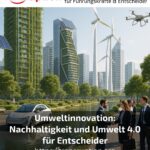
Environmental innovation as an opportunity for sustainable development
More and more decision-makers are looking for ways to integrate environmental innovation into companies in a concrete way. The central question here is what contribution innovative approaches in the area of sustainability can make to address both ecological challenges and economic requirements. Environmental innovation contributes valuable impetus to projects related to sustainable development and supports a variety of themes.
New technologies promote environmental innovation
In today's connected economy, digital technologies play a central role. Smart grids, Internet of Things (IoT) sensors and artificial intelligence enable resources to be used more efficiently and emissions to be reduced. Many companies are relying on digitally connected circular economy models to make material flows transparent and minimise waste. Such approaches drive environmental innovation by making sustainability economically attractive as well.
BEST PRACTICE at company XYZ (name changed due to NDA contract) A fully digitised return system for production waste was established there. The system captures real-time data on material flows, thereby enabling precise control of recycling. This approach has reduced the consumption of primary raw materials by over 30 percent and measurably reduced emissions along the supply chain.
In the context of sustainable Industry 4.0, this is leading to new forms of cooperation across company boundaries. The principle of collaboration is essential for environmental innovation: working together, stakeholders along the value chains can develop innovative business models that simultaneously reduce environmental impacts and maintain competitiveness. In doing so, it is important to support the transition with practical guidance.
Sustainability and Environment 4.0 as strategic guardrails
For companies that embed sustainability within their core business, the importance of environmental innovation has further intensified in 2025. It is no longer just about implementing individual projects in isolation, but about supporting ambitious, strategic transformation processes. Sustainability thus becomes part of company-wide management – supported by standardised reporting frameworks and transparency requirements.
BEST PRACTICE at company XYZ (name changed due to NDA contract) The company implemented a comprehensive environmental management system that aligns sustainability goals with EU regulations such as the Corporate Sustainability Reporting Directive (CSRD). This integration supports management in harmonising environmental and economic indicators and making long-term decisions based on sound data.
In the interplay between economic viability and ecological responsibility, environmental innovation is therefore not an end in itself, but a key factor for future-proof business models. The change demands courage and openness, but is often appreciated by decision-makers who want to responsibly support sustainable development.
Examples of sectors for environmental innovation and sustainability
The implementation of environmental innovation varies greatly, affecting energy supply, mobility, production and more. In the energy sector, renewable energies and smart grids are continuously gaining importance to minimise greenhouse gas emissions. In the chemical industry, some companies are relying on climate-neutral hydrogen as a raw material, thus driving decarbonisation further.
BEST PRACTICE at company XYZ (name changed due to NDA contract) A special chemicals manufacturer developed a process that uses hydrogen from renewable sources on a large scale. This innovation significantly lowers production CO2 emissions and positions the company as a pioneer in environmental innovation.
The automotive industry is also in focus: Sustainable fuels, connected vehicles, and new sharing models are emerging as a result of intensive development work that keeps environmental innovation alive. At the same time, the digitalisation of production is opening up new opportunities to conserve resources and monitor emissions.
BEST PRACTICE at company XYZ (name changed due to NDA contract) A vehicle manufacturer integrated digital sensors and AI-powered analysis tools into its production. This measure enabled predictive maintenance and improved resource efficiency without compromising product quality.
Finally, the construction industry is also exemplary: Smart building technologies, sustainable building materials and energy-efficient planning make environmental innovation tangible and measurable. Only through the joint commitment of planners, developers and investors can a circular economy and climate protection be successfully implemented.
My analysis
Environmental innovation is increasingly becoming an integral part of sustainable corporate management. It supports decision-makers in the targeted implementation of complex projects relating to Environment 4.0. Environmental innovation does not offer quick solutions, but rather provides impetus and support in the development of tailored strategies that are both ecologically and economically sound. In my observation, many clients report that such support is particularly helpful in managing regulatory requirements, integrating digital technologies, and developing future-proof business models.
Further links from the text above:
[1] From AI to the circular economy: these are the sustainability trends for 2025
[3] ESG Trends 2025: Sustainability in Focus Despite Challenges
[6] Sustainability trends businesses must watch in 2025
For more information and if you have any questions, please contact Contact us or read more blog posts on the topic TRANSRUPTION here.






 Deutsch
  English (UK)