
kiroi.org

KIROI - Artificial Intelligence Return on Invest
The AI strategy for decision-makers and managers

Business excellence for decision-makers & managers by and with Sanjay Sauldie

KIROI - Artificial Intelligence Return on Invest: The AI strategy for decision-makers and managers

KIROI - Artificial Intelligence Return on Invest: The AI strategy for decision-makers and managers

Start » KIROI Step 8: Executive Leadership Competency Development
29 August 2024

KIROI Step 8: Executive Leadership Competency Development

4.1
(439)

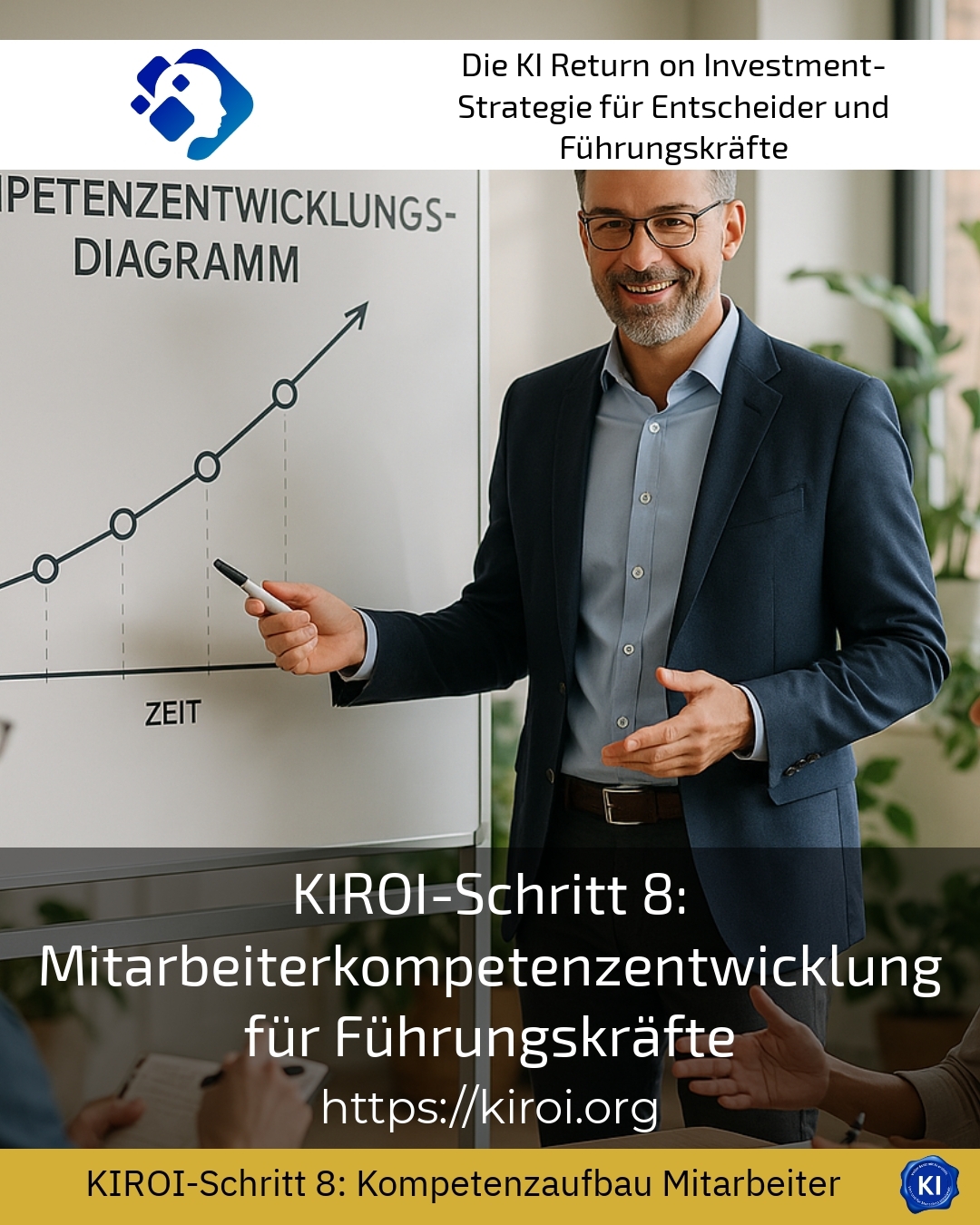
Employee competence development is increasingly important in companies because it empowers leaders to effectively manage their teams and successfully overcome challenges. Sustainable improvements in collaboration, productivity, and innovation can only be achieved through continuous competence development. The eighth step of the KIROI concept particularly demonstrates how comprehensively and systematically employee competence development can be implemented.

Employee Competence Development: The Basis for Future-Proof Leadership

Leaders face the task of developing both technical and social skills within their teams. Only in this way can the potential of each individual be optimally utilised. For example, companies such as Siemens rely on regular internal workshops in which teams jointly try out new methods and work on current challenges. Likewise, organisations such as Lufthansa use Action Learning, where leaders work on real projects and thereby strengthen their skills in a practical way.

Mentoring also plays a crucial role: younger colleagues benefit from the experience of senior leaders, receive guidance, and are encouraged to develop new skills. IBM specifically uses mentoring programmes to meet individual development needs and increase employee retention.

Innovative methods such as peer-learning, where managers challenge each other and benefit from different experiences, have also proven effective. This creates vibrant learning networks in companies like Bosch that dynamically support competence development.

Practical methods for employee competency development

The diversity of methods can be summarised into three categories:

  • On-the-Job Learning Managers take on new projects, rotate through different departments, or coordinate cross-functional teams. This supports the acquisition of practical skills directly in the workplace.
  • Off-the-Job Formats: These include seminars, online courses, and workshops, which specifically impart knowledge and promote exchange with other professionals.
  • Coaching and Mentoring Individual support from external coaches or experienced mentors allows for tailored assistance in personal and professional development.

A practical example: A medium-sized technology group introduced a combined programme where junior managers worked on tandem projects with experienced managers for six months. During this time, they simultaneously received coaching and attended modular workshops to build communication and leadership skills.

The conscious design of feedback processes also counts towards employee competency development. Regular development discussions help managers to recognise strengths and identify individual areas for growth together with employees.

Employee competence development as an integral part of leadership

Leaders not only guide their teams at work but also actively support them in the learning and development process. They create frameworks that enable continuous skill development – whether through learning opportunities, exchange forums, or targeted projects.

In practice, teams whose leaders focus on systematic employee skills development frequently report higher motivation, lower turnover, and greater innovative strength. For example, an international service company found that targeted development measures helped teams to better manage departmental changes within short timeframes, and that the quality of work visibly improved.

Various industries benefit from the comprehensive support of transruptive coaching, which provides impetus for employee skills development projects and helps leaders to constructively shape change processes.

BEST PRACTICE with one customer (name hidden due to NDA contract)In a manufacturing company, an development cycle was implemented using transruption coaching. In interactive workshops, managers were guided to strengthen their communication skills and flexibly coordinate complex project tasks. In doing so, they increasingly recognised their role as learning facilitators and promoted knowledge-based collaboration within teams.

Tips for Successfully Implementing Employee Competency Development

To effectively shape employee competence development, the following aspects should be considered:

  • Needs analysis: First, current competencies and future requirements should be transparently recorded.
  • Individualisation: Development plans must be tailored to the needs and potential of employees.
  • Practical relevance: Learning works best when what has been learned can be directly applied in everyday work.
  • Continuous Support: Regular feedback and coaching provide leaders with support for implementation.
  • Variety of formats: Different methods – from online learning modules to in-person seminars – increase effectiveness.

For example, a global IT service provider showed that, by using blended learning programmes, learning motivation increased significantly due to the use of various learning channels and the ability to accommodate individual learning paces.

My analysis

Employee competence development is an indispensable building block for the sustainable strengthening of leadership skills. It not only supports the growth of each individual but also contributes significantly to the development of agile and high-performing organisations. Effective methods such as coaching, mentoring, workshops and action-oriented learning formats ensure practical competence building. Companies that consistently support this step create the conditions for long-term success and a motivational leadership culture.

Further links from the text above:

Popular methods for developing the skills of company employees
Leadership Development: 6 Key Methods and…
Competence Development: Definition + Successful Examples
Leadership Development: Methods and Concepts
Successful Competence Development in 5 Steps
Leadership Development: Comprehensive Guide
Successful skills development: 9 tips and 3...
Leadership Development – Concept, Methods, Definition…
Skills development: importance and methods
Management Development: The Best Methods

For more information and if you have any questions, please contact Contact us or read more blog posts on the topic Artificial intelligence here.

How useful was this post?

Click on a star to rate it!

Average rating 4.1 / 5. Vote count: 439

No votes so far! Be the first to rate this post.

Spread the love

transruption.org

The digital toolbox for
the digital winners of today and tomorrow

Business excellence for decision-makers & managers by and with Sanjay Sauldie

transruption
transruption

transruption: The digital toolbox for
the digital winners of today and tomorrow

Start » KIROI Step 8: Executive Leadership Competency Development
29 August 2024

KIROI Step 8: Executive Leadership Competency Development

4.1
(439)

Employee competence development is increasingly important in companies because it empowers leaders to effectively manage their teams and successfully overcome challenges. Sustainable improvements in collaboration, productivity, and innovation can only be achieved through continuous competence development. The eighth step of the KIROI concept particularly demonstrates how comprehensively and systematically employee competence development can be implemented.

Employee Competence Development: The Basis for Future-Proof Leadership

Leaders face the task of developing both technical and social skills within their teams. Only in this way can the potential of each individual be optimally utilised. For example, companies such as Siemens rely on regular internal workshops in which teams jointly try out new methods and work on current challenges. Likewise, organisations such as Lufthansa use Action Learning, where leaders work on real projects and thereby strengthen their skills in a practical way.

Mentoring also plays a crucial role: younger colleagues benefit from the experience of senior leaders, receive guidance, and are encouraged to develop new skills. IBM specifically uses mentoring programmes to meet individual development needs and increase employee retention.

Innovative methods such as peer-learning, where managers challenge each other and benefit from different experiences, have also proven effective. This creates vibrant learning networks in companies like Bosch that dynamically support competence development.

Practical methods for employee competency development

The diversity of methods can be summarised into three categories:

  • On-the-Job Learning Managers take on new projects, rotate through different departments, or coordinate cross-functional teams. This supports the acquisition of practical skills directly in the workplace.
  • Off-the-Job Formats: These include seminars, online courses, and workshops, which specifically impart knowledge and promote exchange with other professionals.
  • Coaching and Mentoring Individual support from external coaches or experienced mentors allows for tailored assistance in personal and professional development.

A practical example: A medium-sized technology group introduced a combined programme where junior managers worked on tandem projects with experienced managers for six months. During this time, they simultaneously received coaching and attended modular workshops to build communication and leadership skills.

The conscious design of feedback processes also counts towards employee competency development. Regular development discussions help managers to recognise strengths and identify individual areas for growth together with employees.

Employee competence development as an integral part of leadership

Leaders not only guide their teams at work but also actively support them in the learning and development process. They create frameworks that enable continuous skill development – whether through learning opportunities, exchange forums, or targeted projects.

In practice, teams whose leaders focus on systematic employee skills development frequently report higher motivation, lower turnover, and greater innovative strength. For example, an international service company found that targeted development measures helped teams to better manage departmental changes within short timeframes, and that the quality of work visibly improved.

Various industries benefit from the comprehensive support of transruptive coaching, which provides impetus for employee skills development projects and helps leaders to constructively shape change processes.

BEST PRACTICE with one customer (name hidden due to NDA contract)In a manufacturing company, an development cycle was implemented using transruption coaching. In interactive workshops, managers were guided to strengthen their communication skills and flexibly coordinate complex project tasks. In doing so, they increasingly recognised their role as learning facilitators and promoted knowledge-based collaboration within teams.

Tips for Successfully Implementing Employee Competency Development

To effectively shape employee competence development, the following aspects should be considered:

  • Needs analysis: First, current competencies and future requirements should be transparently recorded.
  • Individualisation: Development plans must be tailored to the needs and potential of employees.
  • Practical relevance: Learning works best when what has been learned can be directly applied in everyday work.
  • Continuous Support: Regular feedback and coaching provide leaders with support for implementation.
  • Variety of formats: Different methods – from online learning modules to in-person seminars – increase effectiveness.

For example, a global IT service provider showed that, by using blended learning programmes, learning motivation increased significantly due to the use of various learning channels and the ability to accommodate individual learning paces.

My analysis

Employee competence development is an indispensable building block for the sustainable strengthening of leadership skills. It not only supports the growth of each individual but also contributes significantly to the development of agile and high-performing organisations. Effective methods such as coaching, mentoring, workshops and action-oriented learning formats ensure practical competence building. Companies that consistently support this step create the conditions for long-term success and a motivational leadership culture.

Further links from the text above:

Popular methods for developing the skills of company employees
Leadership Development: 6 Key Methods and…
Competence Development: Definition + Successful Examples
Leadership Development: Methods and Concepts
Successful Competence Development in 5 Steps
Leadership Development: Comprehensive Guide
Successful skills development: 9 tips and 3...
Leadership Development – Concept, Methods, Definition…
Skills development: importance and methods
Management Development: The Best Methods

For more information and if you have any questions, please contact Contact us or read more blog posts on the topic Artificial intelligence here.

How useful was this post?

Click on a star to rate it!

Average rating 4.1 / 5. Vote count: 439

No votes so far! Be the first to rate this post.

Spread the love

Other content worth reading:

KIROI Step 8: Executive Leadership Competency Development

written by:

Keywords:

#Big Data #Coaching #compliance #Datenintelligenz #Ethikrichtlinien 1TP5Management development #InnovationDurchAchtsamkeit #artificial intelligence #mentoring #Mitarbeiterkompetenzentwicklung #Sustainability #SmartData #Teamwork #Unternehmenskultur #Verantwortungsketten

Follow me on my channels:

Questions on the topic? Contact us now without obligation

Contact us

[wpforms id="331781" title="false"]

More articles worth reading

    Leave a comment










