
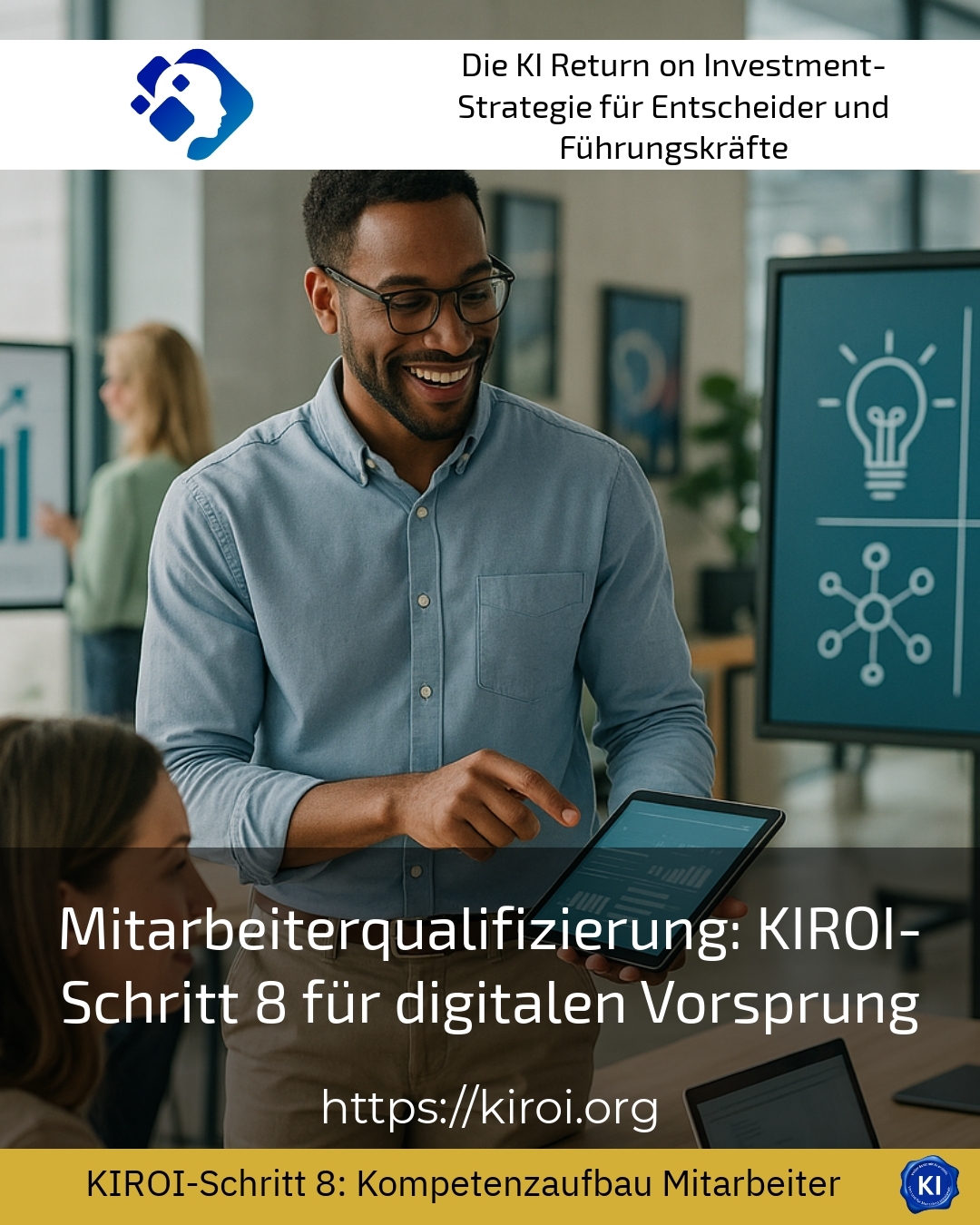
Staff qualification as the key to digital advantage
More and more companies are seeing employee qualification not just as a mandatory part of human resource development, but as a genuine opportunity to secure a sustainable digital advantage. Especially against the backdrop of rapid technological developments, it becomes clear: those who continuously train their workforce remain flexible, highly innovative, and competitive [3][7]. Employee qualification is therefore no longer a peripheral issue, but stands at the centre of every future-oriented company strategy.
Transruptions-Coaching supports numerous companies in this transformation process, helping to strategically plan, implement, and sustainably embed measures in the area of employee qualification. Many come with very specific challenges: How can new technologies be communicated in the first place? How do I create acceptance for digital tools in the company? And how can the entire team be involved?
Why staff development is essential
Digital transformation is changing job content, processes and requirements on a daily basis. Employee training and development significantly contribute to ensuring that employees stay up-to-date and can expand their skills. This pays off for companies twice over: productivity increases because employees complete tasks more efficiently and safely. At the same time, motivation grows because they can take on new responsibilities and develop personally.
Companies that invest in employee training benefit from higher employee satisfaction, lower staff turnover, and an improved employer brand. At the same time, they can better utilise internal potential by specifically preparing existing employees for new areas of responsibility, thus recruiting skilled workers from within their own ranks.
Practical approaches to successful employee training
Employee training is particularly successful when it is needs-based, practical, and sustainable. Here are some practical examples of how companies are implementing innovative training methods and the impetus that Transruption Coaching provides:
Internal learning platforms and digital tools
Modern learning management systems make it possible to impart knowledge independently of location and time. Employees can therefore learn individually and track their own progress. A major advantage is the ability to update content regularly and adapt it to new requirements. Transruption coaching supports companies in selecting suitable platforms and integrating them sensibly into everyday working life.
Cross-functional knowledge management
Experience shows that targeted exchange between different departments fosters innovation. Workshops, in which employees from technology, sales, and administration solve challenges together, strengthen team spirit and open up new perspectives. Such formats are often the starting point for new digital solutions and workflows.
Practical further training through projects
Concrete practical projects provide an ideal learning environment because knowledge is deepened through real tasks. Companies often design training programmes so that employees work directly on current challenges while simultaneously learning new methods. This increases the transfer effect and ensures rapid learning success.
BEST PRACTICE with one customer (name hidden due to NDA contract) A company in the service sector used the introduction of a new digital service for a comprehensive qualification programme. The focus was on interactive online modules that could be accessed individually and practical workshops where employees could directly try out how to use the new tool. Supported by regular feedback loops and coaching, the entire team thus acquired the necessary digital skills in a short time and noticeably increased their innovative strength.
Ideas and tips for sustainable employee training
Experience shows that successful employee qualification should consider several factors. Here are some concrete pointers for practice:
Develop an individual skills profile for each target group. This helps to identify training needs precisely and to design suitable further training offers. Actively involve employees in the planning and set up regular feedback loops. This ensures that the measures actually have an effect.
Opt for blended learning formats that combine face-to-face events with digital elements. This increases flexibility and allows content to be better tailored to different learning styles. Use internal champions who act as multipliers and share their knowledge within the team.
Create incentives beyond formal training. Micro-learning, gamification and internal certifications motivate continuous professional development. They also strengthen company loyalty and promote a culture of lifelong learning.
Many organisations report that the involvement of external coaches significantly increases the acceptance of new measures. Transruption coaching actively supports this process, provides impulses for practical application and moderates regular reflection sessions. This ensures that what has been learned is sustainably anchored in everyday work.
Challenges and success factors
Employee training also presents challenges. Resources must be provided, content kept up to date, and participants motivated. However, the short-term extra effort is clearly outweighed by the long-term benefits[7]. Companies that start training early create a decisive advantage for themselves.
It is critically important to reduce working hours so that training opportunities can actually be used. The interplay between managers and employees is also crucial. Transruption coaching specifically provides impetus here to strengthen managers as role models and promoters of employee qualification.
It is also important to regularly evaluate the measures. Only in this way can it be recognised which formats are effective and where adjustments are necessary. Companies that actively do this will sustainably secure their digital innovation power.
My analysis
Employee qualification is not an end in itself, but a central building block for sustainable corporate success in the digital age. Those who develop their workforce in a targeted manner create the basis for innovative strength, competitiveness and modern employer branding. Transruption Coaching supports companies on this path by developing practical concepts, providing impetus and guiding change processes. Experience shows that companies that approach employee qualification strategically benefit in the long term – and secure a clear advantage in a rapidly changing world of work.
Further links from the text above:
Benefits and funding opportunities for employee training
Further training: Importance and implications
Employee Training: Concepts, Methods & Practice
5 reasons for further training within the company
Upskilling and digital learning
Internal filling through qualification
Corporate training as a benefit
Definition and meaning of qualification
Qualifications and Workforce Management
Support for vocational further training
For more information and if you have any questions, please contact Contact us or read more blog posts on the topic Artificial intelligence here.











 Deutsch
  English (UK)