
kiroi.org

KIROI - Artificial Intelligence Return on Invest
The AI strategy for decision-makers and managers

Business excellence for decision-makers & managers by and with Sanjay Sauldie

KIROI - Artificial Intelligence Return on Invest: The AI strategy for decision-makers and managers

KIROI - Artificial Intelligence Return on Invest: The AI strategy for decision-makers and managers

Start » KIRoi Step 8: Employee skills development for decision-makers
4 February 2025

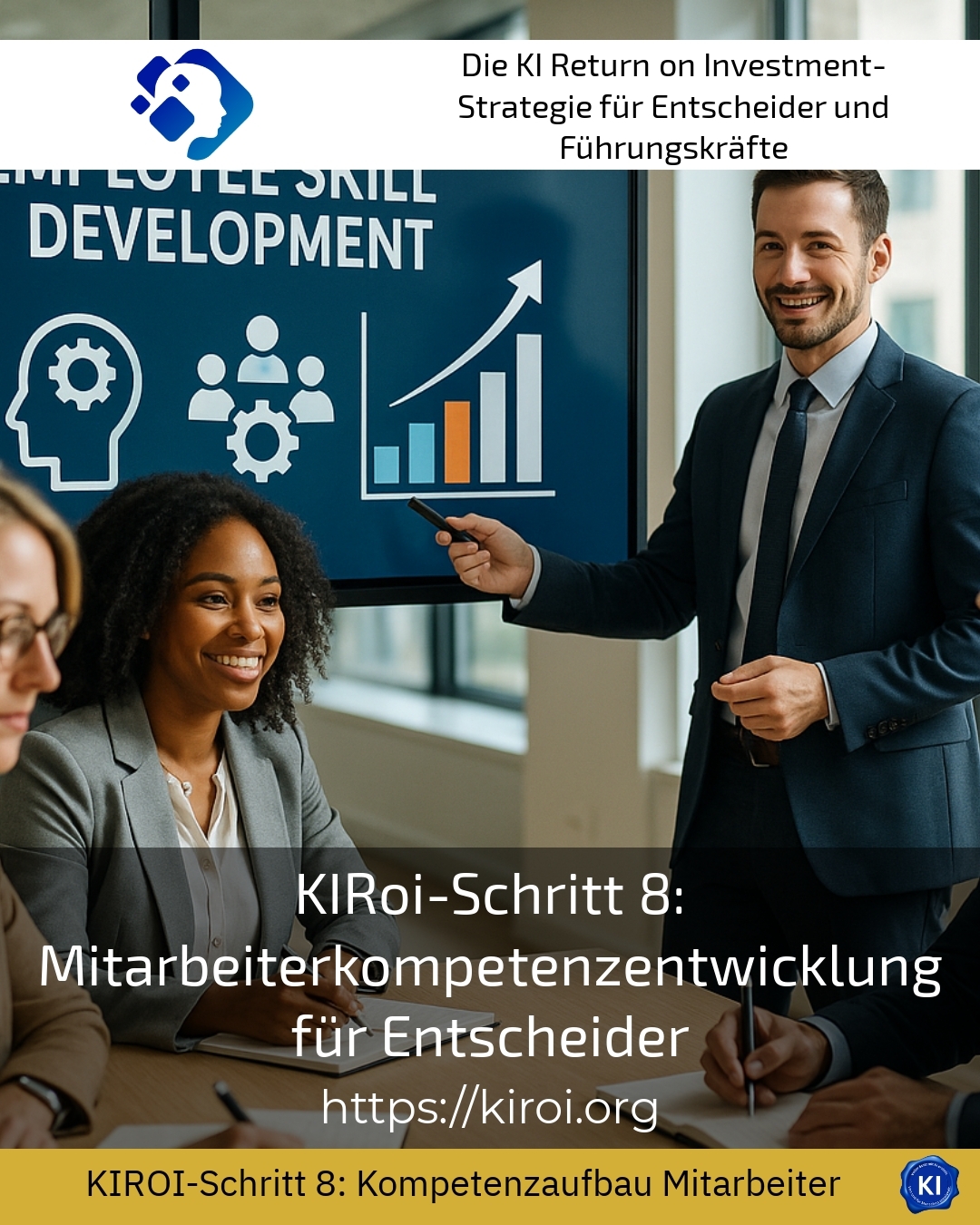
KIRoi Step 8: Employee skills development for decision-makers

4.3
(1435)

Targeted employee competence development is a central lever for sustainable success in modern organisations. Decision-makers who strategically guide this process lay the foundation for innovation, motivation, and long-term competitiveness. Employee competence development means specifically promoting knowledge, skills, and behaviours that are relevant to the company's objectives. Many managers report seeking support in implementing such measures because they are often faced with varying needs, resources, and motivations.

Why Employee Competency Development is Important for Decision-Makers

Companies benefit from systematically developing their employees„ skills. Targeted employee development leads to higher efficiency, better quality, and lower staff turnover. Decision-makers recognise that they are responsible not only for strategic direction but also for the development of the people within the company. Clients often approach with questions such as: “How can we make our teams fit for new challenges?„ or “Which methods are truly effective?"

Real-world examples show that companies with active employee skill development react faster to market changes. For instance, banks benefit from employees who confidently use new digital tools. In the healthcare sector, clinics rely on continuous training to meet increasing demands. Similarly, in retail, companies focus on targeted training to improve customer service and sales strategies.

Employee competence development in practice

Methods of Employee Competence Development

There are numerous ways to design employee competency development. Many organisations rely on mentoring, coaching, and workshops. Others use job rotation, project work, or on-the-job training. Each method has its strengths and is suitable for different situations.

Here's an example: A technology company uses internal masterminds to share knowledge between departments. An insurance company relies on regular simulations to prepare employees for complex customer queries. A trades company encourages staff to gain diverse experience through job rotation.

Individual Development Plans

A central building block of employee competence development is the creation of individual development plans. These are aligned with the needs of the employees and the strategic goals of the company. Regular feedback discussions help to review progress and discover new development potential.

Example: A marketing agency creates a development plan for each employee, addressing strengths and weaknesses. A logistics company uses 360-degree feedback to consider different perspectives. An education provider relies on regular skills analyses to determine training needs.

Employee Competence Development and Transruption Coaching

Transruptions-Coaching supports organisations with projects focused on employee competency development. It provides impetus on how teams and leaders can prepare for change. We often assist with the introduction of new methods, the design of workshops, or the development of competency models.

Example: A medium-sized company wants to train its managers in agile methods. We support the process with targeted coaching and workshops. A large corporation is planning a digital transformation and needs support in developing expertise in new technologies. We develop individual measures together with those responsible.

BEST PRACTICE with one customer (name hidden due to NDA contract) In an international company, management faced the challenge of upskilling their teams for new digital processes. Together with the responsible parties, we developed a multi-stage programme that combined mentoring, workshops, and individual development plans. Employees were able to specifically expand their competencies and thus became multipliers within the company. Satisfaction and motivation increased significantly, and the implementation of the new processes went smoothly.

My analysis

Employee skills development is not a one-off act, but a continuous process. Decision-makers who strategically support this process create the conditions for sustainable success. The combination of individual development plans, targeted measures, and regular feedback discussions is particularly effective. Transruption coaching supports the selection of the right methods and the successful implementation of changes.

Further links from the text above:

Popular methods for developing the skills of company employees

11 Methods of Staff Development & Benefits

Successful Competence Development: 9 Tips and 3 Methods

For more information and if you have any questions, please contact Contact us or read more blog posts on the topic Artificial intelligence here.

How useful was this post?

Click on a star to rate it!

Average rating 4.3 / 5. Vote count: 1435

No votes so far! Be the first to rate this post.

Spread the love

transruption.org

The digital toolbox for
the digital winners of today and tomorrow

Business excellence for decision-makers & managers by and with Sanjay Sauldie

transruption
transruption

transruption: The digital toolbox for
the digital winners of today and tomorrow

Start » KIRoi Step 8: Employee skills development for decision-makers
4 February 2025

KIRoi Step 8: Employee skills development for decision-makers

4.3
(1435)

Targeted employee competence development is a central lever for sustainable success in modern organisations. Decision-makers who strategically guide this process lay the foundation for innovation, motivation, and long-term competitiveness. Employee competence development means specifically promoting knowledge, skills, and behaviours that are relevant to the company's objectives. Many managers report seeking support in implementing such measures because they are often faced with varying needs, resources, and motivations.

Why Employee Competency Development is Important for Decision-Makers

Companies benefit from systematically developing their employees„ skills. Targeted employee development leads to higher efficiency, better quality, and lower staff turnover. Decision-makers recognise that they are responsible not only for strategic direction but also for the development of the people within the company. Clients often approach with questions such as: “How can we make our teams fit for new challenges?„ or “Which methods are truly effective?"

Real-world examples show that companies with active employee skill development react faster to market changes. For instance, banks benefit from employees who confidently use new digital tools. In the healthcare sector, clinics rely on continuous training to meet increasing demands. Similarly, in retail, companies focus on targeted training to improve customer service and sales strategies.

Employee competence development in practice

Methods of Employee Competence Development

There are numerous ways to design employee competency development. Many organisations rely on mentoring, coaching, and workshops. Others use job rotation, project work, or on-the-job training. Each method has its strengths and is suitable for different situations.

Here's an example: A technology company uses internal masterminds to share knowledge between departments. An insurance company relies on regular simulations to prepare employees for complex customer queries. A trades company encourages staff to gain diverse experience through job rotation.

Individual Development Plans

A central building block of employee competence development is the creation of individual development plans. These are aligned with the needs of the employees and the strategic goals of the company. Regular feedback discussions help to review progress and discover new development potential.

Example: A marketing agency creates a development plan for each employee, addressing strengths and weaknesses. A logistics company uses 360-degree feedback to consider different perspectives. An education provider relies on regular skills analyses to determine training needs.

Employee Competence Development and Transruption Coaching

Transruptions-Coaching supports organisations with projects focused on employee competency development. It provides impetus on how teams and leaders can prepare for change. We often assist with the introduction of new methods, the design of workshops, or the development of competency models.

Example: A medium-sized company wants to train its managers in agile methods. We support the process with targeted coaching and workshops. A large corporation is planning a digital transformation and needs support in developing expertise in new technologies. We develop individual measures together with those responsible.

BEST PRACTICE with one customer (name hidden due to NDA contract) In an international company, management faced the challenge of upskilling their teams for new digital processes. Together with the responsible parties, we developed a multi-stage programme that combined mentoring, workshops, and individual development plans. Employees were able to specifically expand their competencies and thus became multipliers within the company. Satisfaction and motivation increased significantly, and the implementation of the new processes went smoothly.

My analysis

Employee skills development is not a one-off act, but a continuous process. Decision-makers who strategically support this process create the conditions for sustainable success. The combination of individual development plans, targeted measures, and regular feedback discussions is particularly effective. Transruption coaching supports the selection of the right methods and the successful implementation of changes.

Further links from the text above:

Popular methods for developing the skills of company employees

11 Methods of Staff Development & Benefits

Successful Competence Development: 9 Tips and 3 Methods

For more information and if you have any questions, please contact Contact us or read more blog posts on the topic Artificial intelligence here.

How useful was this post?

Click on a star to rate it!

Average rating 4.3 / 5. Vote count: 1435

No votes so far! Be the first to rate this post.

Spread the love

Other content worth reading:

KIRoi Step 8: Employee skills development for decision-makers

written by:

Keywords:

#Big Data #compliance #Datenintelligenz #Ethikrichtlinien 1TP5Management development #InnovationDurchAchtsamkeit #artificial intelligence #Mitarbeiterkompetenzentwicklung #Sustainability #SmartData #TransruptionsCoaching #Unternehmensentwicklung #Unternehmenskultur #Verantwortungsketten #further training

Follow me on my channels:

Questions on the topic? Contact us now without obligation

Contact us

[wpforms id="331781" title="false"]

More articles worth reading

    Leave a comment










