
The development of skills and competencies in employees is a crucial factor for sustainable leadership success. Particularly within the framework of the KIROI model, the systematic Employee competence development plays a central role in developing teams effectively and achieving organisational goals. Through careful guidance in various phases, leaders foster the individual and collective performance of their employees.
The contribution of targeted employee competency development to leadership success
At its core, describes Employee competence development the systematic development of employees' knowledge, skills, and abilities. This nurtures strengths and unlocks potential, which has a direct impact on productivity and motivation. In practice, companies often employ a combination of methods such as coaching, project-based learning, and on-the-job training to enhance competencies in a practical way.
A real-world example from the automotive industry illustrates this: Production employees were developed through job rotation in various departments. This not only increased their technical skills but also provided insights into related work processes. This broad range of competencies strengthened team performance and improved problem-solving for technical challenges.
Similarly, IT firms report on successful coaching programmes where team leaders receive individual support. These coaches assist in developing methodological skills such as project management and conflict resolution. The result is better management of agile processes and increased team autonomy.
In the service sector, many companies are turning to e-learning formats to deepen not only professional expertise but also social skills such as communication or customer orientation. This allows for flexible learning and sustainable implementation of content in everyday working life.
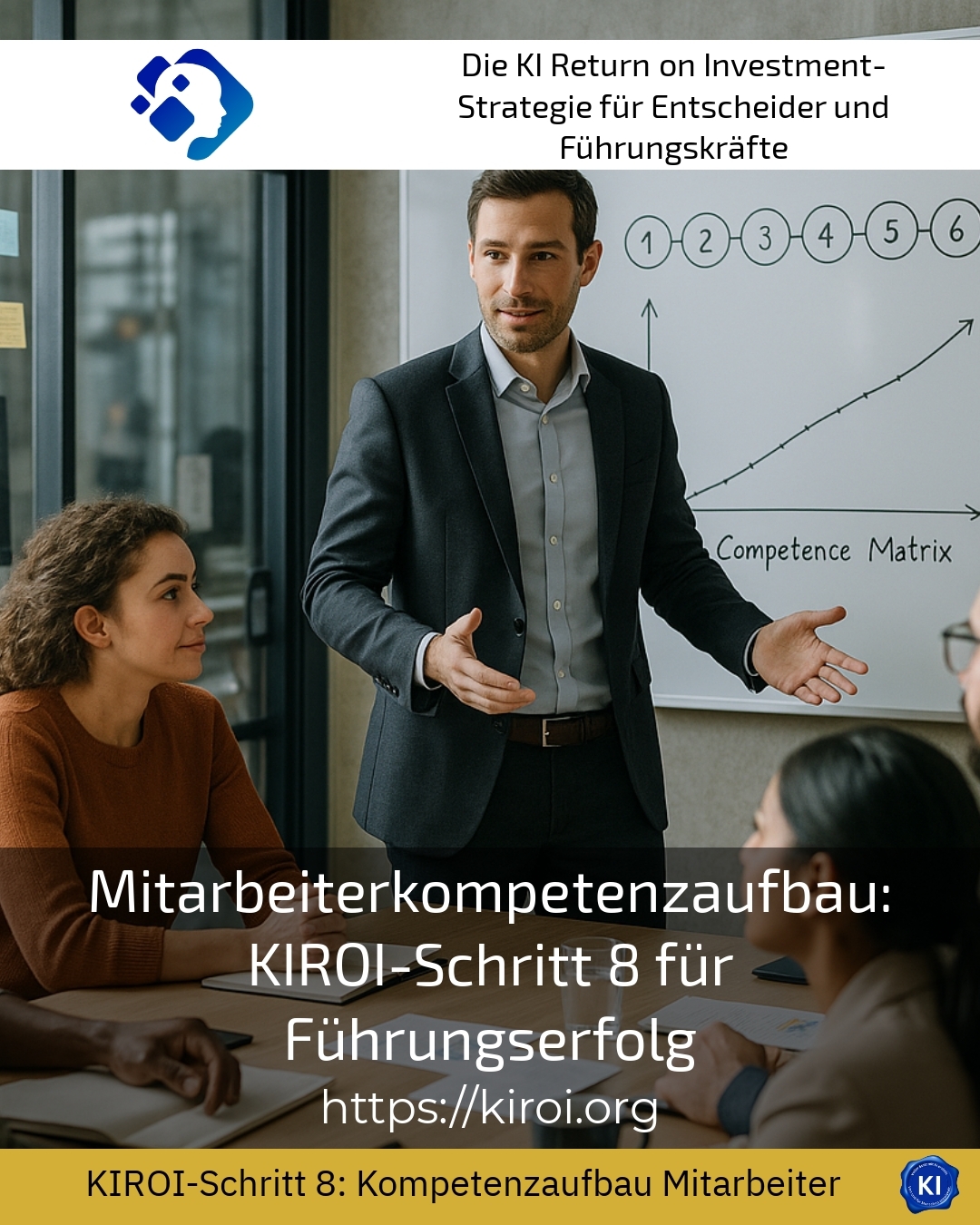
KIROI Step 8: Building Employee Competencies as a Success Factor in Leadership
In the eighth step of the KIROI model, the targeted further development of employee competencies is particularly highlighted. The aim is to strengthen leaders in their role as mentors who continuously empower employees. Individual development plans and regular feedback are used to systematically close competency gaps.
BEST PRACTICE with one customer (name hidden due to NDA contract) In a medium-sized mechanical engineering company, the methodological competence of the technical teams was significantly improved through the targeted use of coaching and mentoring measures. This enabled managers to provide more focused support to employees in implementing complex projects, leading to faster problem-solving and increased customer satisfaction. The development was accompanied over several months and individually adapted to the respective strengths.
In industrial companies, many opportunities present themselves, Employee competence development to bring to life. One example is the introduction of learning circle groups where colleagues exchange knowledge on new technologies or safety standards. These peer-learning formats promote collaboration and a shared sense of responsibility.
Practice-oriented methods for promoting employee competence
Practical approaches combine different learning styles to cover as many areas of competence as possible. The following methods have proven effective:
- On-the-job training, where employees take on new tasks in their work environment and thus gain direct experience.
- Project work as an opportunity to take responsibility and expand methodological and social skills.
- Mentoring and coaching, fostering personal development and unlocking individual potential.
- E-learning platforms for self-directed learning and flexibility in terms of time.
- Regular feedback rounds that strengthen dialogue between employees and managers.
In retail, for example, companies rely on short workshops to improve consulting and presentation skills. This not only boosts customer satisfaction but also the confidence of employees.
In the healthcare sector, managers report that the combination of simulation training and technical instruction contributes to increased confidence and competence in critical situations. This effectively links professional expertise with methodological expertise.
Mentoring as a key role in competence development
The explanation of the KIROI model highlights constant accompaniment by leaders as crucial. They support employees in mastering new tasks and provide impetus for individual development. Clients often report that this support is particularly valuable during challenging project phases.
Another example from the financial sector shows how a manager regularly worked on development topics with an executive coach. This strengthened their leadership skills with a focus on motivation and conflict management, which had a noticeable impact on the team's cohesion and performance.
My analysis
The sustainable Employee competence development is elemental for leadership success in today's dynamic work environment. Through a combination of individual development measures, practical learning formats, and trusted support, skills are developed that strengthen teams and organisations. The KIROI model shows how systematic skills development can be intentionally designed. Companies that take this step seriously benefit from smart leadership and agile, high-performing employees.
Further links from the text above:
Successful Competence Development: 9 Tips and 3 Methods [1]
Skills development: importance and methods [2]
Method Competence: Why It's Crucial for Your Everyday Life [3]
Competency Model: For Successful Staff Development [5]
Competency Management – Definition, Benefits, Models [6]
For more information and if you have any questions, please contact Contact us or read more blog posts on the topic Artificial intelligence here.











 Deutsch
  English (UK)