
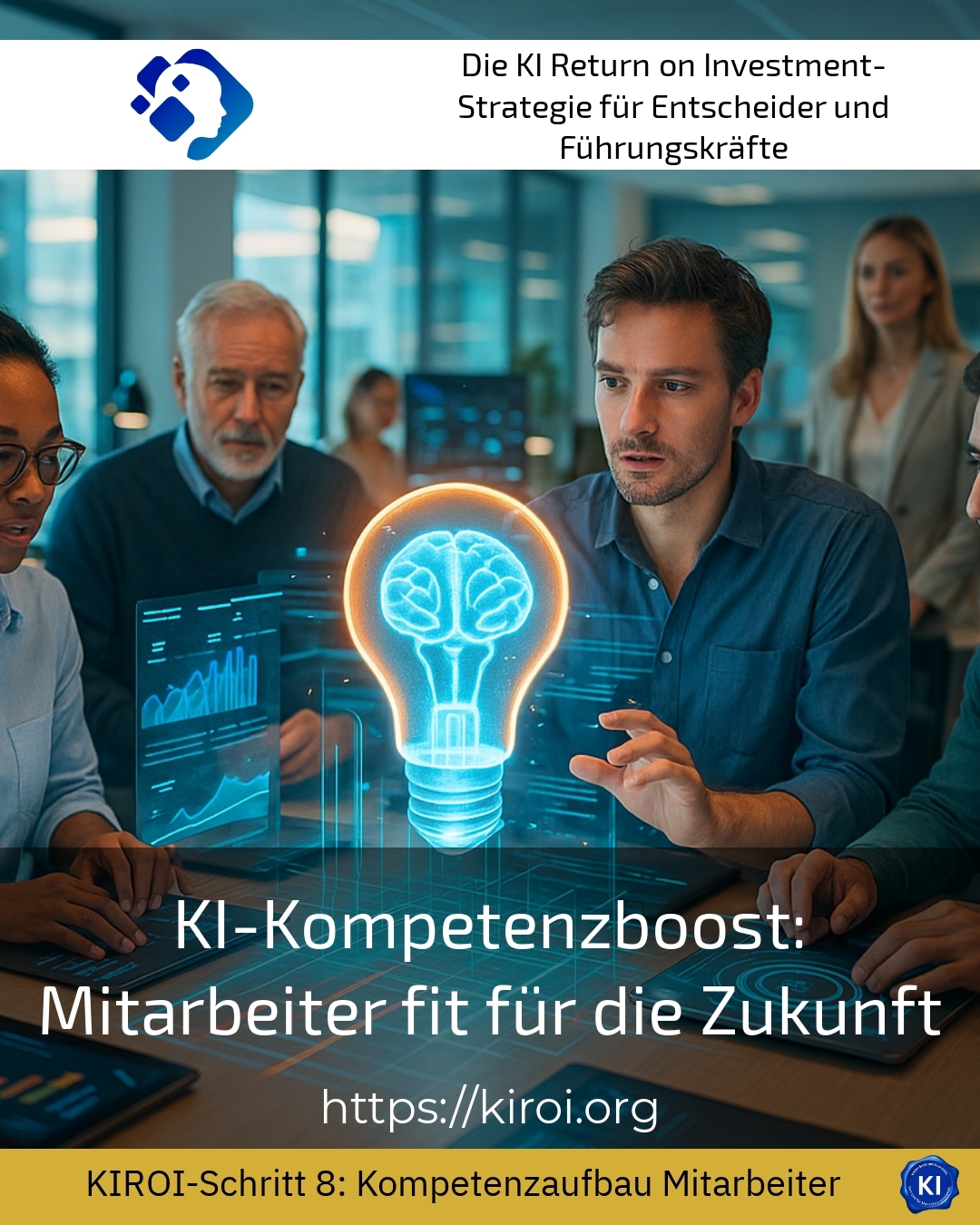
The digital revolution is fundamentally changing our working world. Companies face a crucial challenge. They must prepare their workforce for new technologies. A well-thought-out AI Skills Boost: Employees Fit for the Future becomes a strategic success factor. Many managers report uncertainty in their teams. The good news is: change can be managed with targeted support.
Why the AI skills boost: Employees fit for the future is indispensable today
The world of work is undergoing profound change. Intelligent systems are increasingly taking over repetitive tasks. At the same time, entirely new fields of activity are emerging. Companies that invest in further training now are securing their competitiveness. Clients often report initial resistance. This usually melts away with targeted support.
In the financial sector, for example, automated systems are already analysing loan applications. Insurance companies are using intelligent algorithms for claims assessment. Banks rely on virtual assistants in customer service. All of these developments require new skills from employees. Collaboration between humans and machines needs to be learned. That is why structured training is gaining importance.
Transruptions Coaching supports organisations with precisely these challenges. It's not about short-term training. Instead, a holistic development process is the focus. Teams learn to use technological tools effectively. They also develop a deep understanding of the possibilities. This results in genuine competence rather than superficial knowledge.
Typical starting situations in companies
Many companies come to coaching with similar questions. Management clearly recognises the need for action. At the same time, a concrete roadmap is often missing. Employees feel overwhelmed by technology. Others fear losing their jobs. These anxieties must be taken seriously and addressed constructively.
In the logistics sector, we are experiencing particularly dynamic changes. Warehouse management systems are becoming increasingly autonomous. Route planning is carried out in real-time by intelligent algorithms. Dispatchers must learn to monitor these systems. Their role is changing from executor to supervisor. Drivers are using assistance systems for more efficient tours. This requires a fundamentally new skills profile.
Best practice with a AIROI customer A medium-sized logistics company faced a major challenge because the workforce was sceptical about the planned implementation of intelligent systems. The company management therefore decided to provide comprehensive support through transruptive coaching to manage the change professionally. Initially, we held intensive discussions with all departments and identified employees' specific concerns, ranging from job loss fears to technical uncertainties. We then developed a tailor-made training program that considered both technical and emotional aspects, meeting people where they were. The dispatchers gradually learned to work with the new route planning system, initially working in parallel with the previous system, thereby building trust. After six months of intensive support, the mood had fundamentally changed because employees realised that the technology was making their work easier rather than replacing it. Efficiency in the warehouse increased significantly, and at the same time, job satisfaction improved, which was also reflected in lower rates of sickness absence.
Strategic approaches for the AI skills boost: making employees fit for the future
A successful qualification strategy takes several dimensions into account simultaneously. Technical knowledge alone is not enough. Employees also need methodological skills. Furthermore, social skills play an increasingly important role. Collaboration in mixed human-machine teams requires new forms of communication. A holistic approach connects all these aspects.
This complexity is particularly evident in healthcare. Nurses already use intelligent documentation systems. Doctors work with diagnostic support tools. Administrative staff use automated billing systems. Each professional group requires specific training. At the same time, all those involved must understand the interrelationships. Only in this way can smooth interdisciplinary collaboration be achieved.
Retail is also undergoing massive changes. Till systems with automatic product recognition are becoming standard. Inventory management is largely autonomous. Sales staff receive customer recommendations in real-time. The challenge is to embrace this support. Employees need to learn to trust suggestions. At the same time, they should remain critical.
The Five Pillars of Sustainable Competence Development
Successful qualification programmes are built on five essential pillars. The first pillar encompasses a fundamental technical understanding. Employees must comprehend how intelligent systems function. They do not require programming skills. A conceptual understanding is usually perfectly sufficient. This allows them to better contextualise results.
The second pillar concerns application competence. This is about practical application. Employees learn to operate specific tools. They practise using realistic scenarios from their daily work. In banking, this means, for example, dealing with automated risk analyses. Clerks learn to interpret these results. They also recognise when human intervention is necessary.
The third pillar addresses critical reflection. Intelligent systems do not always deliver perfect results. Employees must learn to question outputs. This is particularly important in human resources. Automated applicant pre-selection can contain biases. Recruiters need the knowledge to recognise such problems. Only then will the selection process remain fair.
The fourth pillar focuses on collaboration skills. Working with intelligent systems is fundamentally different. Employees are increasingly acting as supervisors, monitoring processes rather than executing them. This requires new patterns of attention. In a production environment, skilled workers are now overseeing entire plant parks. They need to learn to recognise relevant signals.
The fifth pillar concerns a continuous willingness to learn. Technologies are developing at lightning speed. What is current today may be obsolete tomorrow. Employees therefore need a fundamental learning attitude. They must view change as an opportunity. This is precisely where transruption coaching comes in and provides valuable momentum.
Best practice with a AIROI customer A regional insurance group approached us because they wanted to prepare their claims handlers for new automated claims assessment systems, placing emphasis on a human-centred approach. The employees' previous working methods had proven effective over decades, so resistance to change was to be expected and indeed occurred. We began with a comprehensive stocktake and analysed together with the teams which tasks would change and what new competencies would be needed. It became clear that many employees were indeed interested in the new tools, but felt fear of the unknown and that they were being left to their own devices. Transruption Coaching supported the entire implementation process over nine months, ensuring that no one was left behind. The claims handlers learned to validate system decisions and, if necessary, to deviate from them with justification, which enhanced their expertise rather than devaluing it. The customer hotline was also involved, as their work also fundamentally changed through intelligent assistance systems. In the end, over eighty percent of the participants reported a positive change in their attitude towards the technology.
Industry-specific challenges and approaches to solutions
Every industry brings its own requirements. Qualification strategies must be adapted accordingly. Different issues dominate in the manufacturing sector compared to the service sector. Transruption coaching takes these differences into account systematically. This results in tailored solutions for every context.
The construction industry is currently experiencing a surge in digitalisation. Project planning is increasingly digital and networked. Construction machinery is partly operating autonomously. Quality control is utilising image recognition systems. Foremen need to learn how to use tablets. Site managers are using real-time data for their decisions. Physical labour is undergoing fundamental change.
In the legal field, intelligent systems are revolutionising research. Contract analysis occurs in seconds. Lawyers receive case suggestions from databases. Law firm staff create documents with assistance systems. The challenge lies in legal responsibility. Legal professionals must critically examine all output. Simultaneously, the speed is increasing enormously.
The education sector faces particular challenges. Teachers are expected to use modern tools. At the same time, they must prepare students for the changing world of work. Administrative staff are digitalising processes. School leaders require strategic competencies. The complexity necessitates comprehensive training measures. Clients often report feeling overwhelmed in this situation.
Practical implementation in company life through the AI competence boost
The best strategy is of little use without successful implementation. Qualification measures must be integrated into everyday work. Longer absences from the workplace are often not possible. Therefore, successful programmes focus on microlearning. Short units fit in better. Peer learning also proves its worth in practice.
Employees in call centres are already working with real-time support. They receive information during the conversation. Suggested responses appear on the screen. Onboarding takes place in parallel with daily operations. Experienced colleagues mentor new employees. Regular reflection sessions consolidate what has been learned. This creates a continuous learning culture.
Marketing departments are increasingly using intelligent analysis tools. Campaign optimisation is data-driven. Copywriting is supported by assistance systems. Marketing professionals must evaluate these results. They refine suggestions with their expertise. Collaboration between humans and systems creates added value. Both sides complement each other optimally.
Best practice with a AIROI customer A retail company with several hundred branches sought support in the introduction of intelligent inventory management systems, which represented a fundamental change in how the goods management sector operated. The previous manual ordering by branch managers was to be supplemented by automated forecasts, which initially met with scepticism because many managers feared for their decision-making authority. Transruption Coaching accompanied the pilot phase at selected locations and ensured close coordination between technology and people, so that problems could be identified early on. Branch managers learned to interpret system suggestions and adapt them if necessary, incorporating their local market knowledge and thus feeling valued. Sales staff received training on the new product presentation, which was based on sales data and enabled a higher turnover rate. Till staff were also involved, as they were to advise customers on questions about the expanded range and therefore required relevant background knowledge. After the successful pilot phase, the rollout to all locations followed, with internal ambassadors from the pilot branches supporting their colleagues and thus ensuring acceptance.
The role of leaders in the transformation process
Leaders play a key role in upskilling. They must actively model change. Their attitude influences the entire team. At the same time, they themselves need support. Many leaders feel insecure. They are expected to promote technologies that they themselves are still learning to understand.
This dynamic is particularly evident in the hotel industry. Revenue management systems automatically optimise prices. Hotel managers must learn to trust the algorithms. At the same time, they retain responsibility for the outcome. This requires a new understanding of leadership. The same applies to staff deployment. Intelligent systems automatically create duty rosters.
In hospitals, the leadership role is also changing. Chief physicians are using diagnostic support systems. Nursing managers are working with automated planning tools. Administrative managers are relying on process-optimised workflows. All these changes require new competencies. Transruption coaching specifically supports managers in this development.
Sustainable anchoring of new competencies
One-off training sessions are not enough for sustainable change. Competencies must be continuously developed. Successful companies therefore establish learning structures. Regular exchange formats promote knowledge transfer. Mentoring programmes support less experienced employees. This creates a learning organisation.
This approach is particularly common in the automotive supply industry. Production employees regularly exchange information about new systems. Best practices are systematically documented. Suggestions for improvement are incorporated into further development. This creates a continuous optimisation cycle. Employees feel involved and valued.
The energy sector is also committed to continuous development. Grid technicians are increasingly monitoring autonomously operating systems. They need to be able to intervene quickly in the event of faults. For this, they require up-to-date knowledge. Regular training keeps their skills sharp. Simulation exercises prepare them for extreme situations. This ensures that security of supply is maintained.
My AIROI Analysis
The systematic qualification of employees for dealing with intelligent technologies represents one of the greatest challenges of our time, and companies that take this task seriously will be more successful in the long term than those that neglect it. My experience from numerous accompanying projects clearly shows that technical training alone is not sufficient, but rather a holistic approach is required that also considers emotional and cultural aspects and puts people at the centre.
The AI Skills Boost: Employees Fit for the Future is best achieved with professional support. Transruption coaching has proven to be a valuable partner in this regard. The combination of strategic consulting and operational support creates lasting added value. Employees not only develop skills, but they also gain confidence in their own adaptability.
What seems particularly important to me is the realisation that resistance to change is usually based on legitimate concerns and must be taken seriously, rather than being ignored or dismissed. When companies address these concerns and offer transparent perspectives, scepticism often turns into engagement, as our best-practice examples impressively demonstrate. The future belongs to organisations that recognise their employees as a central resource and invest accordingly in their development [1].
In conclusion, I would like to emphasise that technological change does not have to be a threat, but rather offers an opportunity for personal and organisational growth when it is professionally managed and involves all stakeholders. The companies we work with consistently report positive developments on several levels, from increased efficiency and higher employee satisfaction to improved innovation capabilities [2].
Further links from the text above:
[1] McKinsey: How to accelerate workforce development
[2] World Economic Forum: The Future of Jobs Report
For more information and if you have any questions, please contact Contact us or read more blog posts on the topic Artificial intelligence here.








 Deutsch
  English (UK)