
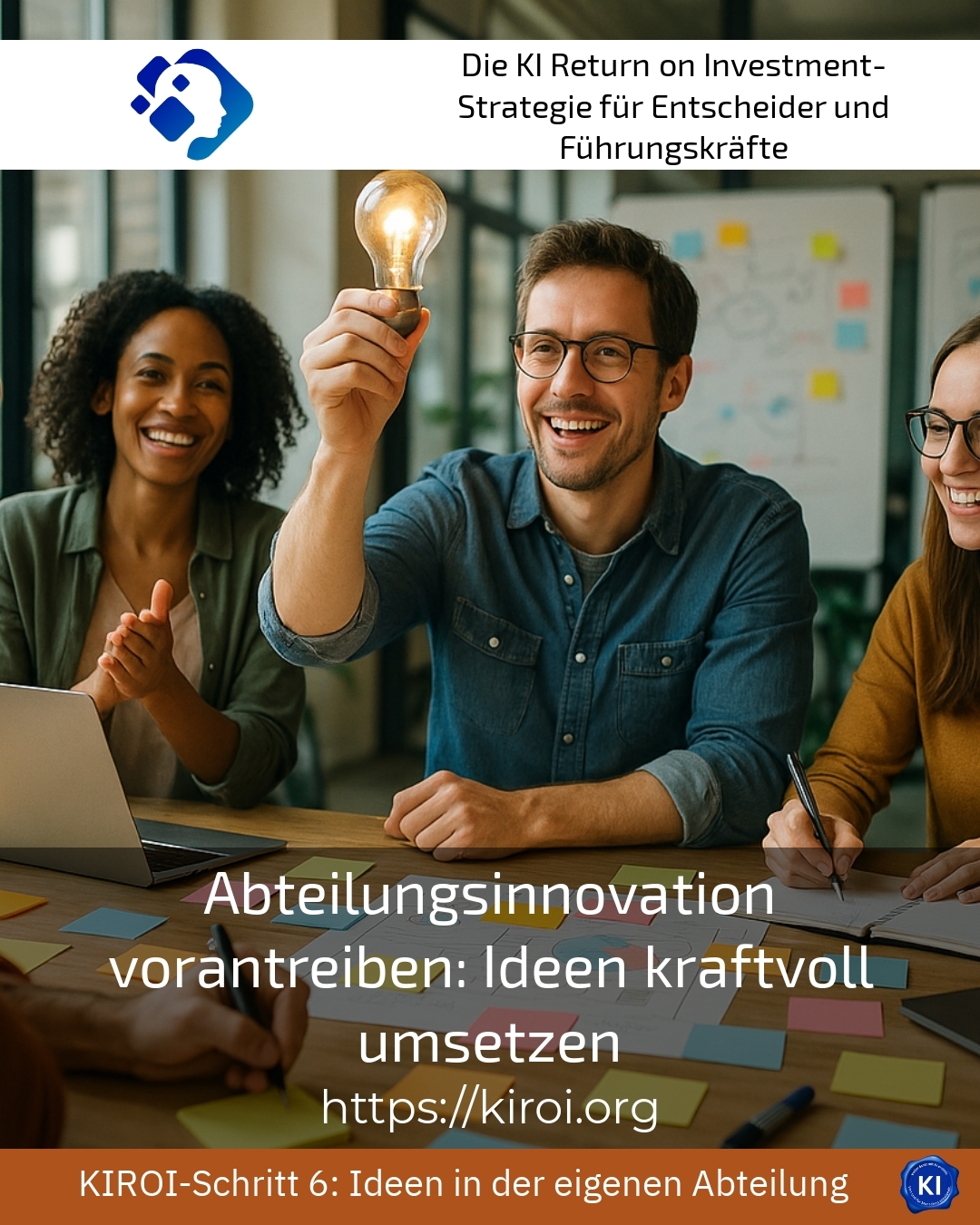
Imagine your department becoming the engine of your entire company. While other areas stagnate, your team flourishes and sets the benchmark for real change. The ability to, Driving departmental innovation The ability to do so today determines success or failure. However, many leaders face a dilemma: they have brilliant ideas, but their implementation fails due to internal resistance, a lack of structures, or insufficient support. This article shows you concrete ways in which you can powerfully shape change in your department.
The Power of Structured Change
Change doesn't happen by chance, but follows clear patterns and principles. Anyone who Driving departmental innovation requires an in-depth understanding of their starting position first. Managers often report that their best concepts get lost in day-to-day operations. They struggle against entrenched processes and sceptical team members. However, the solution is often closer than many suspect.
In modern organisations, a clear pattern emerges with successful transformations. Teams that regularly create space for creative experimentation develop more quickly [1]. They gradually integrate new methods into their daily work and learn from minor setbacks. For example, a medium-sized company introduced weekly innovation hours. Employees were allowed to pursue their own projects and submit suggestions for improvement. After six months, the number of implemented ideas increased by more than fifty percent.
Another example comes from a service company with multiple locations. Regional management recognised early on that while standardised processes bring efficiency, they also limit adaptability. They therefore introduced a system where individual locations served as pilot areas for new approaches. This strategy made it possible to minimise risks while simultaneously gathering valuable experience. The most successful concepts were subsequently rolled out to other locations.
Best practice with a AIROI customer
A client from the technical services sector approached transruptions-Coaching with a complex challenge. His department was tasked with introducing digital tools, but the team showed significant resistance. Employees feared their expertise would be devalued by automation. As part of the support provided, we jointly developed a communication strategy that took these fears seriously while simultaneously highlighting the opportunities. We conducted facilitated workshops in which team members identified areas for improvement themselves. This participatory approach fundamentally changed the dynamic. Instead of resistance, the manager suddenly experienced support and genuine engagement. After three months, the team had not only accepted the new tools but also made their own suggestions for their optimisation. The success was based on putting people at the centre and understanding their concerns as valuable feedback.
Driving departmental innovation through targeted impetus
The key to sustainable change lies in the right dosage of impetus. Too many innovations at once overwhelm any team. Too few impulses, on the other hand, lead to stagnation and frustration. The art lies in finding a balance that promotes development without overwhelming.
A proven approach comes from agile project work and can be adapted at department level [2]. Teams work on defined goals in short cycles and regularly reflect on their progress. This method allows for quick adjustments and prevents projects from going in the wrong direction. A financial service provider used this principle to modernise its customer service. The department tested new conversation formats in two-week sprints and gathered direct feedback from customers and employees.
Similar success stories can be found in the manufacturing sector too. One production department introduced regular improvement rounds, where every employee could submit suggestions. The best ideas were implemented and evaluated within four weeks. This rapid implementation highly motivated the team. Employees experienced that their voice mattered and their expertise was valued. Productivity increased measurably, and at the same time, the working atmosphere noticeably improved.
In the healthcare sector, we frequently encounter particular challenges when implementing changes. Structures are often heavily regulated, and safety aspects are of paramount importance. Nevertheless, it is also possible to drive innovation here. A nursing department developed a system for digital documentation that significantly reduced administrative effort. The time saved could be used for direct patient care. This success shows that change is possible even under difficult conditions.
Understanding resistance as a resource
Resistance to change is often perceived as an obstacle. However, this viewpoint is too narrow. Resistance contains valuable information about the needs and concerns of those involved. Those who take these signals seriously can make change processes more sustainable.
Transruptions-Coaching helps leaders develop a constructive approach to resistance. We support the analysis of underlying motives and help to find appropriate responses. It often becomes apparent that behind resistance lies the fear of losing control or being overwhelmed. These fears are understandable and deserve respect.
An example from the retail sector illustrates this approach particularly well. A branch manager wanted to introduce new sales concepts but encountered significant resistance within the team. Instead of pushing through the change, they decided to engage in dialogue with the dissenting voices. It emerged that the employees feared jeopardising their established customer relationships. Together, they developed a solution that combined new methods with proven strengths. The result exceeded all expectations.
Creating structures for sustainable development
One-off change impulses often fizzle out ineffectively. Sustainable development requires structures that enable continuous learning and adaptation. These structures must suit the culture and framework conditions of the respective department [3].
For instance, a logistics company established an internal mentoring system for innovations. Experienced employees guided younger colleagues in implementing their ideas. This system fostered knowledge transfer while simultaneously strengthening team cohesion. The mentors experienced appreciation for their expertise. The mentees benefited from practical experience and contacts within the organisation.
Successful approaches to structuring are also evident in the field of public administration. A municipal department established a regular innovation day, where new ideas were presented and discussed. The best suggestions received resources for a pilot phase. This structure created transparency and fairness in dealing with innovations. At the same time, it created a space for creative exchange across usual hierarchies.
Best practice with a AIROI customer
Another client from the energy sector sought guidance on an ambitious transformation project. The department was to be fully digitised within a year, but previous attempts had failed. As part of the collaboration with transruptions-coaching, we first analysed the reasons for the previous failures. It became apparent that while the technical solutions were available, the human aspect had been neglected. We developed a comprehensive support programme that included technical training as well as coaching elements for the executives. The employees were given space to articulate their concerns and actively participate in shaping the process. Regular reflection sessions allowed for adjustments during the process. After nine months, the digitisation was successfully completed, and the team expressed pride in the results achieved together. The success was based on the combination of technical expertise and people-centred support.
The role of the manager in driving departmental innovation
Leaders significantly shape the innovation culture of their department through their behaviour. They set priorities and set the tone. Their attitude towards mistakes and experiments influences the entire team's willingness to take risks.
A leader in mechanical engineering recognised this responsibility and consciously changed her communication style. Instead of criticising mistakes, she asked about the lessons learned from them. This small change had enormous effects on the team's willingness to innovate. The employees dared to experiment more and developed more creative solutions. The department became a role model within the company for a constructive approach to mistakes.
A similar dynamic is evident in the education sector with the introduction of new learning formats. The head of a continuing education institution actively promoted the development of digital course offerings. She provided resources and protected her team from excessive pressure from other departments. This supportive attitude enabled the staff to bravely forge new paths. The formats developed later became the standard for the entire organisation.
Practical tools for everyday life
The theory of change must prove itself in everyday life. Therefore, leaders need practical tools that are easy to use. These tools should be flexible enough to handle different situations.
A tried-and-tested tool is structured idea generation followed by prioritisation. Teams initially gather all suggestions for improvement without evaluation. Subsequently, they jointly assess the expected benefit and effort of each idea. This method creates transparency and allows for well-informed decisions. One insurance company used this approach to optimise its claims processing. The employees themselves identified the most promising improvements.
Another tool comes from Design Thinking and focuses on the needs of the users [4]. Teams do not develop solutions at their desks, but in direct dialogue with those affected. A software company used this method to develop internal tools. The developers spent time in the departments that used their software. They observed daily work and held discussions about challenges and wishes. The resulting solutions met the users' needs precisely.
In the field of personnel development, the concept of learning partnerships is proving particularly effective. Two employees support each other in learning new skills. They meet regularly, exchange experiences, and give each other constructive feedback. This method is cost-effective and simultaneously promotes networking within the department. A consulting firm introduced learning partnerships and recorded a significant increase in further training activities.
My AIROI Analysis
Looking at numerous change projects reveals a clear pattern for success. Departments that sustainably increase their innovative capacity combine three essential elements. They create structures for continuous experimentation and learning. They take people seriously, with their fears and hopes. And they have leaders who embody and enable change.
The role of transruption coaching is to guide these processes professionally. We provide impetus where guidance is lacking and support in overcoming blockages. In doing so, we always respect the personal responsibility of those involved and do not impose ready-made solutions. Our experience shows that sustainable change is only successful when people shape it themselves.
The examples described make it clear that Driving departmental innovation in a wide variety of industries and contexts. The specific methods may vary, but the fundamental principles remain the same. Respect for people, clear structures, and courageous leadership form the foundation for successful transformation. Those who heed and consistently apply these principles will experience positive changes in their department. The journey may be challenging, but it is worthwhile for all involved.
Further links from the text above:
[1] Harvard Business Review – Innovation Management
[2] Scrum.org – Agile Methods and Their Application
[3] McKinsey – Insights into Organisational Performance
[4] IDEO – Design Thinking Fundamentals
For more information and if you have any questions, please contact Contact us or read more blog posts on the topic Artificial intelligence here.






 Deutsch
  English (UK)