
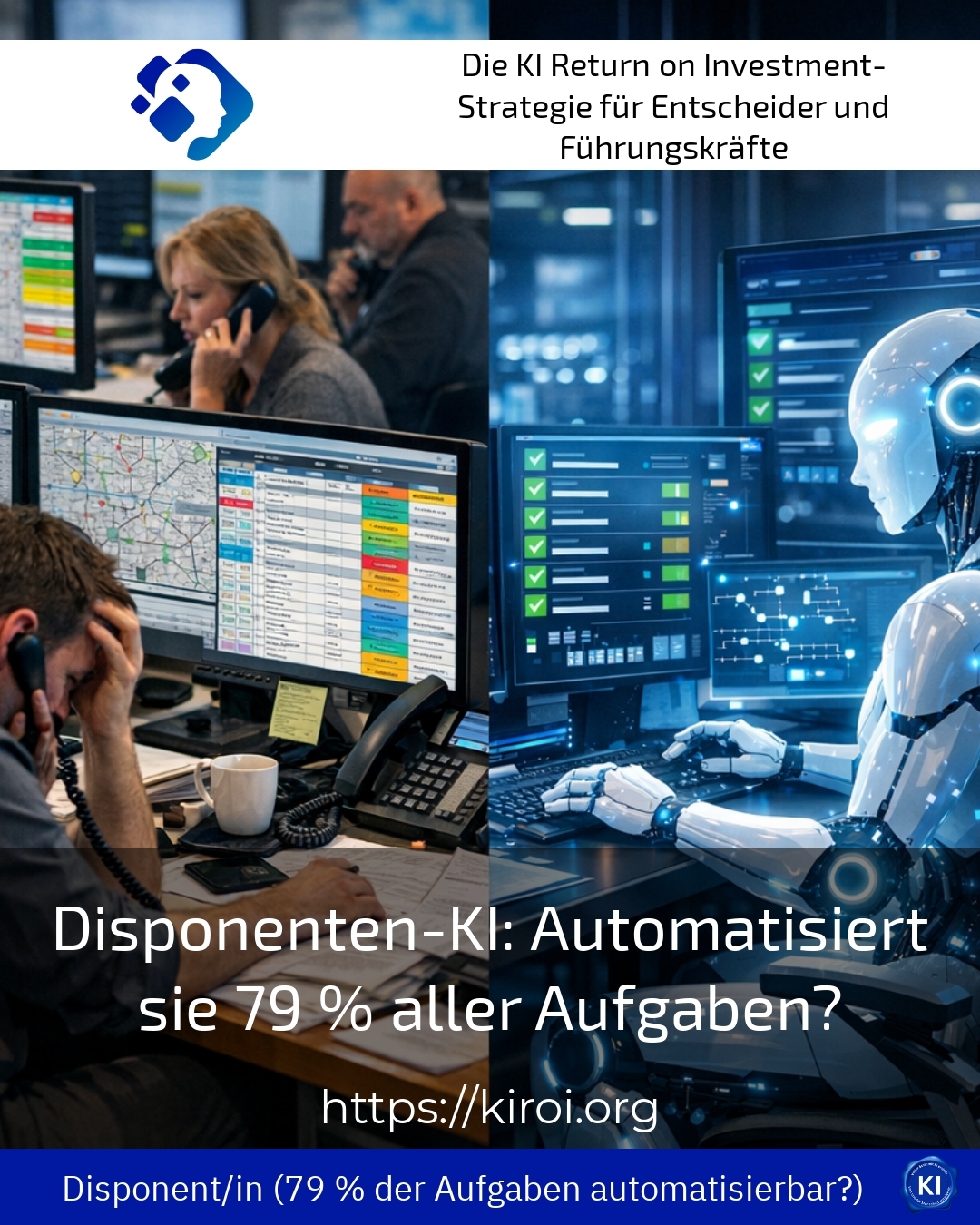
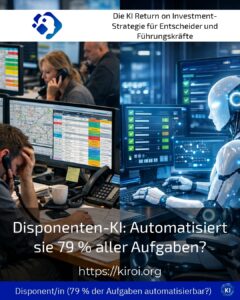
Will the Disponent AI Will you be taking over your workplace soon while you are still thinking about the next route planning?
This question currently concerns countless professionals in logistics. Digitalization is advancing relentlessly. According to the Job Future Report of the Institute for Employment Research, around 79 percent of typical activities can already be automated by intelligent systems [1]. But what does this mean in practice for people who coordinate daily flows of goods and optimize transport routes? Disponent AI promises enormous efficiency gains while raising important questions. In this article, we explore how transruptive coaching can support companies in this profound transformation.
The reality of automation in the logistics industry
The numbers speak volumes, because the potential for automation is significant. However, a high automation potential does not automatically mean the elimination of jobs. Rather, the scope of activities shifts towards more complex tasks. Today, intelligent systems are already taking on the creation of tour plans. The calculation of optimal loading capacities is also increasingly being automated. Real-time monitoring of supply chains often works more precisely through algorithms than through human control.
A freight forwarder in the Munich area recently reported on his experience. His team now uses a system that analyzes traffic data. The software takes weather conditions into account when planning routes. It also integrates information about construction sites and traffic jams. The result: a time saving of approximately 40 percent in daily planning. Nevertheless, humans remain indispensable because emergency situations still require a fine sense of intuition.
Another example comes from the area of warehouse management. Algorithms analyze order patterns and predict demand. The systems automatically order goods. They also optimize the placement of products in the warehouse. This significantly reduces the walking distances for staff. The error rate during picking also decreases significantly.
Best practice with a AIROI customer
A medium-sized company in the freight transport sector faced significant challenges in planning the daily operation of its vehicle fleet. The previous manual scheduling procedure regularly resulted in empty runs and suboptimal utilization of available capacity. As part of a transruptive coaching program, we supported the company in the gradual implementation of an intelligent planning system. First, we jointly analyzed the existing processes and identified specific optimization potential. It turned out that approximately 60 percent of the planning tasks were automatizable. However, the remaining activities still required human judgment and experience. After a six-month implementation phase, the company was able to increase its utilization rate by 23 percent. At the same time, employees gained time to focus on important customer relationships. The professionals evolved from being mere planners to strategic coordinators. Today, the participants often report a significantly increased level of job satisfaction, because monotonous tasks have disappeared.
What tasks the dispatching AI already handles
The intelligent systems demonstrate their strengths particularly in recurring standard tasks. They create freight documents and delivery notes in seconds. Communication with interfaces to customer and supplier systems is automated. The programs also reliably handle the status tracking of shipments. The billing of transport services can also be performed automatically.
In practice, this is evident in a logistics service provider in the food sector. There, a system continuously monitors the cooling chain of all shipments. In the event of deviations, it immediately sends alarm notifications to the staff. At the same time, it documents all temperature fluctuations in a comprehensive manner for quality control purposes. In this way, the company meets strict regulatory requirements without additional personnel costs.
Another example concerns the area of customs clearance. International transport requires extensive documentation and precise declarations. Intelligent systems automatically classify goods according to customs tariff numbers. They calculate duties and create the necessary forms. This significantly reduces error rates, and delays at border crossings are noticeably reduced.
The Disponent AI It also supports resource planning in fleet management. It analyzes wear data and forecasts maintenance requirements. Workshop appointments are automatically coordinated. The availability of vehicles increases measurably as a result.
Limits of current automation technology
Despite impressive progress, the systems encounter clear limits. Complex negotiations with business partners still require human expertise. Solving unforeseen problems also remains a human domain. When a vehicle fails, quick decisions must be made. Experience and intuition play a crucial role in this.
An example from the field of freight transport illustrates this clearly. The transport of oversized loads requires individual permits and complex route planning. Bridge heights, road widths, and curve radii must be taken into account. In addition, coordination with authorities and accompanying vehicles is required. These multifaceted coordination tasks regularly overwhelm current algorithms.
The same applies to hazardous goods logistics. Strict regulations and restrictions on mixing of materials apply here. The systems do support documentation and classification, but the final responsibility and control remain with qualified professional staff. Human expertise remains indispensable for the safety of all involved parties.
How transruptions coaching helps companies transform
The introduction of automated systems presents organizations with numerous challenges. Employees often fear for their jobs and react with resistance. Leaders often underestimate the necessary change effort in the organization. Technical implementations often fail due to a lack of acceptance within the team.
This is where transruptive coaching comes into play as a support for transformation projects. It helps companies to design the change in a holistic way. The technical component is linked to the human dimension. This results in sustainable changes that are supported by all involved parties.
An example from contract logistics demonstrates the benefits of this approach. A service provider wanted to comprehensively digitize its warehouse processes. The staff initially reacted skeptically to the announced changes. Through a structured coaching process, fears were addressed. The employees were actively involved in shaping the new work processes. The result was significantly higher acceptance of the implementation of the new systems.
Best practice with a AIROI customer
A family-run freight forwarding company with about 120 employees faced the decision to implement a comprehensive transport management system. The management team recognized the potential of Disponent AI To increase efficiency, we were simultaneously concerned about the long-standing professionals in the company. As part of an intensive transruptive coaching program, we developed a strategy together that linked technological progress with personnel development. First, we conducted individual interviews with all the affected employees to understand their perspectives and concerns. Many reported uncertainty about their future role in the company. At the same time, some also expressed an interest in new tasks and training opportunities. Based on these findings, we designed a qualification program for the entire team. The experienced dispatchers went on to become process experts and system administrators. They took on the responsibility of maintaining the algorithms and handling exceptional cases. The younger employees specialized in data-driven analysis tasks. After a year, management reported increased productivity while improving the operating environment. Not a single employee had to leave the company due to automation.
Opportunities through intelligent human-machine collaboration
The future does not lie in a binary choice; it lies in intelligent collaboration. Humans and machines complement each other in their respective strengths. Algorithms process large amounts of data faster and more flawlessly than humans. For this, humans bring creativity, empathy, and judgment to complex situations.
In practice, this is evident in customer service in the transportation industry. Automated systems inform recipients about delivery times and shipment status. However, trained employees handle the conversation in case of problems or complaints. They can address individual situations and find appropriate solutions. This creates a level of service quality that would not be achievable purely through machine technology.
Another example comes from the field of strategic network planning. Here, algorithms analyze traffic volumes and identify optimization potential. However, the final decisions regarding locations and collaborations are made by people. They also take into account soft factors such as corporate culture and regional peculiarities.
The same applies to pricing for transport services. Systems calculate costs and analyze market prices in real time. However, negotiating with customers and drafting long-term contracts require human skill. Maintaining relationships and building trust remain genuine human competencies.
My AIROI Analysis
The automation potential in the logistics industry is undeniably significant, as the data from the Job Future Monitor impressively demonstrate. However, it would be premature to draw hasty conclusions from this regarding the imminent disappearance of entire occupational groups. Reality paints a more nuanced picture, in which job profiles are changing rather than disappearing. Disponent AI becomes a valuable tool that frees skilled workers from routine tasks and gives them space for value-adding activities.
What is crucial for success is the way companies shape this change. Technology alone does not create transformation. It requires a holistic approach that involves and empowers people. This is where the importance of professional support through transruptive coaching lies; it provides impetus and supports development processes.
The companies that invest today in the combination of technological innovation and personnel development will be the winners tomorrow. They have motivated employees who can use modern tools with confidence. The logistics industry is facing exciting developments that hold more opportunities than risks. It is up to all of us to actively seize these opportunities and shape the change positively.
Further links from the text above:
[1] Job-Futuromat of the Institute for Employment Research
For more information and if you have any questions, please contact Contact us or read more blog posts on the topic Artificial intelligence here.






 Deutsch
 English (UK)