
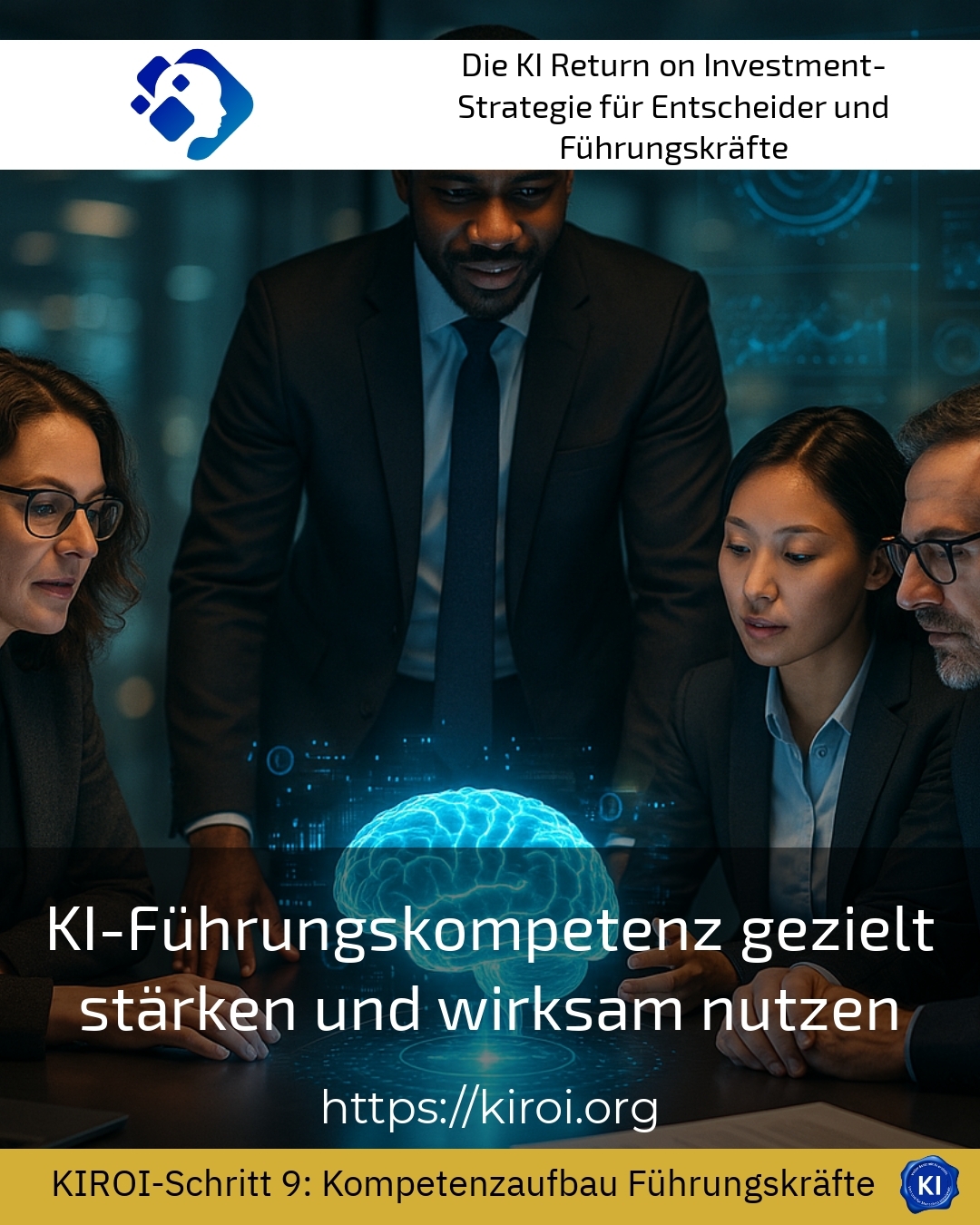
The digital transformation is fundamentally and sustainably changing the way companies are run. Leaders face the challenge of not only understanding technological innovations but also actively integrating them into their leadership practices. This involves going beyond simply improving efficiency or reducing costs; it is now about a completely new dimension of management. Strengthening AI leadership skills deliberately To want to is today to embark on a journey that involves both personal and organizational changes. Those who embark on this journey will find that the combination of human intuition and machine intelligence unleashes enormous potential. But how does this change concretely take place, and what steps are necessary to succeed as a leader in this new world?
The new role of the manager in the age of intelligent systems
Executives need to understand more than ever before how intelligent systems work and what added value they can offer. This does not mean that every manager has to become a technology expert. Rather, it is about developing an understanding of the possibilities and limitations of these technologies. For example, a medium-sized company in the mechanical engineering industry has systematically trained its production managers to better understand data-based decision-making processes. The managers learned how predictive analyses can be used for maintenance planning. They suddenly understood why certain recommendations were made and were able to critically question them. Another example comes from the retail sector, where store managers are now able to interpret automated inventory forecasts and, if necessary, correct them. In healthcare, department heads, in turn, use intelligent systems for personnel planning, comparing the suggestions with their own experience to achieve better results.
Strengthening AI leadership competence through continuous learning
The topic of continuous learning takes on a central role in this context. Executives who want to expand their skills in handling intelligent technologies should regularly engage with new developments. This can be done through workshops, seminars, or even practical experiments in their own work environment. For example, a logistics company has provided its executives with so-called „experimentation rooms,“ where they were able to try new technologies risk-free [1]. The results were remarkable, as the executives developed a significantly deeper understanding of the technology. In the financial sector, banks have begun to train their executives in multi-day intensive programs, with the focus on practical application scenarios. Insurance companies, in turn, rely on mentoring programs in which experienced technology experts mentor executives and help them understand the relevant connections.
Best practice with a AIROI customer
An international trading company approached us because the senior management was having difficulty integrating recommendations generated by intelligent systems into their strategic decisions. The management realized that technological investments alone were not enough to achieve the desired success. As part of our support, we developed a customized program that included both theoretical foundations and practical exercises. The management first learned how data-based recommendation systems work in principle and what factors influence the quality of the results. Subsequently, they worked on real case studies from their own company, critically reflecting on their previous decision-making processes. Particularly valuable was the realization that human expertise and machine analysis can ideally complement each other. After six months, the participants reported a significantly increased level of confidence in handling technological recommendations. The collaboration between the various departments also improved, as all parties now spoke the same language. As a result, the company was able to strengthen its market position and open up new business opportunities.
Strategic integration of intelligent technologies into leadership processes
The strategic integration of intelligent technologies into existing leadership processes requires a thoughtful approach that takes into account both technical and human factors. Leaders should first analyze which of their current tasks could be improved through technological support. For example, an automotive supplier has expanded its quality control processes through intelligent image recognition systems, with production managers using these systems as decision support [2]. The leadership retains the final decision-making authority, but benefits from the consistency and speed of the automated analysis. In the energy sector, power plant operators rely on intelligent monitoring systems that detect anomalies early and inform the responsible management. Pharmaceutical companies use data-based systems to support research decisions, with project managers contextualizing the results with their expertise.
The importance of trust and transparency
Trust and transparency play a crucial role in the introduction of intelligent systems, because executives and employees can only effectively work with these systems if they understand their functioning. Many executives report that they were initially skeptical about automated recommendations. This skepticism can often be reduced through targeted training and transparent communication. For example, a telecommunications company provided its executives with detailed insights into the functioning of their customer analysis systems, so that they could understand on what data basis certain recommendations were generated [3]. In the banking sector, transparency is particularly important because regulatory requirements require the traceability of decisions. Insurance companies, in turn, have recognized that the adoption of intelligent systems increases when executives have the opportunity to question recommendations and, if necessary, override them.
Strengthening AI leadership competence through practical application
The practical application of intelligent technologies in management everyday life is arguably the most important building block for competence development, because theoretical knowledge alone is not enough to fully exploit the capabilities of these systems. Managers should actively seek opportunities to deploy new technologies in their work area. For example, a chemical company has tasked its production managers with making at least three decisions per month with the support of intelligent analysis systems and documenting the results. This structured approach has led to the fact that the managers quickly developed a sense of when technological support is helpful and when human experience should prevail. In the hotel industry, hotel managers use intelligent systems for dynamic pricing, combining recommendations with their knowledge of local specifics. Airport operators rely on predictive systems for passenger flow control, with management personnel being able to make adjustments in real time.
Best practice with a AIROI customer
A medium-sized manufacturing company approached us with the challenge that its department heads were increasingly confronted with automated planning systems whose recommendations they could not understand. The frustration was palpable on both sides, as the technical teams did not understand why their well-intentioned implementations were met with resistance. We supported the company over a period of nine months, initially conducting a comprehensive assessment of the existing competencies and attitudes. It became apparent that many executives were generally open to new technologies, but felt that they were losing control. Together, we developed a concept that gradually transferred responsibility while simultaneously incorporating feedback loops. The executives were given the opportunity to evaluate recommendations and to feed their own experiences into the system. This participation led to significantly higher acceptance and improved results. At the end of the process, the participants reported a fundamental change in their perception of technological support. They now understood that intelligent systems can serve as partners rather than replacing their own expertise.
The role of corporate culture in skills development
Corporate culture significantly influences how successfully leaders can develop and apply new skills, because a supportive environment significantly facilitates the learning process. Organizations that maintain an open culture of mistakes allow their leaders to experiment with new technologies without having to fear negative consequences. For example, a media company has established an internal community where leaders can exchange their experiences with intelligent systems and learn from one another [4]. This peer-to-peer approach proved particularly effective because the participants benefited from concrete practical examples from their own environment. In the transportation sector, logistics companies have introduced regular „Innovation Days“ where leaders can learn about and try out new technologies. Construction companies, in turn, rely on multidisciplinary teams in which technical experts and experienced executives work together to find solutions.
Challenges and Approaches to Competence Development
The development of leadership skills in the context of intelligent technologies is associated with various challenges that range from time constraints to psychological barriers. Many executives report that they have little time in their daily work to deal with new technologies. Structured learning formats can help here, which can be integrated into everyday work routines. For example, a pharmaceutical company has developed short, modular learning units that executives can complete during their commutes. Moreover, there is often emotional resistance to changes that should not be underestimated. In the financial sector, banks have had good experiences with coaching programs that support executives in their personal engagement with technological change. Insurance companies rely on „change agents,“ that is, leaders who act as role models and motivate their colleagues.
Targetedly strengthen sustainable AI leadership competencies and embed them within the company
The sustainable embedding of leadership skills in the handling of intelligent technologies requires a long-term approach that goes beyond one-time training measures. Companies should create structures that enable continuous learning and application. For example, an energy provider has introduced goal-setting agreements that explicitly include the use of data-based decision-making tools. This linkage with the evaluation system signals to leaders that the organization takes these competencies seriously. In retail, retail companies have expanded their leadership development programs with modules on technological competence, with a focus on practical application. Industrial companies, in turn, rely on regular refresher courses because the technological possibilities are continuously evolving and leadership must remain up to date.
My AIROI Analysis
Supporting senior leaders in developing technological competencies constantly shows me how important a holistic approach is. Many organizations underestimate the human dimension of technological change and focus too much on implementing systems. In doing so, they overlook the fact that the real success factor lies in the ability of leaders to use these systems meaningfully and integrate them into their decision-making processes. Experiences from numerous projects show that leaders who are actively involved in the change process develop significantly higher acceptance. Transruptive coaching can provide valuable insights by addressing both the technical and personal aspects of competence development. I find it particularly important to recognize that intelligent technologies should not be viewed as a threat, but as an extension of human capabilities. Executives who adopt this perspective are able to unlock the full potential of technological support without neglecting their own expertise. The future belongs to those executives who understand how to combine human intuition with machine analysis in a synergistic way. This skill can be developed when organizations create the right conditions and executives are willing to embrace new ways of working. The journey may be challenging, but the results speak for themselves and motivate them to continue this path consistently.
Further links from the text above:
[1] McKinsey – The State of AI
[2] Harvard Business Review – Artificial Intelligence
[3] Gartner – Artificial Intelligence Insights
[4] World Economic Forum – AI and Robotics
For more information and if you have any questions, please contact Contact us or read more blog posts on the topic Artificial intelligence here.










 Deutsch
  English (UK)