
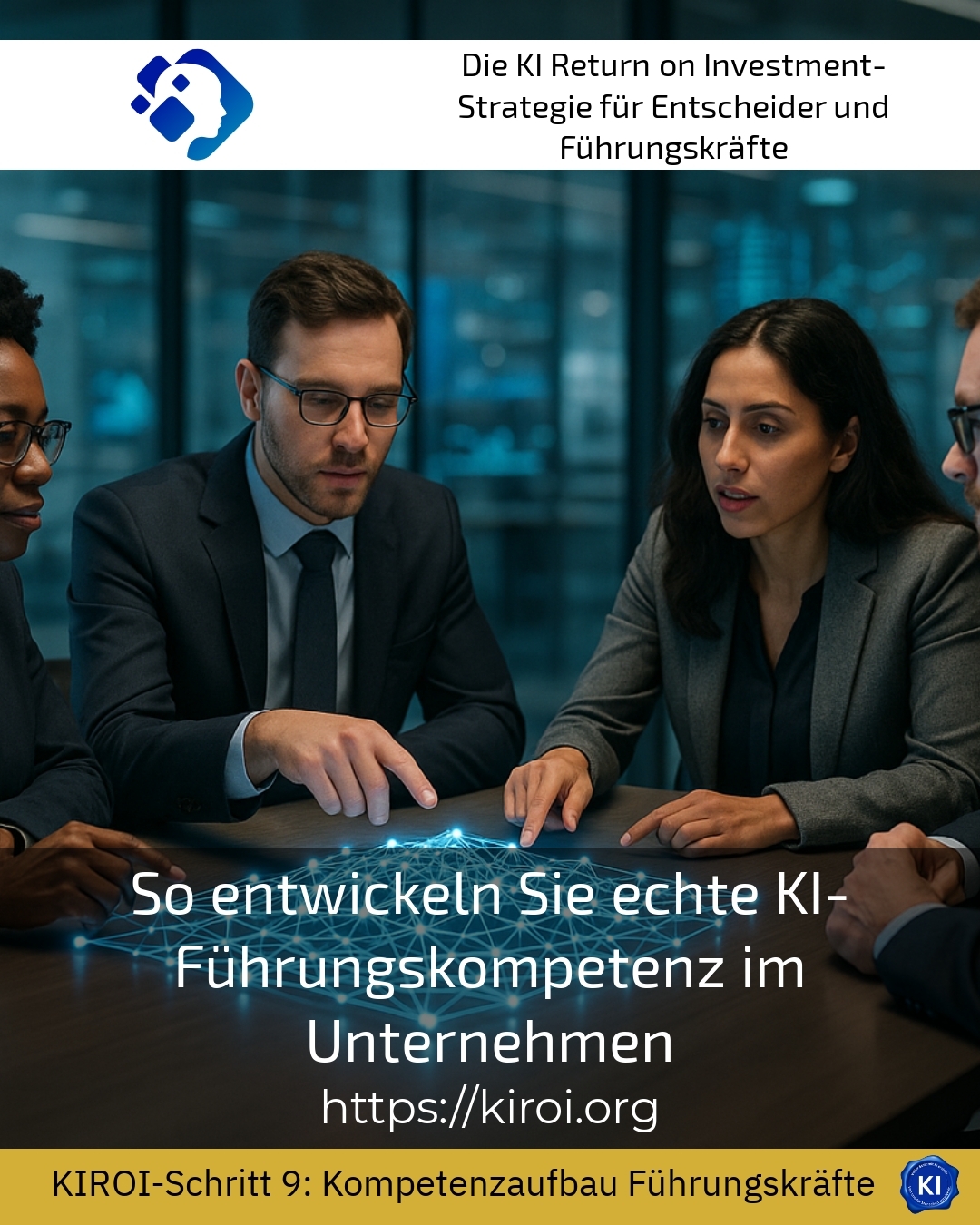
Digital transformation is fundamentally changing companies. Leaders face a crucial challenge. They must understand and strategically deploy new technologies. At the same time, they need to guide their teams through the change. How to develop genuine AI leadership competence within a company is a question that concerns almost every industry today. Because those who do not develop this ability risk being left behind. The good news, however, is that this competence can be systematically built. In this article, you will learn how this can be achieved.
Why classic leadership models are no longer sufficient today
Traditional management approaches are increasingly reaching their limits. The speed of technological change is overwhelming rigid hierarchies. Many decision-makers report similar experiences. They feel torn between day-to-day business and innovation. Their employees expect clear direction. But they themselves are also looking for answers to complex questions. Clients in consulting frequently describe this situation very vividly.
In mechanical engineering, for example, production managers are experiencing massive upheaval. Predictive maintenance is changing the entire logic of maintenance. A plant manager suddenly needs to be able to interpret data analyses. At the same time, they must bring their experienced technical staff along. In retail, personalised recommendation systems are revolutionising customer behaviour. Store managers have to understand why certain products are prominently displayed. And in healthcare, intelligent systems are supporting diagnostics. Doctors and clinic managers are facing fundamental ethical questions.
These examples illustrate a common challenge. Leaders require a new set of competencies. They need to combine technical understanding with human leadership skills. This is precisely where transruption coaching comes in as project support. It systematically assists decision-makers in building this bridge.
The Five Pillars of Modern Technology Literacy for Leaders
So you develop real AI leadership skills in your company through a structured approach. Five core pillars form the foundation. These pillars can be applied regardless of industry. They provide impetus for your own development.
Building strategic understanding
Leaders do not need to become programmers. But they do need a solid basic understanding. A logistics manager should understand how route optimisation works. A marketing manager needs to know what data algorithms use. The HR manager of an industrial company should be able to assess recruitment tools. This knowledge enables sound strategic decisions. It also protects against unrealistic promises from vendors.
In the finance sector, for example, managers must be able to question risk models. They should understand which parameters influence credit decisions. In agriculture, modern systems analyse soil quality and weather data. Farm managers must reconcile these recommendations with their experienced knowledge. And in the media industry, algorithms control content delivery. Editorial managers need the competence to uphold journalistic standards.
Developing ethical judgment
Technology is never neutral. Every application carries ethical questions. Leaders bear a special responsibility here. They must be able to set boundaries and defend values. An insurance manager must decide which data may be used for premiums. An HR manager must know when automated applicant selection could be discriminatory. The CEO of an e-commerce company must recognise dark patterns.
This competence requires continuous reflection. Transruption coaching offers valuable support for projects here. It creates space for critical thinking. Clients often report initial uncertainty. However, they gradually develop clear stances.
Best practice with a AIROI customer
A medium-sized trading company faced a complex decision. Management wanted to implement an employee monitoring system. The technology promised efficiency increases of up to thirty percent. However, the executives felt uneasy about this undertaking. As part of AIROI's support, we jointly analysed all aspects of this decision. We carefully considered legal frameworks and ethical implications alike. Through structured reflection, the executives developed a nuanced position on this issue. They realised that short-term efficiency gains could damage staff trust in the long run. Instead, they implemented a transparent feedback system with voluntary participation for all employees. Acceptance amongst the workforce was significantly higher than originally expected. Nevertheless, productivity increased measurably because the employees felt valued. This case impressively demonstrates how ethical reflection and business success can work together. The executives gained confidence and decisiveness through this process.
Strengthen change competence for technological transformation
Every introduction of new technology means change. People react differently to such upheavals. Some are enthusiastic, others skeptical or anxious. Leaders must be able to understand and support all these reactions. They need tools for professional change management.
An example from the automotive industry highlights this challenge impressively. A production manager introduced collaborative robots to his assembly line. Initially, the experienced skilled workers felt threatened by this development. They feared for their jobs and their status within the company. The production manager invested a lot of time in personal conversations with each individual. He pointed out how the technology would take over physically demanding tasks. The skilled workers were further trained to become experts in human-machine collaboration. Today, they are proud of their new role in the production process.
We observe similar dynamics in tax advisory firms regarding automation. Architectural firms are also experiencing upheavals through parametric design and generative design tools. And in law firms, automated document analysis is fundamentally changing the professional image. Everywhere, leaders with strong change management skills are needed.
How to Develop Genuine AI Leadership Skills in Business Through Practical Implementation
Theoretical knowledge alone is not enough. Leaders must apply their understanding in everyday situations. Certain practices have proven effective for this. These can be integrated into day-to-day leadership step by step.
Foster a learning organisation
Leaders should themselves be role models for continuous learning. This means being open to asking questions and admitting to not knowing something. It also means regularly setting aside time for further personal development. For example, the CEO of a pharmaceutical distribution company participates in internal tech talks monthly. A hospital director has younger colleagues show her new applications. The head of an insurance agency regularly attends start-up events.
This attitude permeates the entire organisation. Employees experience that learning is desired and encouraged. Mistakes are accepted as a necessary part of the innovation process. This creates a culture of openness and curiosity.
Building bridges between departments
Technology projects often fail due to silo thinking and a lack of collaboration. IT departments speak a different language to business departments. Leaders must act as translators and intermediaries between these worlds. They create spaces for dialogue and mutual understanding.
At an energy supply company, the head of department introduced regular workshops. During these sessions, technicians presented their projects in a way that was easy for colleagues in sales to understand. In turn, sales staff explained customer needs from their perspective. This approach led to significantly improved product development and higher customer satisfaction. Similar approaches have proven successful in publishing houses when it comes to collaboration between editorial and technical teams.
Best practice with a AIROI customer
A family-run manufacturing company wanted to digitise and modernise its processes. The managing director recognised the need for fundamental changes within the company. However, he lacked direction on precisely where to begin this extensive undertaking. AIROI's support began with a systematic analysis of the existing competencies within the management team. Together, we identified knowledge gaps and developed individual development plans for each manager. Networking between the different company areas and departments was particularly important. The production manager learned from sales which customer data could be relevant for forecasting. Through discussions with IT, the HR manager understood how data-driven personnel planning works. The CFO recognised potential for automated reporting and was able to specifically harness it. After twelve months, collaboration within the management team had fundamentally improved and intensified. Digitalisation projects progressed significantly faster than in comparable companies in the industry. The continuous support provided through regular reflection sessions with all participants was crucial.
The role of accompaniment and reflection in the development process
Leadership development is not a given in times of rapid technological change. This is how you most effectively develop genuine AI leadership competence within your company through professional support. External perspectives help to identify and overcome blind spots. They allow for honest feedback without internal political considerations.
Transruptions-Coaching offers precisely this form of support for projects and transformation processes. It uniquely combines technological understanding with psychological expertise. Leaders receive a safe space for their questions and uncertainties. They can play through scenarios and prepare decisions without risk.
Clients frequently report a particular added value from this collaboration over time. They gain clarity on their own values and priorities as leaders. They develop stronger self-confidence in dealing with technological issues. And they learn to lead their teams more confidently through change.
Concrete topics from practice
Managers come to consultancy on these topics with very different concerns. Some feel overwhelmed by the pace of change and are looking for direction. Others want to prepare specific projects and avoid pitfalls from the outset. Yet others seek support with difficult personnel decisions in the context of digitalisation.
For example, a hotel manager wanted to understand how he could use review algorithms for his business. A head teacher was looking for ways to use digital tools in a pedagogically sound manner. The managing director of a craft business wondered which processes he should automate. A clinic manager wanted to win over his medical staff to new diagnostic tools. All these concerns require individual approaches and tailor-made solutions.
Long-term prospects for leaders in the digital age
The development of technological leadership competence is not a one-off project with a clear endpoint. It is a continuous process of further development and adaptation. Technologies will continue to change at an ever-increasing pace. New ethical questions will arise and will need to be answered. Leaders must remain agile and willing to learn throughout their entire careers.
In the banking sector, for instance, new regulatory requirements for algorithmic systems are constantly emerging. Energy companies must be able to intelligently manage their grids for decentralised generation. Mobility providers are integrating ever more data sources for optimised route planning and capacity management. And in the education sector, adaptive learning systems are fundamentally changing the role of educators.
Leaders who invest in their competence development today create sustainable competitive advantages. They can recognise opportunities faster and act with greater risk awareness than others. They gain the trust of their employees through competent guidance of change. And they position their organisations for a successful future in a digitalised world.
My AIROI Analysis
The coaching of numerous leaders clearly highlights recurring patterns and success factors. The initial crucial step is the willingness to honestly acknowledge and address one's own knowledge gaps. Many leaders fear appearing incompetent to their employees. However, this fear blocks the necessary learning process and significantly delays important development steps. The most successful leaders, instead, openly demonstrate their willingness to learn in front of their teams.
A second success factor is the integration of technology topics into day-to-day management from the outset. Those who treat digitalisation as a separate project will fail due to the complexity of this task. Instead, technological issues should become and remain part of every strategic discussion. This initially requires conscious effort but quickly becomes an automatic habit in management.
Thirdly, many leaders fundamentally underestimate the emotional dimension of technological transformation. Employees have legitimate concerns about their future and their professional identity as specialists. Taking these concerns seriously is not a waste of time, but a necessary investment in success. Only when people feel secure can they become open to new things and get involved.
Finally, the AIROI analysis shows that sustainable development requires external support over longer periods. Internal resources are often too heavily tied up in daily operations for such reflection processes. External coaches bring fresh perspectives and cross-industry experience. They create commitment to one's own development goals and maintain focus. This leads to measurable progress within manageable timeframes and sustainable changes in leadership culture. [1]
Further links from the text above:
[1] Transruptions-Coaching – Support for digital transformation projects
For more information and if you have any questions, please contact Contact us or read more blog posts on the topic Artificial intelligence here.







 Deutsch
  English (UK)