
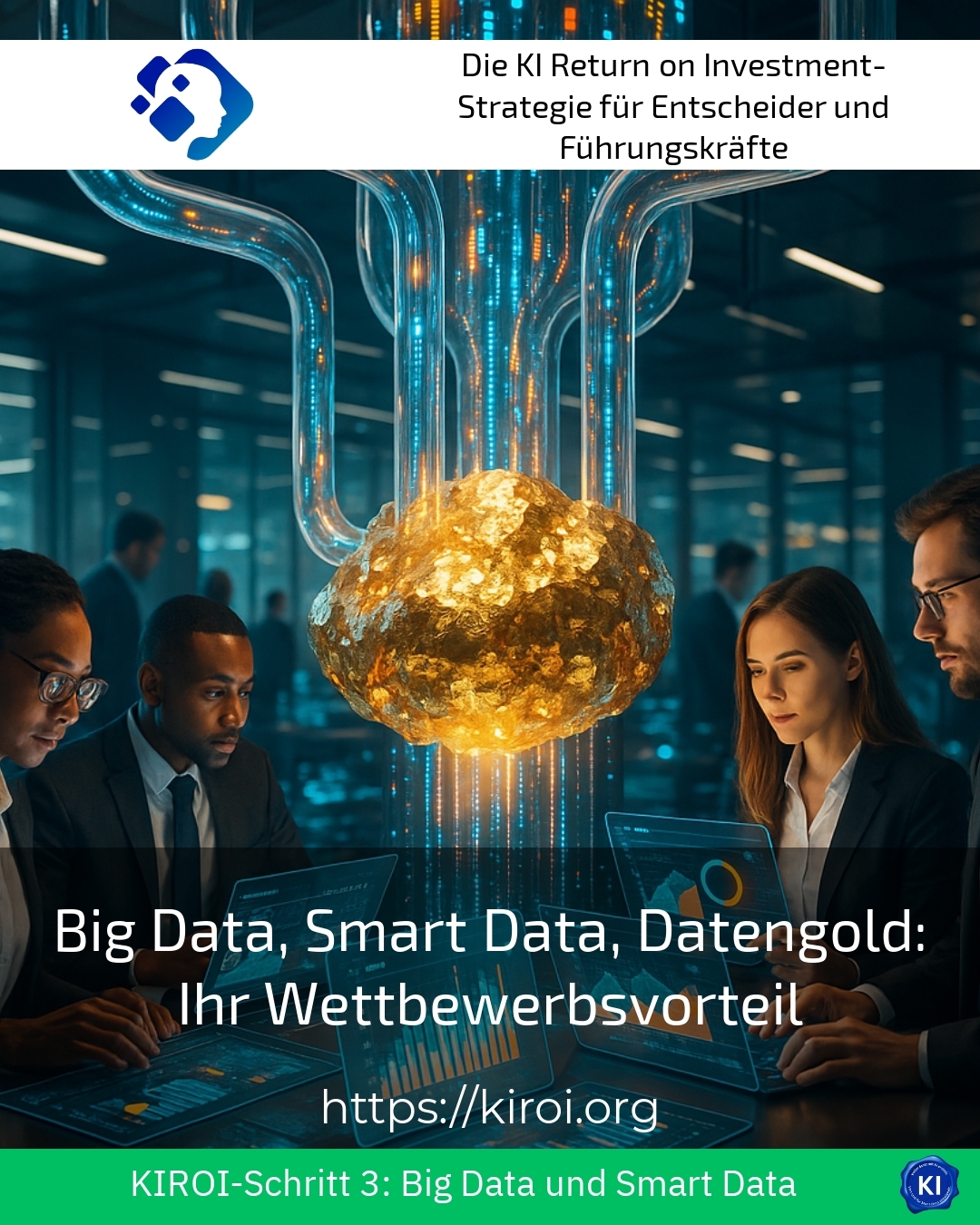
Have you ever wondered why some companies seem to effortlessly gain market share, while others stagnate despite enormous efforts? The answer is often hidden in the way organisations handle their digital resources, because Big Data, Smart Data, data gold: Your competitive advantage decides today on success or failure in almost all industries. At a time when information is growing exponentially, it is long no longer sufficient merely to collect it. Rather, what matters is distilling from the flood of information those insights that are actually actionable and can soundly support strategic decisions.
The transformation of raw data into strategic value
The sheer volume of available information overwhelms many organisations. They face the challenge of extracting actionable insights from terabytes of unstructured data streams. Time and again, this shows that it is not the quantity that is decisive, but the quality of the analysis and the resulting courses of action. A medium-sized retail company, for example, has millions of transaction data records, but without intelligent evaluation these remain worthless. The real challenge lies in recognising patterns, establishing connections and developing predictive models that can anticipate future developments.
In healthcare, for example, medical institutions generate enormous amounts of patient data, laboratory results and treatment protocols every day. By systematically evaluating treatment courses, a rehabilitation clinic can identify which treatment combinations are particularly effective for certain patient groups. Similarly, pharmaceutical companies use aggregated study data to identify active ingredient candidates more efficiently and shorten development cycles. Hospitals, in turn, optimise their resource planning by forecasting patient volumes and deploying staff accordingly.
Best practice with a AIROI customer
A regionally operating logistics company faced the challenge of optimising its route planning while simultaneously increasing customer satisfaction. As part of a transruption coaching process, we supported the company in implementing a data-driven decision-making architecture that linked various information sources together. First, we jointly analysed the existing data silos and identified those information flows that had previously remained unused. In doing so, we established that traffic data, weather data and historical delivery times were not being systematically correlated with one another. Following implementation, the company reported a significant reduction in delivery times, while fuel consumption dropped noticeably. It was particularly remarkable that employees experienced less stress due to the more transparent planning and staff turnover in the driver sector decreased. This case illustrates how Big Data, Smart Data, data gold: Your competitive advantage can not only improve economic figures, but also has a positive impact on the corporate culture.
Intelligent data use as the foundation for modern business models
The ability to generate knowledge from information differentiates successful companies from those lagging behind the competition. This is not solely about technological competence, but rather about a fundamental change in corporate culture and decision-making processes. Organisations that act in a data-driven manner make decisions faster and on a sounder basis because they rely on objective insights rather than gut feeling. However, this transformation requires guidance and impetus that go beyond pure technology consulting.
In retail, for example, forward-thinking companies use purchasing behaviour patterns to create personalised offers and precisely control inventory levels. By analysing past sales data and current trends, a clothing store can predict which items will be in demand in which sizes and colours. Supermarkets, in turn, optimise their shelf replenishment based on movement analyses and completed purchases. Online retailers also benefit from recommendation algorithms based on the comparison of similar customer profiles, thereby generating relevant product suggestions.
The strategic dimension of big data, smart data, data gold: your competitive advantage
Many leaders come to us because they feel that their organisation is not exploiting the potential of its information resources. They frequently report fragmented systems that do not communicate with one another, and decisions that are made on incomplete foundations. In such situations, transruptions coaching can help to develop a holistic perspective and initiate the necessary change processes. We accompany projects related to digital transformation and provide impetus that goes beyond short-term optimisations.
A mechanical engineering company, for example, was faced with the question of how it could use the sensor data from its networked systems to optimise maintenance intervals and minimise unplanned downtime. Through predictive analytics, critical wear patterns could be identified before they led to costly stoppages. An energy supplier, in turn, used consumption profiles to forecast peak loads and adjust its grid management accordingly. Even in traditional sectors such as agriculture, data-driven insights are revolutionising productivity by analysing soil conditions, weather data and plant growth in real time.
Best practice with a AIROI customer
A financial services provider was looking for ways to put its risk management on a new footing while simultaneously improving customer loyalty. In the joint coaching process, we first developed an understanding of the available information resources and how they could be networked. This revealed that the organisation had valuable insights into customer behaviour and market developments, but that these were isolated in different departments. We accompanied the project team in the design of an integrated analysis platform that brought together various data streams and enabled automated evaluations. Today, the company reports improved early detection of potential credit risks, while at the same time new cross-selling potentials could be identified. The employees perceive data-supported decision-making as a relief because they can now objectively underpin their assessments. This case impressively illustrates how a systematic approach can generate strategic advantages.
Cultural transformation as a success factor
The technical implementation of analysis systems represents only part of the challenge. Much more crucial is often the cultural shift required to embed data-driven decision-making within the organisation. Employees must learn to trust insights and to reconcile their intuition with objective findings. Managers, in turn, must lead by example to show that decisions are made on the basis of facts, even when these are sometimes uncomfortable.
In the education sector, for example, innovative institutions use learning analytics to identify individual support needs at an early stage and offer tailored assistance. Universities evaluate study paths to identify dropout risks and initiate preventive measures. Schools, in turn, can evaluate and continuously improve pedagogical concepts by analysing learning progress. In professional development too, adaptive learning systems enable personalised development paths that are aligned with individual competency profiles.
Big Data, Smart Data, data gold: your competitive advantage in practical implementation
The clients who come to us are often at a turning point. They realise that their previous methods are no longer sufficient to remain competitive. At the same time, they often lack orientation as to which steps to take next and where it would make the most sense to start. In such situations, transruptions coaching offers valuable support that helps to gain clarity and develop concrete measures.
In the tourism sector, for example, dynamic pricing models are revolutionising yield optimisation by anticipating fluctuations in demand in real time. Hotels automatically adjust their room rates based on booking trends, local events and competitor activity. Airlines optimise their capacity utilisation through complex yield management systems that take thousands of factors into account. Tour operators, in turn, personalise their offers on the basis of previous bookings and identified preferences [1].
The insurance industry uses predictive models to assess risks more precisely and make premiums more individual. Telecommunications companies analyse usage behaviour to predict customer churn and counteract it proactively. Even traditional trade businesses can optimise their capacity planning and avoid bottlenecks by evaluating order patterns [2].
My AIROI Analysis
Engaging with data-driven value creation reveals a fundamental paradox of our time: although information is available in abundance, many organisations lack the ability to transform it into actionable knowledge. In my observation, many initiatives fail not due to technical hurdles, but because of a lack of strategic alignment and a missing cultural readiness for change. The most successful companies are characterised by the fact that they do not view data-driven decision-making as an isolated IT project, but understand it as a fundamental transformation of their way of working.
I find the increasing democratisation of analytical tools particularly remarkable, as it enables even smaller organisations to benefit from advanced methods. At the same time, however, there is a growing responsibility to use these capabilities ethically and transparently. The question of how companies handle sensitive information and what limits they set on analysis is increasingly becoming a competitive differentiator. Organisations that develop and communicate a clear stance in this regard win the trust of their stakeholders and thus create a sustainable foundation for long-term success. Ultimately, it turns out that Big Data, Smart Data, data gold: Your competitive advantage does not arise solely through technology, but through the clever combination of analytical competence, strategic vision and human judgement.
Further links from the text above:
[1] Gartner Insights on Data Analytics and Business Intelligence
[2] McKinsey Digital: The Data-Driven Enterprise
For more information and if you have any questions, please contact Contact us or read more blog posts on the topic Artificial intelligence here.







 Deutsch
  English (UK)