
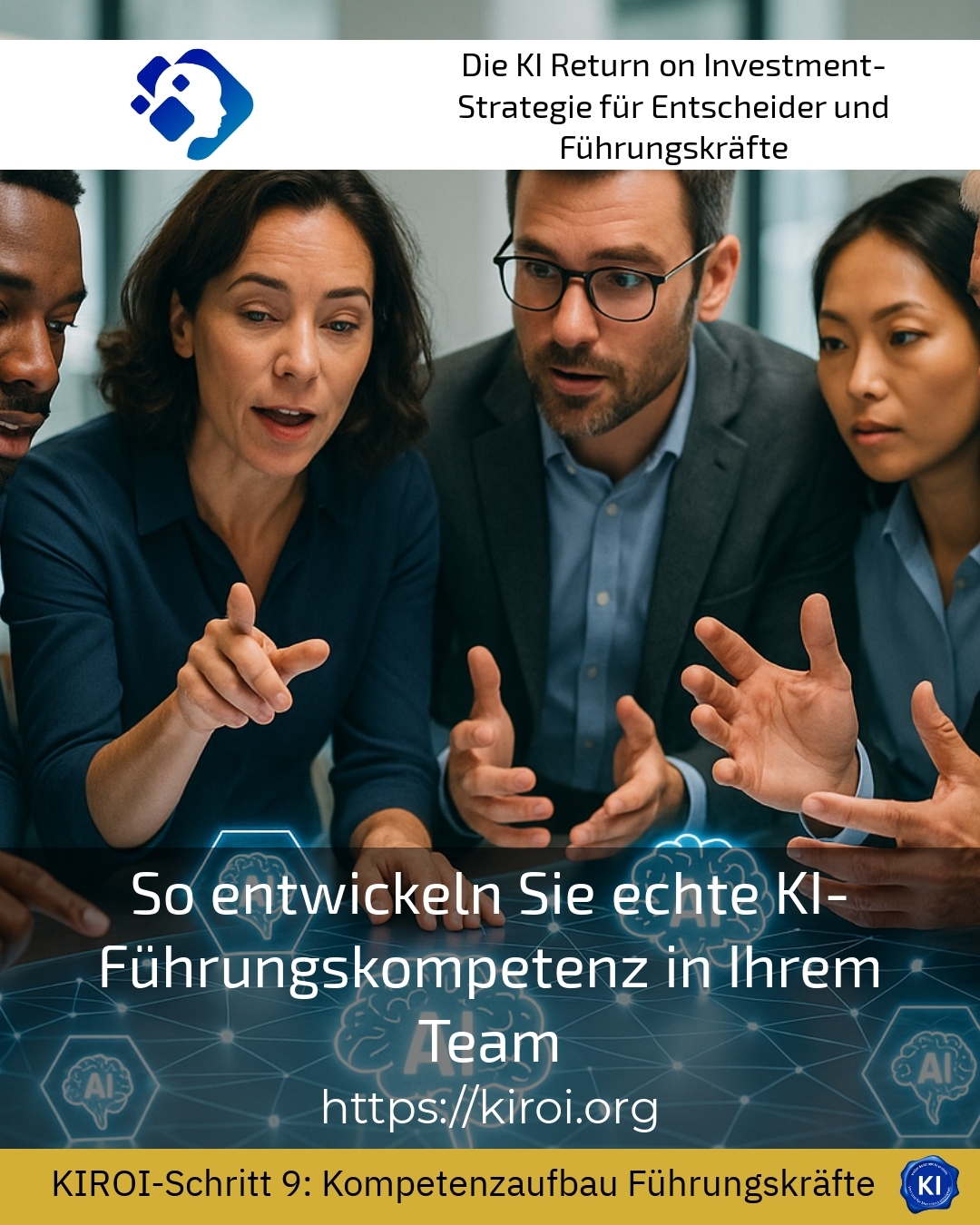
Imagine your team independently mastering complex challenges and confidently utilising cutting-edge technologies. This vision is more tangible than many leaders realise. Because real AI leadership skills does not develop overnight. It arises through targeted support, practical impulses, and a structured development process. Clients often report how transformative the first step in this direction feels. The following sections will provide you with concrete tools and tried-and-tested methods.
Warum KI-Führungskompetenz heute unverzichtbar geworden ist
The world of work is changing rapidly. Companies face the challenge of making their teams fit for new requirements. This isn't just about technical knowledge. Rather, managers need a deep understanding of digital processes. They must be able to recognise opportunities and assess risks. For example, a manufacturing company in the mechanical engineering sector faced the challenge of optimising production processes. Initially, the management team didn't know where to start. It was only through structured support that those responsible recognised the potential of intelligent systems.
Another example comes from the healthcare sector. A clinic group wanted to improve administrative processes. However, the department heads had concerns about implementation. Through transruptive coaching, they received impetus for the gradual introduction of new solutions. This led to a shared understanding of the possibilities offered by modern technologies. Furthermore, the participants developed confidence in their own decision-making abilities.
A similar picture emerges in the financial sector. Banks and insurance companies are under enormous pressure to innovate. Managers must learn to make and communicate data-driven decisions. A medium-sized financial institution supported its management team over several months. The result was impressive: the managers made decisions faster and with greater confidence.
The cornerstones of genuine AI leadership competence in a team
Genuine expertise in this area is based on several pillars. Firstly, a fundamental understanding of technology is required. Leaders need to know what is possible and where the limits lie. Furthermore, communication skills play a central role. This is because the introduction of new systems requires persuasion and transparency. For example, a logistics company realised that resistance within the team often stemmed from uncertainty. Through open discussions and targeted training, these blockages gradually dissolved.
The importance of empathy is particularly evident in retail. Store managers are caught between corporate directives and the concerns of their employees. They must build bridges and foster trust. A major retail company therefore relied on regular workshops. These promoted exchange between different hierarchical levels. The results were noticeable: lower staff turnover and higher satisfaction.
The energy sector also offers insightful findings. A municipal utility company wanted to modernise its grid control. The technical staff were sceptical of the innovations. It was only when the management team itself built up expertise that the mood changed. The managers were then able to answer questions and take concerns seriously.
Best practice with a AIROI customer
A medium-sized manufacturing company in the automotive supply industry faced a unique challenge when its management realised that traditional leadership approaches were no longer sufficient. The management team comprised twelve individuals from various departments, each bringing different prior experiences. Some were tech-savvy, while others were more hesitant towards change. Through six months of support as part of transruptions coaching, the team gradually developed new competencies. The leaders learned to make data-based decisions and communicate them clearly. The exchange among the team members was particularly valuable, as participants learned from each other and offered mutual support. After the process concluded, those involved reported significantly increased confidence in dealing with new technologies. They felt better prepared for upcoming changes and were able to lead their teams with greater assurance. The company also recorded a measurable improvement in project implementation speed. The investment in developing AI leadership competence therefore paid off multiple times over.
Practical steps for development within your own company
The development of expertise begins with an honest assessment. Where does your team currently stand? What are the strengths and what are the gaps? For example, a pharmaceutical company conducted an anonymous survey. The results surprised the management team quite positively. Many employees were more open to change than expected.
In the telecommunications sector, a different approach proved successful. One provider focused on pilot projects with volunteer participants. These pioneers gathered valuable experience and subsequently shared it within the company. This created a positive multiplier effect that encompassed the entire organisation.
The food industry demonstrates the importance of continuous learning. A large manufacturer established a monthly format for knowledge sharing. Executives presented current developments from their areas during these sessions. The format not only promoted learning but also strengthened team cohesion.
How AI leadership skills grow through structured mentoring
External support can significantly accelerate the development process. An experienced coach brings new perspectives and asks the right questions. In the construction industry, a general contractor successfully utilised this opportunity. The management team regularly received input and feedback on their progress. This kept the process dynamic and focused.
A media company decided on a workshop-based approach. Every six weeks, the department heads met for collaborative work. The topics were based on specific challenges from day-to-day business. This created a direct practical relevance that kept motivation high.
A combination of different formats proved successful in the chemical industry. The company relied on individual coaching, group workshops, and digital learning modules. This variety made it possible to address different learning styles and take individual needs into account. The managers particularly valued the flexibility of this approach.
Typical challenges and how to overcome them
Many teams come for support with similar issues. Clients often report uncertainty about the right priorities. They wonder where to start and which steps will yield the most. An insurance company faced exactly this question. Through a structured analysis, the most important action areas were identified.
Another common topic concerns internal resistance. Not all employees welcome changes with open arms. A craft business experienced precisely this situation when introducing new planning systems. Management learned to take concerns seriously and communicate benefits clearly. Thus, sceptics gradually turned into supporters.
Lack of time is another common challenge. Managers juggle many tasks simultaneously and have little room for further training. One tourism company solved this problem with compact learning units. Short, focused sessions fitted better into their daily work routine than full-day seminars.
Best practice with a AIROI customer
A service company in the facility management sector wanted to fundamentally develop its leadership culture because the previous structures had reached their limits. Management recognised that technological changes also required new leadership approaches. The company employed over five hundred staff at various sites, making coordination particularly challenging. As part of transruption coaching, a detailed status assessment was initially carried out, identifying existing strengths and areas for development. Subsequently, the management team jointly developed a vision for the coming years, which served as a guide for all further steps. The involvement of middle management was particularly important because they act as the link between strategy and operational business. Participants learned to explain complex interrelationships comprehensibly and to win over employees for change. After approximately nine months, the first measurable successes became apparent in the form of faster decision-making processes and higher employee satisfaction. The company is now planning to extend the successful approach to other management levels to ensure continuous competency development.
The role of transruption coaching in transformation projects
Transruptions-Coaching clearly positions itself as guidance for projects involving profound change. The aim is not to deliver ready-made solutions, but to empower leaders. A textile company used this guidance when realigning its sales strategy. The leaders developed their own solution approaches and gained self-confidence in the process.
The value of this approach was particularly evident in the renewable energy sector. A project developer guided his team through a period of intense growth. The leaders learned to cope with uncertainty while remaining capable of action. This ability proved crucial to the company's success.
A software company used transruption coaching to modernise its leadership culture. The previous top-down structure was to be replaced by greater self-responsibility. The support helped to recognise old patterns and practice new behaviours. The change occurred step-by-step, but sustainably [1].
My AIROI Analysis
In my assessment, the development of AI leadership skills only at the beginning of a long road. Many companies still underestimate how fundamentally leadership requirements will change. Technical possibilities are growing exponentially, but the human skills for classification and control are often lagging behind. This is precisely where the greatest opportunity lies for organisations that invest early in the development of their leadership teams.
What I find particularly noteworthy is that successful transformations almost always go hand in hand with a cultural shift. Technology alone changes little if people are not willing to embrace new ways of working. The examples from various industries impressively show that support and continuous learning are crucial success factors. Leaders need space for experimentation and reflection [2].
Based on my experience, I recommend a pragmatic approach without unrealistic expectations. Small, consistent steps often get you further than grand announcements lacking substance. The development of AI leadership skills is not a one-off project, but an ongoing process. Companies that understand this and act accordingly will have the better hand in the long run. The key lies in the combination of technical understanding, communication skills, and the willingness to engage in lifelong learning [3].
Further links from the text above:
[1] Transruptions Coaching with RISAwave
[2] The AIROI Masterplan for Businesses
[3] Developing an AI Strategy with RISAwave
For more information and if you have any questions, please contact Contact us or read more blog posts on the topic Artificial intelligence here.









 Deutsch
  English (UK)