
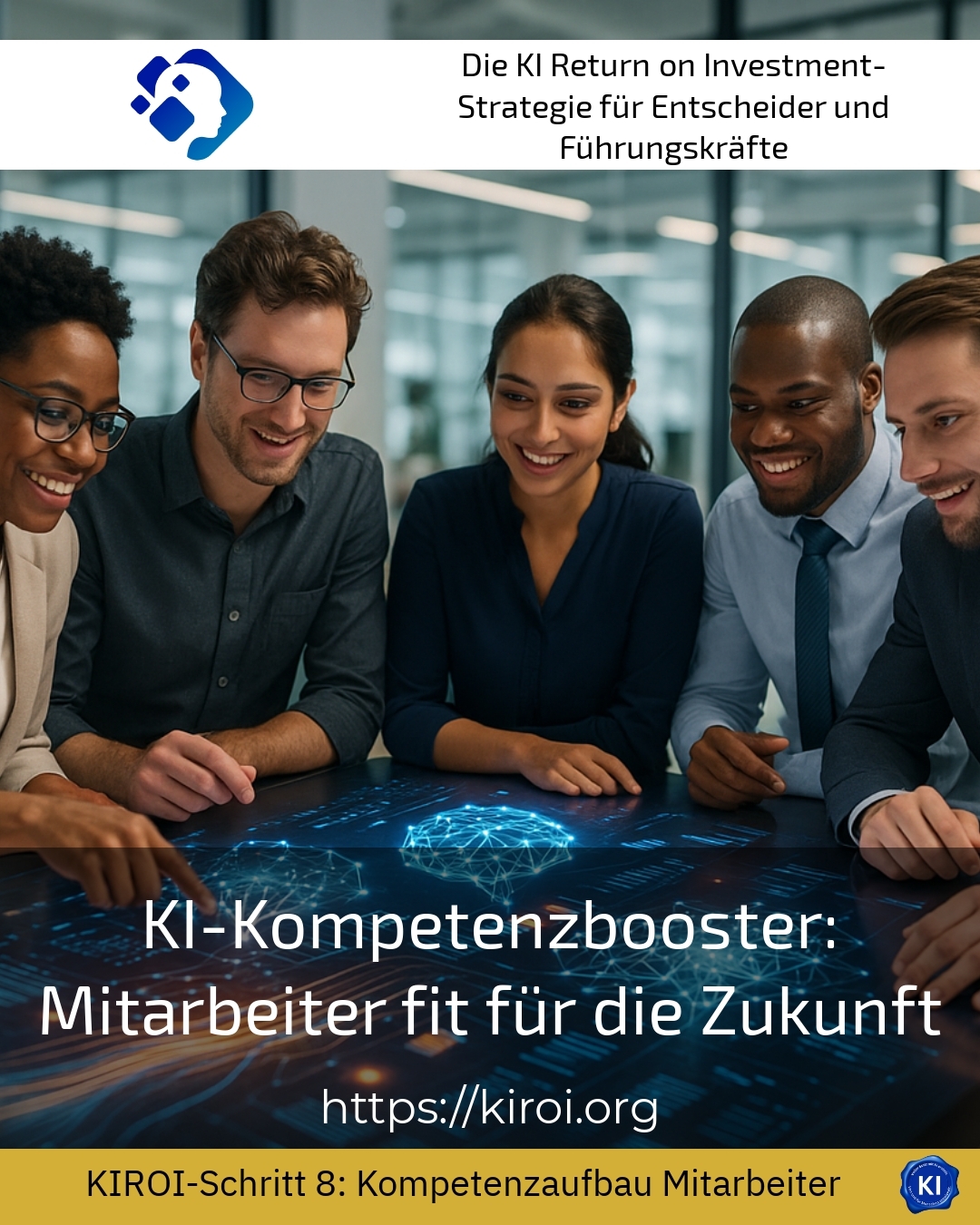
The world of work is changing at a breath-taking pace. Companies are facing the challenge of equipping their workforce for entirely new demands. The AI Skills Booster: Staff Fit for the Future This describes an approach that goes far beyond classic training. But how is this transformation achieved in practice? What strategies lead to success? And why do so many organisations fail at this task? These questions preoccupy leaders and HR managers alike. Immerse yourself in a world where technological know-how and human creativity form a powerful symbiosis.
Why the AI Skills Booster is becoming indispensable
The integration of intelligent systems into business processes is fundamentally changing almost every workplace. Manufacturing employees are experiencing how automated quality controls influence their daily work. Administrative staff in insurance are suddenly using algorithmic decision-support tools for claims settlement. Marketing teams are relying on data-driven campaign optimisation. These developments require a completely new skills profile. Transruption coaching supports companies in addressing this transformation in a structured way.
A medium-sized mechanical engineering company faced the challenge of further training its service technicians. The skilled workers were to be able to operate predictive maintenance systems, while at the same time traditional craft knowledge had to be preserved. A logistics service provider recognised that its dispatchers required new skills. They would from now on be working with intelligent route planning systems. A retail company also invested in the qualification of its buyers. They would now be using forecasting models for optimal order quantities.
The necessity of such investments is underpinned by studies [1]. According to these studies, many employees lack fundamental skills in using intelligent applications. The situation in small and medium-sized enterprises (SMEs) appears particularly critical. Here, there is often a lack of time and resources for comprehensive training measures. The AIROI Masterclass programme offers a structured framework for systematic competence development.
The psychological dimension of change
Every technological transformation triggers emotional responses in those affected. Some employees feel enthusiastic about the new possibilities. Others react with scepticism or even fear. These differing reactions require sensitive support. A pharmaceutical company experienced how experienced laboratory technicians initially reacted negatively to automated analysis systems. Only through intensive dialogue did these employees open up to the change. An energy supplier observed similar dynamics among its network technicians. Here too, an empathetic communication strategy helped.
Research shows that resistance to change is often based on fears of loss [2]. People worry that their acquired skills could be devalued. These concerns deserve serious consideration. At the same time, new technologies offer opportunities for personal development. An automotive supplier successfully communicated this perspective. Employees recognised that their experience would remain indispensable in the future.
Best practice with a AIROI customer
An internationally active plant construction company approached the transruptions coaching team with a complex challenge. The company had invested significant sums in intelligent maintenance systems. However, adoption among service staff fell far short of expectations. Many experienced technicians viewed the new tools as a threat to their expertise. In intensive workshops, we collaboratively developed a new perspective. Employees recognised that their experience was indispensable for interpreting system recommendations. We developed a buddy system, where tech-savvy younger colleagues worked with experienced veterans. These pairs benefited mutually. The younger ones learned from practical experience, and the older ones gained confidence in using digital tools. After six months, the usage rate of the new systems had tripled. Customer satisfaction increased measurably. Particularly noteworthy was the shift in company culture. Initial scepticism transformed into genuine enthusiasm for continuous learning.
Strategic approaches for the AI skills booster: getting employees ready for the future
A successful qualification strategy takes into account different learning types and initial levels. Not every employee needs the same content. An electronics manufacturer differentiated its programme by functional areas. Production received different training from sales. An insurance group developed role-specific learning paths. Clerks, managers and IT specialists were addressed differently. A retail company also relied on tailor-made qualification. Branch managers learned different aspects than buyers or logistics planners.
The AIROI Masterclass programme offers a structured framework for this differentiation. It combines theoretical foundations with practical application cases. Participants work on real projects from their work environment. This linking of theory and practice significantly accelerates learning transfer. Scientific studies confirm the effectiveness of such approaches [3].
Leaders as key figures of transformation
The attitude of senior management significantly influences the success of any upskilling initiative. Leaders must not just support the change; they should actively embody it. One chemical company experienced the importance of this role-modelling. The production manager regularly used the new analytical tools himself. His employees willingly followed his example. A financial services provider reported similar experiences. There, the executive board specifically focused on visible use of intelligent assistance systems.
Transruption coaching places particular emphasis on supporting leaders. They face the challenge of managing their own uncertainty whilst simultaneously needing to exude confidence. A construction company benefited from targeted coaching for its project managers, who learned to deal productively with ambivalent feelings. A telecommunications provider invested in leadership programmes, enabling their leaders to develop competencies for guiding change processes.
Studies show that transformational leadership significantly influences the success of qualification initiatives [4]. Leaders who inspire and support achieve better results. Authoritarian approaches, on the other hand, frequently generate resistance. These findings are incorporated into the AIROI consulting concept.
Practical implementation across different functional areas
The specific requirements vary significantly depending on the field of activity. In human resources, algorithmic pre-selection systems are gaining importance. Recruiters need competencies to critically assess these recommendations. A personnel service provider trained its employees accordingly. They learned to understand machine suggestions as support rather than a replacement. A consumer goods corporation invested in the qualification of its HR business partners. These individuals were to be able to effectively use data-based HR planning tools.
Intelligent analysis systems are opening up new opportunities in controlling. Controllers are evolving from data providers to strategic consultants. A medical technology company supported its controlling department through this transformation. The employees learned to interpret and question predictive models. A media company experienced similar changes. There, controllers used intelligent systems for scenario analyses.
Sales teams benefit from personalised customer recommendations. Sales representatives must integrate this information meaningfully into conversations. A software company trained its field sales team in this competency. The employees learned to combine algorithmic recommendations with human intuition. A building materials wholesaler also invested in sales training. The field sales representatives subsequently utilised intelligent visit planning systems.
Best practice with a AIROI customer
A large tax advisory firm recognised the shift in its business model early on. Routine tasks such as bookkeeping and simple tax returns were increasingly becoming automated. The partners feared that their employees might fall behind. Together, we developed a comprehensive qualification programme lasting several months. The tax advisors and specialist employees learned to position themselves as strategic consultants. They were to handle complex structuring issues that intelligent systems cannot solve independently. The programme included both technical and communication components. Participants practised conveying the added value of human expertise to clients. We integrated practical case studies from everyday client work into the curriculum. The employees worked on real client situations. After the programme concluded, the firm's culture changed noticeably. Employees viewed intelligent tools as a welcome relief, using the time gained for more demanding advisory services. Client satisfaction increased measurably. The firm was able to successfully expand its service offering.
The AI Competence Booster as a Catalyst for Corporate Culture
Successful qualification programmes change more than just individual skills. They transform the entire company culture. A learning culture emerges that makes continuous development a given. A textile company experienced this cultural shift impressively. Initially, further training was seen as a tiresome chore. After the transformation, it was recognised as an opportunity. A manufacturer of industrial valves reported similar experiences. The employees developed a genuine curiosity for new technologies.
Transruption coaching considers cultural aspects as central to sustainable change. Technical training alone is not enough. A fundamental shift in the organisation's self-understanding is required. A facility management company successfully underwent this transformation, with employees redefining their roles. A specialist in packaging solutions also invested in cultural development, fostering an atmosphere of open exchange about learning progress.
Measurability and continuous improvement
Every investment in training should deliver measurable results. The AIROI Masterclass programme defines clear success metrics. These range from skills diagnostics to business key performance indicators. A machine manufacturer systematically tracked the development of its employees. Regular assessments documented learning progress. A building services provider linked training successes with productivity metrics. The correlation was clearly positive.
Scientific methods for evaluating training programmes offer guidance in this regard [5]. They allow for a nuanced examination of various levels of impact. A food manufacturer used these approaches for its qualification programme. The evaluation showed impressive results at all levels. An office furniture supplier developed its own key performance indicator system. This captured both hard and soft factors.
The knowledge gained is incorporated into the further development of the programmes. This creates an iterative improvement process. A tool manufacturer adapted its curriculum several times. Feedback from participants was systematically taken into account. A specialist in safety technology established regular review cycles. This ensured that the programmes always remained up-to-date and relevant.
My AIROI Analysis
The systematic development of competencies in dealing with intelligent systems is no longer an option. Instead, it is a strategic necessity for every company. The examples presented impressively show how different the initial situations can be. At the same time, common success factors become visible. A differentiated approach that considers different target groups considerably increases effectiveness. The active involvement of managers as role models accelerates cultural change. Linking learning content with real work situations improves transfer into everyday practice.
Transruption coaching has established itself as an effective partner for these transformation processes. The combination of strategic consulting, practical implementation support, and individual guidance is proving successful across a wide range of industries and company sizes. I consider the inclusion of emotional aspects to be particularly important. Technical qualifications alone are not enough. People must also be psychologically prepared for change. This readiness can be fostered through empathetic support. Experience shows that initial resistance can indeed turn into enthusiasm.
For companies wishing to embark on this journey, the AIROI Masterclass programme offers a structured framework. It combines proven adult learning methods with current insights into technological transformation. Investing in the development of employees' skills pays off in the long term. It secures competitiveness while strengthening the loyalty of engaged specialists to the company.
Further links from the text above:
[1] McKinsey Global Survey: The State of AI
[2] Harvard Business Review: Change Management
[3] Association for Talent Development: Research Insights
[4] Gallup Workplace Insights: Leadership and Engagement
[5] Kirkpatrick Partners: The Kirkpatrick Model
For more information and if you have any questions, please contact Contact us or read more blog posts on the topic Artificial intelligence here.








 Deutsch
  English (UK)