
Have you ever wondered why some teams seemingly effortlessly develop brilliant solutions, while others, despite enormous resources, fall flat?
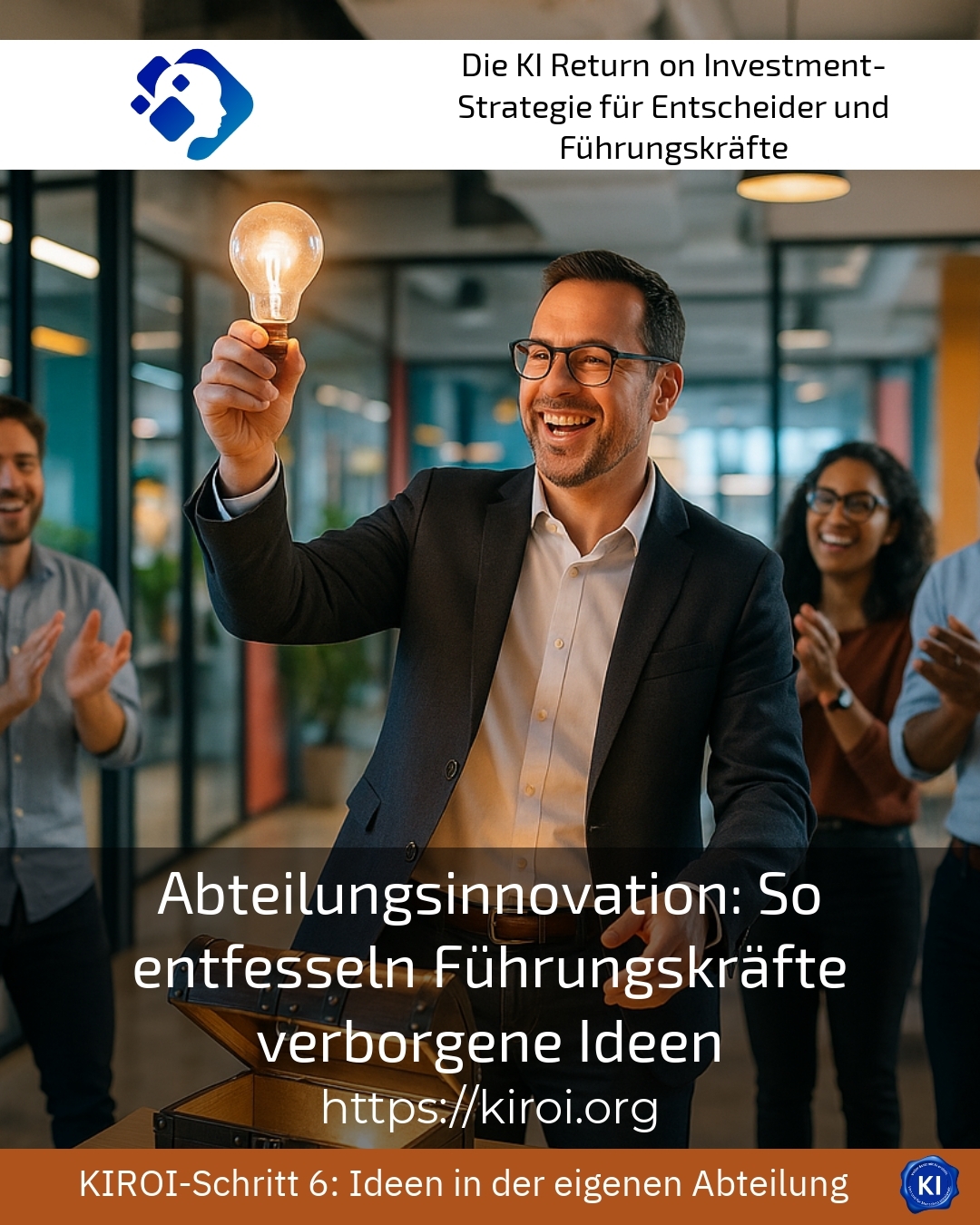
The answer often lies not in a lack of talent or lack of budgets. Rather, unused potential lurks in almost every organization. These potential are just waiting to be unleashed. Departmental Innovation It begins where leaders summon the courage to leave familiar paths behind. They must open up real space for creative thinking among their employees. In today’s working world, many clients report similar challenges. Valuable ideas are drowning in hierarchical structures. Or they are not even voiced because the corporate culture does not encourage this. Transruptive coaching can help you uncover these hidden treasures. It supports you in initiating sustainable change processes.
The invisible treasure chamber of ideas in your organization
Every department has a wealth of unused ideas. These exist in the minds of employees. Studies show that on average, only about twenty percent of all improvement suggestions are actually communicated [1]. The rest remains hidden. Some employees remain silent out of fear of rejection. Others simply do not have the appropriate platform for their thoughts. Still others do not believe that their ideas will be heard. This situation is particularly regrettable because it is often the people on the ground who know best where processes are stuck.
In the manufacturing industry, for example, machine operators know their systems down to the smallest detail. They notice inefficiencies long before they become visible in metrics. In healthcare, nurses know exactly which administrative hurdles complicate their work. And in software development, programmers often have already come up with more elegant solutions in their minds. However, these remain unspoken unless the communication culture supports them.
Best practice with a AIROI customer
A medium-sized company in the logistics industry faced a particular challenge that many organizations will be familiar with, because despite the latest technology, process improvements had stagnated for several years and the management was clueless about the causes of this stagnation. As part of our transruptive support, we first conducted structured discussions with employees at all levels of the organization, revealing a surprising picture: there was a veritable flood of ideas hidden beneath the surface that had not previously found a channel for expression. For example, a warehouse worker had had an idea for optimizing picking for years, but he never dared to express it because he feared being seen as a know-it-all or upsetting his superiors. After implementing an anonymous idea portal and establishing regular innovation workshops, over two hundred concrete improvement suggestions were submitted within just three months; forty-five of them were directly implemented and led to an efficiency increase of approximately seventeen percent.
Fostering departmental innovation through psychological safety
The term psychological safety has gained enormous importance in recent years [2]. It describes a team climate in which people can take risks. They do not have to fear negative consequences. Leaders play a central role in this. They set the tone for the entire department. When supervisors frame mistakes as learning opportunities, the dynamics change fundamentally.
In technology companies, the practice of so-called Blameless Post-Mortems Established. After errors or failures, the team analyzes the causes together. Blame is kept out of the equation. This method not only promotes learning from mistakes; it also encourages the expression of experimental ideas. In the financial sector, progressive institutions, in turn, rely on regular idea labs. There, employees can also submit unconventional proposals. The banking sector is traditionally considered conservative. Yet it is precisely here that surprisingly innovative approaches emerge when the right framework is created.
Retail also shows interesting examples of a lived-in innovation culture. Sales staff are in direct contact with customers every day. They experience first-hand which products are in demand and where there are service gaps. Smart leaders use this knowledge systematically. They establish short feedback loops between the sales floor and the purchasing department.
Concrete methods for developing ideas
Practice shows that certain methods are particularly effective. Reverse mentoring, for example, turns traditional hierarchies on their head. Younger employees mentor experienced executives. In the automotive industry, companies are successfully using this technique. Young talent brings fresh perspectives on digital transformation. At the same time, they feel valued and included. Design Thinking workshops have proven themselves across industries [3]. They force teams to view problems from a user perspective.
The method of brainstorming in silence is also gaining popularity. In this process, all participants first individually record their ideas. Only then does an exchange take place. This procedure prevents dominant personalities from monopolizing the conversation. Introverted employees thus have a better opportunity to speak up. In pharmaceutical research, for example, hypotheses are often developed first in silence. Subsequently, a structured discussion takes place in the team.
Create structural framework conditions for department innovation
In addition to the cultural dimension, structural factors play a significant role. Time-based freedom of action is of central importance. Employees need space to think and experiment. The well-known twenty percent rule from the technology industry illustrates this idea. Developers are allowed to use part of their working time for their own projects. Numerous successful products have thus emerged.
In the media industry, newsrooms are experimenting with similar approaches. Journalists are given time for investigative research that goes beyond the day-to-day business. In the consulting industry, some companies promote internal research projects. Consultants can develop and test new methods. The results then feed into client projects. The public sector is also increasingly exploring such models. Administrations are setting up innovation labs. There, civil servants can work on digital solutions for citizen services.
Best practice with a AIROI customer
A service company with several hundred employees approached us with a question that we often encounter: how to better channel the creative energy of the workforce and use it for strategic goals without falling into bureaucratic structures. Together, we developed a low-key system for ideation gathering that was based on a simple digital platform and could be used by all employees without complicated registration processes. The special feature of this approach was the introduction of so-called innovation sponsorships, where each submitted idea automatically received a sponsor from the middle management who followed up on the further development and provided feedback to the ideator. This personal support led to a drastic reduction in the threshold for submitting ideas and at the same time increased the quality of the proposals, because employees knew that their ideas would be taken seriously and developed constructively, which ultimately led to a measurable improvement in employee satisfaction and a significant increase in the rate of innovation.
The role of leaders as facilitators
Leaders must see themselves as facilitators, not controllers. This paradigm shift is difficult for many. Traditional management training emphasizes other aspects. Yet the modern work environment requires new competencies. Leaders should ask questions rather than provide answers. They should encourage experimentation rather than demand perfection. They should actively incorporate diverse perspectives.
In the construction industry, for example, a change of mindset has taken place. Project managers involve tradespeople early in the planning process. They bring practical knowledge that architects often lack. In the restaurant industry, successful restaurant owners invite their service staff to discuss menus. After all, the waiters know which dishes guests order. In the insurance industry, companies are experimenting with interdisciplinary product development teams. Account managers work side by side with actuaries and IT specialists.
Identifying and overcoming obstacles
The path to innovative departmental culture is rarely straightforward. Resistance is to be expected and should not be underestimated. Some employees have had bad experiences. Their previous suggestions were ignored or even mocked. Others are simply exhausted from the day-to-day work. They have no capacity for additional creative efforts. Others fear that innovative ideas will make them redundant themselves. These fears must be taken seriously.
In the energy sector, this phenomenon is particularly evident. Employees of traditional power plant operators often view the renewable future with mixed feelings. Management must communicate sensitively here. They must demonstrate the opportunities that change offers. In the printing industry, many companies face similar challenges. Digitalization is fundamentally changing the business model. Employees need perspectives for their professional future.
Transruptions coaching helps leaders navigate these complex dynamics. It provides insights into how to deal with resistance. It supports the development of an authentic communication strategy. And it helps balance the various needs within the team.
Consistently embed departmental innovation
Unique innovation workshops quickly fade away. Sustainable change requires continuous attention. Rituals can help here. Weekly short meetings to collect ideas, for example. Or monthly innovation prizes for the best proposals. In the tourism industry, hotels have had positive experiences with such approaches. Staff at the reception desk collect guest feedback daily. This is fed into weekly improvement rounds.
The food industry uses similar mechanisms. Quality management and innovation are often intertwined there. Production workers not only report defects. They also suggest improvements. In the telecommunications industry, companies have established digital idea platforms. These also enable asynchronous collaboration. Teams in different time zones can thus innovate together.
My AIROI Analysis
Coaching numerous organizations has shown me that innovation is not a random product. It can be systematically promoted when the right conditions are created. Leaders often underestimate the amount of creative potential that lurks in their teams. The people at the grassroots level possess valuable knowledge. However, this knowledge often remains untapped because structures and cultures do not encourage the exchange of ideas.
From the perspective of the AIROI-perspective, several success factors crystallize. First, there must be genuine commitment from the leadership level. Lip service is not enough. Second, low-threshold channels for ideas must be established. The simpler the submission process, the more proposals will come. Third, quick feedback is crucial. Employees must experience that their ideas are heard. Fourth, small improvements should also be appreciated. Not every idea has to be revolutionary.
The biggest challenge often lies in patience. Cultural change takes time. Rapid successes are possible, but profound change requires perseverance. Transruptive coaching can accompany and accelerate this process. It offers an external perspective on established patterns. It helps to try new paths. And it helps to constructively process setbacks. The investment in an innovation-promoting culture pays off in the long term. It not only increases competitiveness. It also significantly increases employee satisfaction and commitment.
Further links from the text above:
[1] Harvard Business Review: Research and Insights into Innovation
[2] Google re:Work: Guide to Understanding Team Effectiveness
[3] IDEO Design Thinking Methodology
For more information and if you have any questions, please contact Contact us or read more blog posts on the topic Artificial intelligence here.








 Deutsch
 English (UK)