
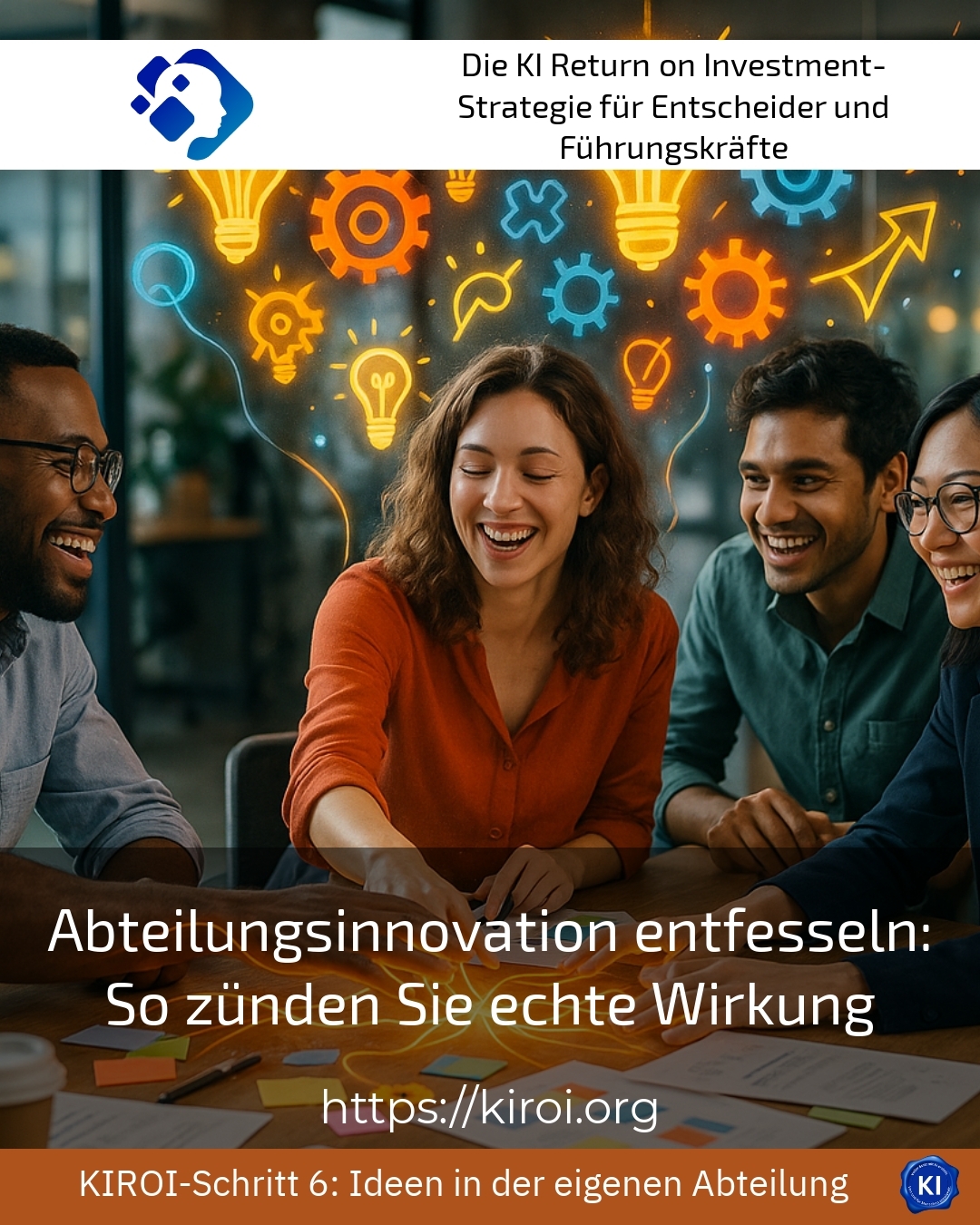
Imagine your department transforming from a sluggish administrative unit into a vibrant engine of innovation within a few months. Sounds utopian? Not at all. The ability to, Unleashing departmental innovation The ability to do so today determines the long-term success of entire companies. While some teams remain stuck in familiar patterns and wonder why progress is passing them by, others succeed in achieving genuine breakthroughs and sustainably transforming their organisation. The decisive difference lies not in higher budgets or more modern technologies, but rather in the way people work together, think and act. In this post, you will learn which concrete levers you can pull to establish a culture of continuous renewal in your department.
Why classic structures stifle creative sparks
Many organisations suffer from entrenched hierarchies and rigid processes that stifle any form of creativity at birth. Employees often come up with brilliant ideas but find their managers won't listen. Valuable impulses then wither in overcrowded email inboxes or are talked to death in endless committees. This phenomenon is particularly evident in traditional industries like mechanical engineering, where procedures established over decades are often considered untouchable. A medium-sized automotive supplier recently reported that innovative suggestions took an average of eight months before they were even evaluated. Insurance companies have similar experiences, where new product ideas often founder on complex approval procedures. Even in the healthcare sector, dedicated professionals battle bureaucratic hurdles that turn even the smallest improvements into a marathon [1].
The consequences of this innovation blockade are serious and ultimately affect overall competitiveness. Talented employees lose their motivation and seek out employers who value their creativity. Customers turn to competitors who can react more quickly to changing needs. And the company itself gradually loses touch with market developments, without initially being consciously aware of it.
Unleashing departmental innovation through psychological safety
The cornerstone of any sustainable change lies in creating an environment where people are allowed to experiment without fear of negative consequences. Psychological safety describes precisely this state, where team members can speak openly, admit mistakes, and bring forward unconventional suggestions. A leading pharmaceutical company has taken this insight to heart and introduced so-called "failure days," where teams present their failed experiments and learn from them together. The results were impressive because the willingness to undertake bold projects increased significantly. In retail, progressive companies rely on anonymous idea platforms that give even reserved employees a voice. Banks are experimenting with rotation programmes, where employees temporarily work in other departments and bring fresh perspectives [2].
Best practice with a AIROI customer
A medium-sized logistics company faced the challenge of its departments operating like isolated silos with very little knowledge exchange. Management recognised that they needed to initiate fundamental changes to remain competitive in an increasingly digitised market. As part of a transruption coaching process, we supported the company over several months in transforming its communication structures. Initially, we conducted workshops where employees from all hierarchical levels could articulate their frustration about existing processes. It became clear that many valuable suggestions for improvement had gone unheard for years. We then established weekly innovation circles where two departments at a time worked together on specific problems. Participants were explicitly permitted to question existing rules and propose alternative solutions. After six months, management reported significantly improved collaboration between teams. The turnaround time for internal suggestions for improvement decreased from several weeks to a few days. Particularly pleasing was the observation that even introverted employees increasingly actively contributed ideas and felt valued.
Concrete measures to strengthen trust
Leaders can significantly contribute to fostering an atmosphere of trust through their own behaviour. If a department head openly admits in a meeting that their own assessment was incorrect, this sends a powerful signal to the entire team. In the technology sector, some companies practice so-called Blameless Post-Mortems, where mistakes are analysed without singling out individuals. Energy providers have had good experiences with mentoring programmes that provide junior staff with experienced points of contact. And in the media industry, progressive organisations encourage open dialogue through regular town hall meetings, where even uncomfortable questions are welcomed.
Harnessing the power of interdisciplinary collaboration
Real breakthroughs often emerge at the intersection of different disciplines and perspectives. When an engineer works together with a designer and a business economist on a problem, solutions are created that none of them could have developed alone. Forward-thinking companies leverage this insight by deliberately assembling heterogeneous teams and giving them space for creative collaboration. One telecommunications provider has completely restructured its product development and now relies on mixed project groups that unite all relevant competencies. Chemical corporations are experimenting with open innovation platforms where external partners can also contribute ideas. And in the tourism industry, innovative offerings often arise when technology experts collaborate with experienced travel consultants [3].
The challenge lies in bridging the different specialist languages and working cultures. Professional support through transruption coaching can provide valuable impetus here, as external perspectives often uncover blind spots. Moderated workshops help to develop a common understanding and break down communication barriers.
Unleashing departmental innovation with agile methods
Agility is far more than a buzzword from software development; it describes a fundamentally different approach to complex challenges. Instead of labouring over perfect plans for months, agile teams focus on rapid experimentation and continuous adaptation. This mindset can be applied to virtually any industry, enabling a quicker response to change. Construction companies use Scrum elements for their project planning, thereby reducing delays and cost overruns. In the education sector, schools and universities are developing new teaching formats in iterative loops rather than implementing finished concepts. And even in public administration, there are pioneers who are streamlining bureaucratic processes with agile approaches [4].
Best practice with a AIROI customer
A family-run business with a long tradition in the manufacturing sector wanted to fundamentally modernise its development department without compromising established quality standards. The previous working methods were characterised by lengthy planning phases and rigid project management, which led to significant delays in the market launch of new products. Working with the transruptions coaching team, we developed a hybrid model that combined agile elements with industry-specific requirements. We began with a pilot project where a small team worked according to Kanban principles and conducted two-week sprints. Team members received training in agile methods and learned to break down their work into smaller, manageable units. The introduction of daily short meetings, which allowed obstacles to be identified and addressed early, was particularly important. Managers had to learn to grant the team more autonomy and focus on their role as supporters. Following the successful pilot phase, the model was gradually extended to other projects, with each team having the freedom to adapt the methods to its specific needs. The lead times for development projects decreased noticeably, and employee satisfaction increased significantly.
Tools and techniques for everyday work
The introduction of agile practices doesn't require expensive software solutions or elaborate training programmes. Simple tools such as physical Kanban boards can often be sufficient, on which tasks can be visualised and prioritised. Retail companies successfully use this technique in their branches to organise inventory more efficiently. Craft businesses rely on digital task management tools that can also be operated remotely. And in hospitals, visual management systems support coordination between different wards and specialist departments.
Overcoming resistance constructively
Every change initially meets with resistance, because humans by nature tend to favour the familiar and avoid the uncertain. This reaction is completely normal and should not be misunderstood as sabotage, but rather as an expression of legitimate concerns. Successful change processes are characterised by taking these resistances seriously and dealing with them constructively. In the financial industry, some institutions have had good experiences with deliberately involving sceptical employees in transformation projects. Industrial companies rely on transparent communication and explain in detail why certain changes are necessary. And in the non-profit sector, it is often more successful to turn those affected into stakeholders by involving them in decision-making processes from the outset [5].
The art lies in distinguishing between legitimate criticism and fundamental rejection. Sometimes sceptics point out genuine weaknesses in planned measures that would have been overlooked without their objection. In other cases, it is important to stick persistently to the chosen direction and convince through initial successes.
Unleashing departmental innovation through continuous learning
The ability for continuous development distinguishes sustainable organisations from those that will eventually fall behind. Learning teams regularly reflect on their working methods, identify potential for improvement, and consistently implement new insights. This practice cannot be imposed, but must be established as a natural part of collaboration. Consulting firms conduct systematic project reviews, analysing both successes and failures. Catering businesses continuously gather feedback from guests and adapt their offerings accordingly. And in agriculture, innovative farms experiment with new cultivation methods and document their experiences for future decisions.
Structures for sustainable knowledge transfer
Knowledge is only valuable when it is shared and applied, rather than remaining in the minds of individual experts. This is why forward-thinking companies invest in structures that systematically promote and document knowledge transfer. Engineering firms maintain knowledge databases where project experience is made accessible for future undertakings. Law firms use case study libraries that assist case handlers with similar queries. And trading companies regularly train their employees on new products and sales techniques.
My AIROI Analysis
After intensive engagement with the topic and numerous accompanying projects, a clear pattern emerges that distinguishes successful transformations from failed attempts. Organisations that manage to initiate real change do not treat the process as a one-off project, but as an ongoing journey without a definitive end goal. They create spaces for experimentation and accept that not every attempt will be crowned with success. At the same time, they foster a culture of appreciation where employees dare to speak up and suggest new approaches. The leadership level sees itself as an enabler rather than a controller, which requires a fundamental shift in self-understanding.
What particularly impressed me in previous projects was how quickly positive changes can occur when the right framework is created. Teams that had previously languished in resignation for years suddenly developed astonishing dynamics and creativity. The key was always the combination of structural adjustments and cultural change, as both dimensions are inextricably linked. Companies that only tackle one aspect usually achieve only short-term effects, whereas holistic approaches enable sustainable transformation. Support from external transruption coaching can provide valuable impetus and help to avoid typical pitfalls. Ultimately, however, the key to success lies in the willingness of all those involved to question accustomed patterns of thought and to embrace new experiences.
Further links from the text above:
[1] Harvard Business Review – Insights on Change Management
[2] McKinsey – Insights into Organisational Performance
[3] Forbes – Innovation and Enterprise Technology
[4] Agile Alliance – Resources and Best Practices
[5] MIT Sloan – Research into Organisational Change
For more information and if you have any questions, please contact Contact us or read more blog posts on the topic Artificial intelligence here.








 Deutsch
  English (UK)