
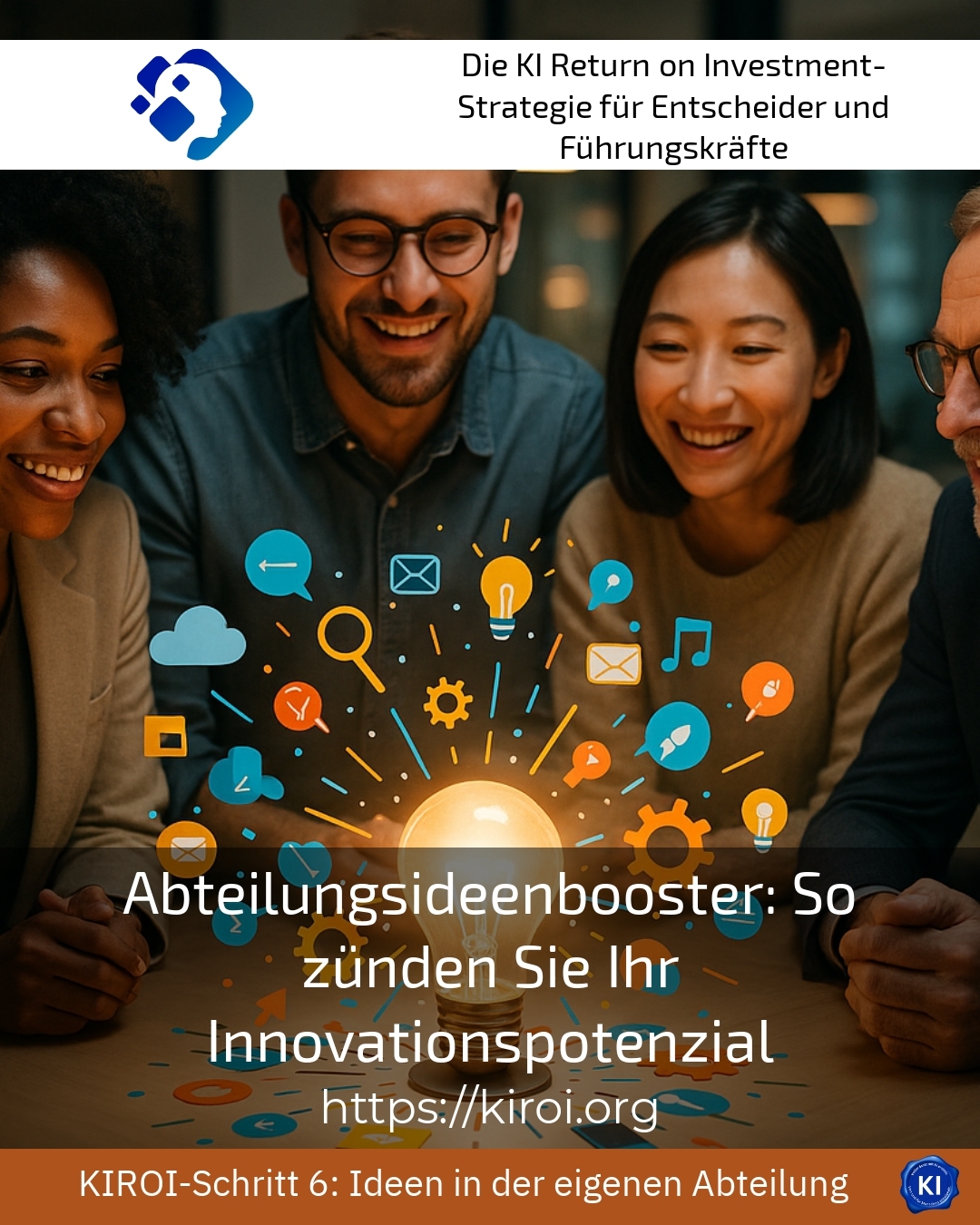
Imagine your department suddenly develops groundbreaking solutions. Ideas are just gushing from your employees' minds. The Departmental idea booster can bring about exactly this change. Many leaders report stagnant creativity in their teams. They are looking for ways to unleash hidden potential. Yet, the solution is often closer than one thinks. In this post, you will learn how to systematically build innovative strength. We will show you proven methods and concrete approaches from various fields.
Understanding the basics of the department idea booster concept
Innovation rarely arises by chance or spontaneous flashes of insight. Instead, it requires a structured framework and the right environment. Leaders must first understand what promotes creativity and what inhibits it. Teams often report time pressure and a lack of freedom. These factors stifle new ideas at the outset. A well-thought-out approach, on the other hand, creates fertile ground for innovation. Psychological safety and appreciation play a central role in this [1].
In the manufacturing industry, many companies are experimenting with so-called innovation labs. These separate rooms offer protection from day-to-day business. Employees can experiment there without performance pressure and develop new concepts. Another example can be found in the retail sector. Progressive companies there use regular idea competitions with attractive incentives. The healthcare sector also shows interesting approaches. Hospitals are establishing interdisciplinary teams for process optimisation.
Transruption coaching supports organisations with precisely these kinds of transformation projects. It helps to break down rigid structures and establish new ways of thinking. The support provided is always individual and tailored to the specific situation.
Best practice with a AIROI customer
A medium-sized logistics company faced a particular challenge, as employees had little initiative left for improving work processes. For years, management had maintained a strongly hierarchical leadership style. New suggestions were rarely implemented, and the workforce had grown accustomed to this. As part of the AIROI project, we first carried out a comprehensive analysis of the existing communication structures. This revealed that a lack of a feedback system was the biggest obstacle. Together, we developed a digital idea management tool that made all suggestions transparent. In addition, we established monthly innovation meetings at department level. Within six months, the number of submitted improvement suggestions more than tripled. The quality of the ideas was particularly noteworthy, as many led to measurable efficiency increases. Employees felt heard and valued again. This cultural change also had a positive impact on employee satisfaction.
Implementing the departmental idea booster in practice
Successful implementation requires a systematic approach in several phases. First, managers should honestly assess the current state of their department. Where are the greatest potentials and where are the most persistent blockages? This stocktake forms the basis for all further steps. Then, it is important to define clear goals and allocate resources. Without free time, even motivated employees cannot develop ideas [2].
In the banking sector, some institutions have set up special innovation budgets. Each department receives a fixed amount for experimental projects. The insurance industry is following similar paths with so-called sandbox environments, where new products and processes can be tested risk-free. Inspiring examples can also be found in the manufacturing industry. Automotive suppliers use shop floor meetings to collect suggestions for improvement directly at the production line.
The implementation of a Departmental idea booster-Systems benefits from external support. Neutral experts identify blind spots and bring fresh perspectives. They can mediate as facilitators in difficult situations. Transruption coaching offers precisely this form of support. It guides companies through the entire transformation process.
Methodological Tools for the Department Idea Booster
Various creativity techniques can systematically stimulate idea generation. Design Thinking, for example, consistently focuses on the user. This method is particularly suitable for complex issues. Brainstorming sessions work best with clear rules and experienced moderation. Edward de Bono's Six Thinking Hats method promotes diverse perspectives. Each technique has its specific strengths and application areas [3].
In the technology sector, many companies rely on hackathons as innovation drivers. These intensive events pool energy and quickly generate initial prototypes. The retail sector is experimenting with customer workshops for product development, directly involving end consumers in the creative process. In the service sector, service safaris have proven effective, allowing employees to experience their own offerings from a customer's perspective.
Best practice with a AIROI customer
An internationally active pharmaceutical company wanted to strengthen the innovation culture within its research department, as the number of new patent applications had stagnated despite highly qualified employees. The scientists worked in isolated teams on their respective projects. There was hardly any exchange between the groups, even though many synergies would have been possible. In the AIROI project, we developed a multi-stage concept to promote interdisciplinary collaboration. We introduced monthly cross-team meetings where different departments presented their current challenges. In addition, we established a digital matching system for informal knowledge-sharing meetings. The spatial design was also adapted by creating new encounter zones. Within a year, documented collaborations between different research groups doubled. Several of these collaborations led to promising new approaches. Employees reported increased job satisfaction and more inspiration. Management was particularly impressed by the improved communication culture.
Overcoming obstacles and having a lasting impact
Every change initiative encounters resistance and sceptics. These reactions are natural and should not be underestimated. Often, they hide valid concerns and negative past experiences. Employees may have experienced previous initiatives that came to nothing. This makes it all the more important to achieve quickly visible successes. These so-called quick wins build trust and momentum.
Many authorities in the public sector struggle with bureaucratic hurdles. Nevertheless, there are successful examples of innovative administrative units. They use agile methods despite strict regulatory requirements. The education sector shows similar challenges and approaches. Schools and universities are experimenting with new teaching formats. In healthcare, pilot projects allow new working methods to be tested.
Transruption coaching is particularly helpful for dealing with resistance. It helps to turn critics into allies and engage sceptics. The guidance provides impetus for constructively dealing with obstacles. Clients often report surprising breakthroughs after seemingly deadlocked situations.
Digital tools to support the departmental idea booster
Modern technologies can significantly accelerate and simplify innovation processes. Collaboration platforms enable cross-location cooperation on new ideas. Artificial intelligence can recognise patterns in large datasets. These findings often provide starting points for improvements. Visualisation tools help to present complex relationships in an understandable way [4].
The media industry uses AI-powered trend analyses for content development. Algorithms identify emerging topics before they become mainstream. In e-commerce, data analyses enable personalised product suggestions. The finance sector relies on predictive analytics for risk assessment. Digital innovation tools are also making inroads into agriculture.
However, caution is advised when selecting digital tools. Not every new technology is suitable for every company. A careful analysis of actual needs should precede any investment. The AIROI framework offers a structured approach to this.
Best practice with a AIROI customer
A long-established mechanical engineering company faced the challenge of enthusing its experienced skilled workers about digital innovation processes. Many employees had been with the company for decades and were skeptical of change. At the same time, they possessed invaluable practical knowledge that should be leveraged for improvements. In the AIROI project, we developed a multi-stage approach that combined traditional and digital elements. We initially introduced simple analogue idea cards that could be attached to machines. These cards were then digitised and transferred to a clear dashboard. This allowed employees to submit their suggestions in a familiar way, while management gained a digital overview. Step-by-step, we then introduced digital input options, starting with a very simple app. The experienced employees became mentors for younger colleagues on process-related issues. This appreciation of their knowledge significantly increased acceptance of the new systems. After one year, over eighty percent of the workforce actively used the digital tools.
My AIROI Analysis
The systematic promotion of innovation potential in departments is not a one-off measure. Instead, it requires a continuous process and genuine commitment from management. The Departmental idea booster unfolds its full effect only with consistent implementation over longer periods. It repeatedly becomes apparent that technical solutions alone are not sufficient. The human factor remains crucial for the success of any innovation initiative. Organisations must create a culture in which mistakes are seen as learning opportunities. Only then will employees dare to express unconventional ideas.
The AIROI methodology has proven to be an effective framework in numerous projects. It combines strategic planning with practical implementation support at all levels. The combination of analytical depth and agile flexibility is particularly valuable. Companies benefit from the structured approach without being constrained by rigid processes. The individual circumstances of each organisation are always taken into account and respected. Transruption coaching offers precisely this tailored support for a wide variety of industries and company sizes. It guides leaders and teams through the inevitable ups and downs of the change process.
In summary, every department has untapped innovative potential. The art lies in recognising this potential and systematically unlocking it. With the right methods, a supportive culture and continuous guidance, remarkable results can be achieved. Clients often report a real sense of renewed enthusiasm after successful implementation.
Further links from the text above:
[1] Harvard Business Review – Innovation Management
[2] McKinsey – Innovation Essentials
[3] IDEO U – Design Thinking Resources
[4] Gartner – Digital Innovation Insights
For more information and if you have any questions, please contact Contact us or read more blog posts on the topic Artificial intelligence here.








 Deutsch
  English (UK)